
.png)

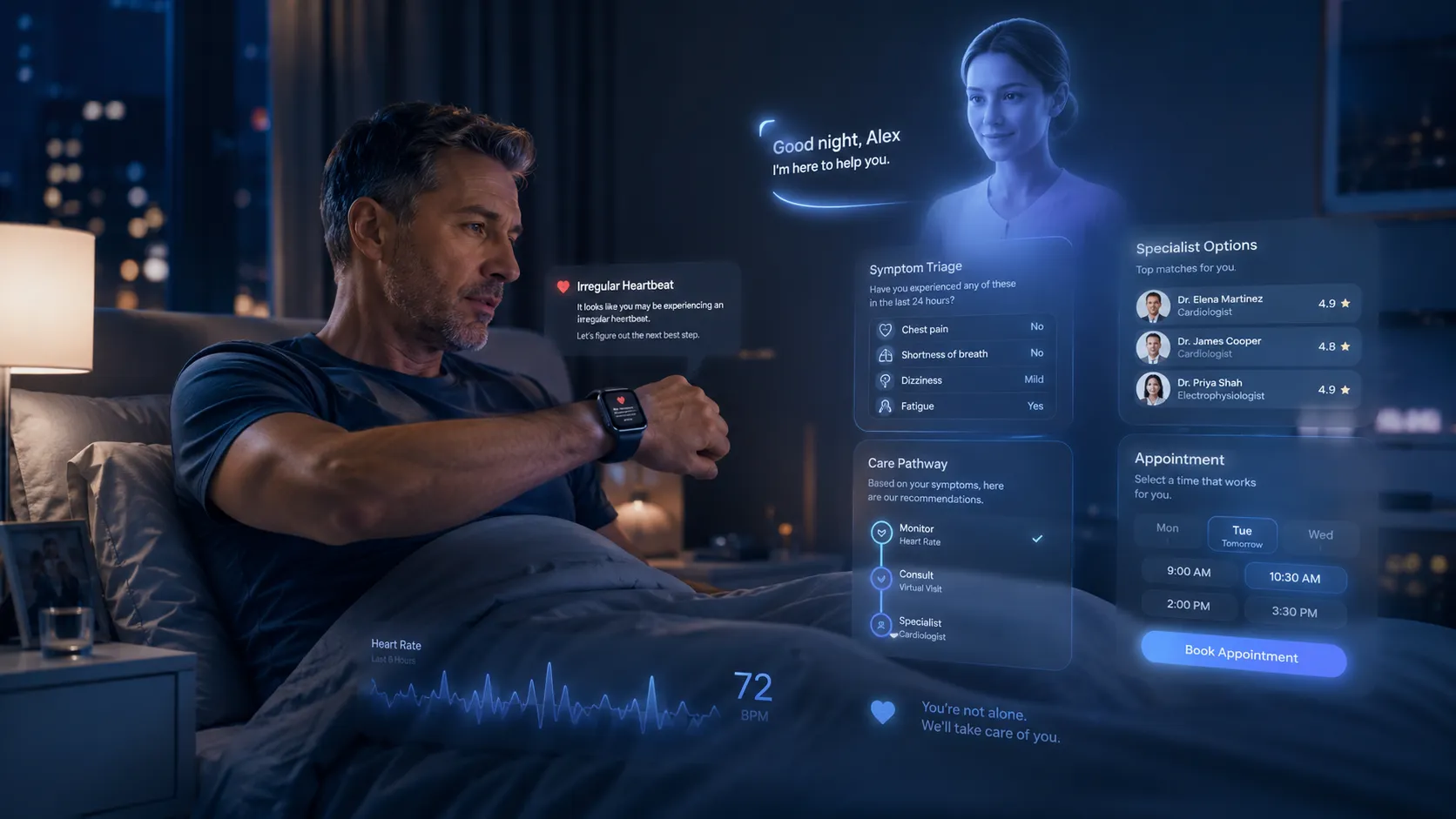

A patient wakes up at 2 AM after their smartwatch detects an irregular heartbeat. Instead of Googling symptoms, they ask an AI assistant what to do next., shifting it from linear search to conversational triage. Patients increasingly use advanced prompts, guided by AI for discovery and referrals; they demand highly personalized, empathetic interactions to secure appointments. Health systems must optimize these AI-mediated pathways, transforming their digital front door to capture evolving patient intent effectively.
The traditional patient discovery model has become obsolete. An alarming 63% of patients switch providers due to poor digital communication during their initial discovery phase; experts call this phenomenon "silent churn." This critical friction point, exacerbated by the rapid evolution of artificial intelligence, demands a complete re-evaluation of how health systems engage prospective patients. The shift from keyword-based search to sophisticated AI dialogue fundamentally alters 2026 patient journey mapping, compelling strategists to design a new Healthcare digital front door 2026 that meets patients within the conversational AI space.
Redefining Patient Intent Mapping in a Post-AI Search Behavior Landscape
The era of short, two-word keyword searches has ended. Patients now employ eight-plus word conversational prompts when seeking medical information or care, indicating a profound shift in Post-AI search behavior, according to Expert Insights. This evolution necessitates a sophisticated approach to Patient intent mapping, moving beyond mere keyword volume. Organizations must understand the nuanced context, emotional state, and immediate needs embedded within these longer, more complex queries. For health system strategists and practice owners, this means recognizing a fundamental change. Patients are no longer just searching for a "cardiologist near me," but rather, "My Apple Watch detected an irregular heartbeat, and I'm looking for a highly-rated heart specialist who accepts my insurance and can see me this week for a preventative check-up." This rich intent, often expressed through voice search or text-based conversational AI, compels medical practices and healthcare digital marketing agencies to rethink their entire digital strategy.
Capturing this evolving patient intent effectively requires organizations to deploy advanced analytics. They must parse natural language, identifying underlying conditions, urgency, preferred communication channels, and even psychological states. A focus on AI patient discovery becomes paramount, utilizing machine learning algorithms to predict patient needs before explicit statements. For instance, an AI might analyze a user's health history, recent activity data from wearables, and conversational patterns to infer a potential need for a specialist. This occurs even if the patient hasn't explicitly searched for one. This proactive approach allows health systems to present highly relevant information and services, interrupting the AI cycle with expert medical guidance. Without this deeper understanding, organizations risk becoming invisible to patients whose initial journey begins with an AI rather than a search engine, leaving significant opportunities for "silent churn."
Pro-Tip: Embrace Holistic Intent Signals
- Move beyond traditional keyword research to analyze full conversational prompts, identifying subtle cues about urgency, emotional state, and specific needs.
- Integrate data from wearables, patient portals, and CRM systems to build comprehensive patient profiles that inform patient intent mapping.
- Train AI models on diverse datasets of patient inquiries to improve natural language understanding and predictive capabilities for AI patient discovery.
Building a Conversational Triage for Healthcare's Digital Front Door 2026
The Healthcare digital front door 2026 has evolved beyond a static website, becoming an interactive, empathetic Conversational triage for healthcare. Recent 2026 studies, according to Expert Insights, reveal patients rated AI-generated triage as more empathetic than traditional web-form results, highlighting a critical shift in patient expectations. This implies patients value immediate, personalized, and understanding digital interactions over generic information or delayed human responses. For Patient Experience (PX) Officers, this presents both a significant challenge and an immense opportunity to reduce friction and eliminate "silent churn" during the discovery phase.
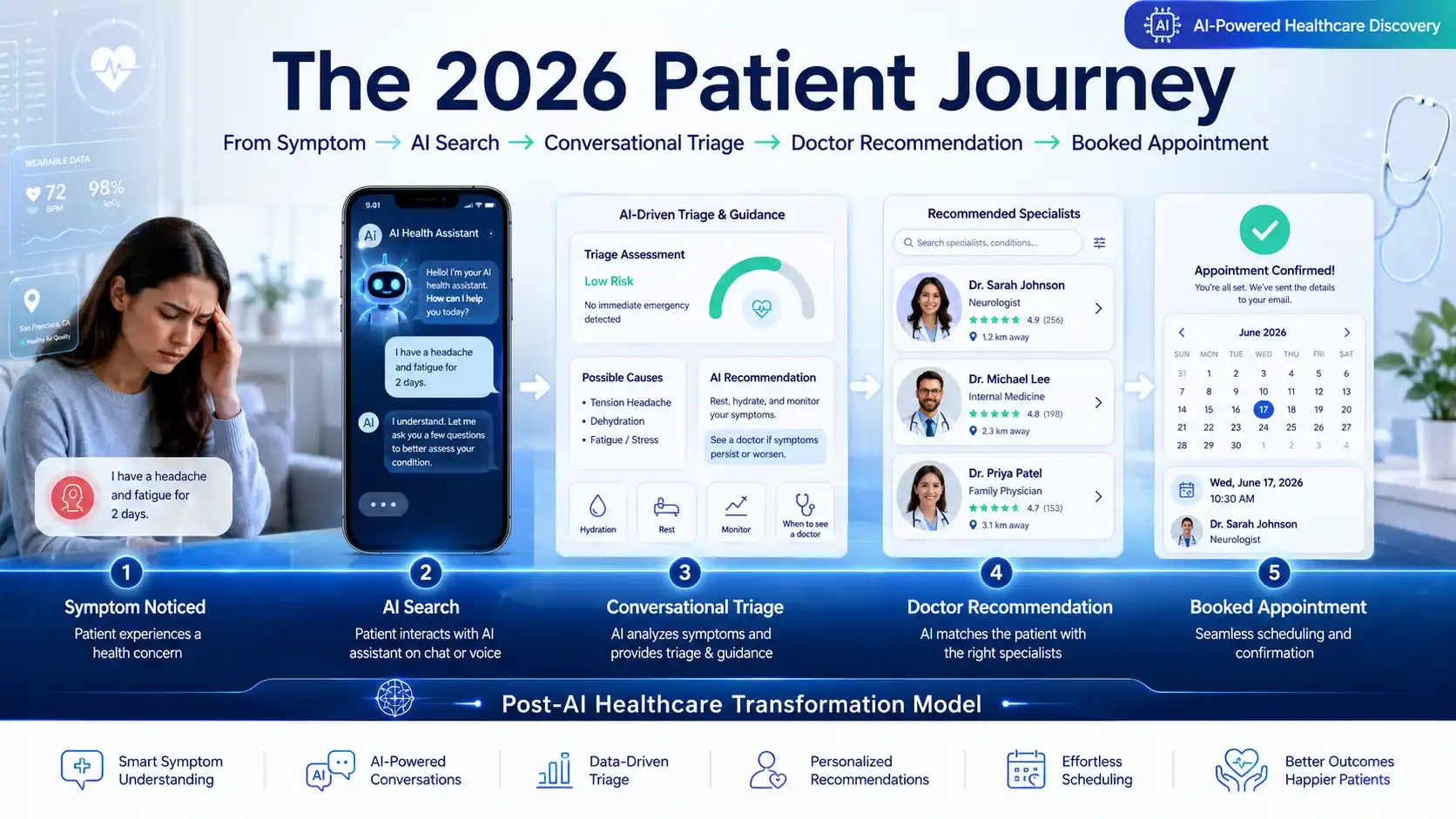
Implementing effective Healthcare conversational AI involves deploying advanced chatbots and virtual assistants, powered by large language models (LLMs). These tools accurately assess symptoms, provide preliminary guidance, and route patients to the most appropriate care setting. This intelligent triage acts as the initial point of contact, capable of handling a broad spectrum of inquiries. Examples range from booking routine appointments to urgent symptom evaluation. For instance, a patient experiencing persistent headaches might interact with an AI chatbot. It would ask a series of diagnostic questions, cross-reference symptoms with potential conditions, then, based on severity and patient history, recommend either an immediate telehealth visit with a neurologist or self-care advice with a prompt to monitor symptoms. This kind of AI-driven medical recommendation enhances patient satisfaction and optimizes clinical workflows by ensuring patients arrive at the right provider at the right time. These AI interactions must be seamless, secure, and integrated with existing Electronic Health Records (EHR) systems to provide a truly personalized experience.
Driving Generative Engine Optimization (GEO) and AI-Mediated Patient Acquisition
The rise of generative AI introduces a new paradigm: Generative Engine Optimization (GEO). This replaces traditional SEO as the primary strategy for AI-mediated patient acquisition. With AI models directly synthesizing information and providing answers, the goal shifts. It is no longer just ranking on a search results page but influencing the AI's "summary" answer. This demands that healthcare providers and healthcare digital marketing agency partners focus on creating authoritative, contextually rich, and verifiable content. AI models must readily consume, understand, and use this content to generate responses. Organizations must consider how their information will be presented, not just to a human eye, but to an LLM's analytical processing.
Excelling in GEO requires content to be structured, factual, and to deeply address specific patient needs and common questions, often anticipating follow-up inquiries. This includes optimizing for "explainability," ensuring content clearly states its sources and expertise, which makes it trustworthy for an AI to cite. For instance, rather than simply listing services, a medical website should publish detailed, evidence-based articles on common conditions, treatment options, and patient outcomes. It must clearly attribute this information to medical professionals within the practice. This content enhances the AI's ability to provide accurate and helpful responses when patients ask questions such as, "What are the latest treatments for chronic back pain?" or "How do I choose the best orthopedic surgeon?" Furthermore, practices must monitor how their services and providers appear in AI-generated summaries. They must actively work to correct inaccuracies or enhance positive portrayals. This continuous feedback loop is vital for ensuring AI-mediated patient acquisition pathways lead directly to their services.
Driving LLM-Driven Medical Referrals and Proactive Prevention
Healthcare discovery's future extends beyond reactive search, embracing proactive AI monitoring and LLM-driven medical referrals. The shift from "reactive" search, where a patient seeks care after experiencing a symptom, to "proactive" AI monitoring, where wearables detect an anomaly and prompt a patient to act, fundamentally alters the referral pathway, according to Expert Insights. This predictive capability, powered by Predictive analytics in patient care, allows health systems to engage patients before a condition becomes severe, fostering a model of preventative care. Digital patient engagement platforms become central to this process. They integrate data from various sources, including wearables, patient-reported outcomes, and EHRs, to identify at-risk individuals.
For instance, an LLM might analyze a patient's wearable data, detecting a consistent elevation in resting heart rate combined with self-reported fatigue in a patient portal message. The LLM could then proactively suggest a consultation with a primary care physician or even a cardiologist, along with providing context-specific educational materials. It might even facilitate direct scheduling. This improves patient outcomes and positions the health system as a proactive partner in health management. For LLM-driven medical referrals, these models analyze a vast database of specialist expertise, patient demographics, insurance coverage, and even appointment availability. They recommend the ideal provider within the system. This approach transcends simple network matching; it considers patient preferences, communication styles, and the specific nuances of their condition, ensuring a more appropriate and satisfying referral experience. Such AI-driven medical recommendations reduce the burden on patients to navigate complex care pathways, leading to higher conversion rates from intent to booked appointment.
Optimizing Local SEO for Healthcare in a Post-Keyword World
Even with AI's rise, local presence remains critical. Local SEO for healthcare transforms from keyword-centric optimization to "entity-first" strategies. These strategies ensure practice information remains consistently accurate and discoverable across all AI interfaces and traditional platforms. While Post-AI search behavior leans into conversational queries, these often include explicit or implicit local intent. For instance, "I need a pediatric dentist for my child with special needs near downtown Denver who takes Medicaid" represents a highly specific, locally-driven prompt an AI will process. Optimizing Google Business Profile, Apple Maps listing, Yelp, and other authoritative directories thus becomes more important than ever for local SEO for medical professionals and local SEO for medical website visibility.
Practices must provide comprehensive, consistent, and verified data about their operations. This includes specialties, accepted insurance, operating hours, accessibility features, and physician bios. For a healthcare digital marketing agency, this means implementing a robust strategy for citation building and reputation management. The strategy ensures positive patient reviews appear prominently and accurately reflect the patient experience. AI models rely heavily on these consistent data points and user reviews to generate recommendations. A practice with fragmented or outdated information across various directories will struggle. An AI cannot accurately represent or recommend it, regardless of its excellent care. Therefore, investing in tools and processes to maintain data integrity across the digital ecosystem proves crucial for 2026 patient journey mapping. This ensures local discoverability translates into booked appointments.
Healthcare organizations that fail to optimize for AI-mediated discovery risk losing patients before human interaction even begins. The time to redesign the digital front door is now.
Comparison: Traditional vs. AI-Mediated Patient Discovery (2026)
Key Takeaways
The 2026 patient journey demands a shift from reactive search to proactive, AI-mediated engagement. Health systems must optimize their digital front door for conversational triage and Generative Engine Optimization (GEO). This approach effectively captures patient intent, reduces silent churn, and facilitates AI-driven medical referrals, ultimately leading to more booked appointments.
Pro-Tips for Navigating the 2026 Patient Journey
- Audit Your Digital Footprint for AI Readiness: Ensure all online information about your practice—including specialty, services, hours, and physician bios—remains consistent, structured, and easily digestible by AI across all platforms, not just your website.
- Invest in Conversational AI Solutions: Prioritize integrating empathetic, intelligent chatbots and virtual assistants into your Healthcare digital front door 2026 to manage initial patient inquiries and provide instant, personalized triage.
- Develop Contextually Rich Content for GEO: Create detailed, evidence-based content that answers complex patient questions thoroughly and cites internal medical expertise, optimizing it for AI to synthesize and present as authoritative answers.
- Prioritize Patient Intent Mapping: Move beyond superficial keyword analysis to understand the deeper, conversational intent of patients, utilizing advanced analytics to predict needs and personalize digital interactions.
- Integrate Wearable Data for Proactive Care: Explore secure, patient-consented ways to integrate data from wearables into Digital patient engagement platforms to enable Predictive analytics in patient care and proactive outreach.
- Strengthen Local SEO Fundamentals: Maintain impeccable Google Business Profile listings, encourage and respond to reviews, and ensure consistent practice information across all local directories for effective local SEO for healthcare in an AI-driven world.
FAQ
Q. What is the primary change in patient search behavior by 2026?
A. By 2026, patients primarily use 8+ word conversational prompts instead of short keywords when seeking healthcare information or providers. AI drives this shift, demanding a focus on understanding nuanced intent and context rather than simple keyword matching. Health systems must adapt their content strategy to address these complex queries.
Q. How does "silent churn" relate to the new digital front door?
A. "Silent churn" refers to the 63% of patients who switch providers due to poor digital communication during their initial discovery phase (Expert Insights). The new Healthcare digital front door 2026 must combat this by offering empathetic, AI-driven conversational triage, ensuring seamless and satisfying digital interactions from the very first touchpoint to reduce patient friction.
Q. What is Generative Engine Optimization (GEO) and why is it important?
A. Generative Engine Optimization (GEO) describes the process of optimizing content for consumption and synthesis by generative AI models, not just for search engine rankings. It's crucial because AI now directly answers patient queries. This means providers must create authoritative, factual, and structured content that AI can trust and cite in its responses.
Q. How will AI impact medical referrals by 2026?
A. By 2026, LLM-driven medical referrals will leverage AI to analyze comprehensive patient data. This includes health history, preferences, and even wearable data, recommending the ideal provider. This shifts from reactive referrals to proactive, personalized AI-driven medical recommendations, improving patient satisfaction and care coordination within health systems.
Q. What should healthcare practices do to improve their local presence in a post-AI world?
A. Healthcare practices must focus on "entity-first" local SEO for healthcare. This means ensuring meticulous accuracy and consistency of practice information across all online directories, including Google Business Profile. AI relies heavily on this consistent data and strong patient reviews to provide local recommendations, making data integrity paramount for local SEO for medical professionals.