
.png)

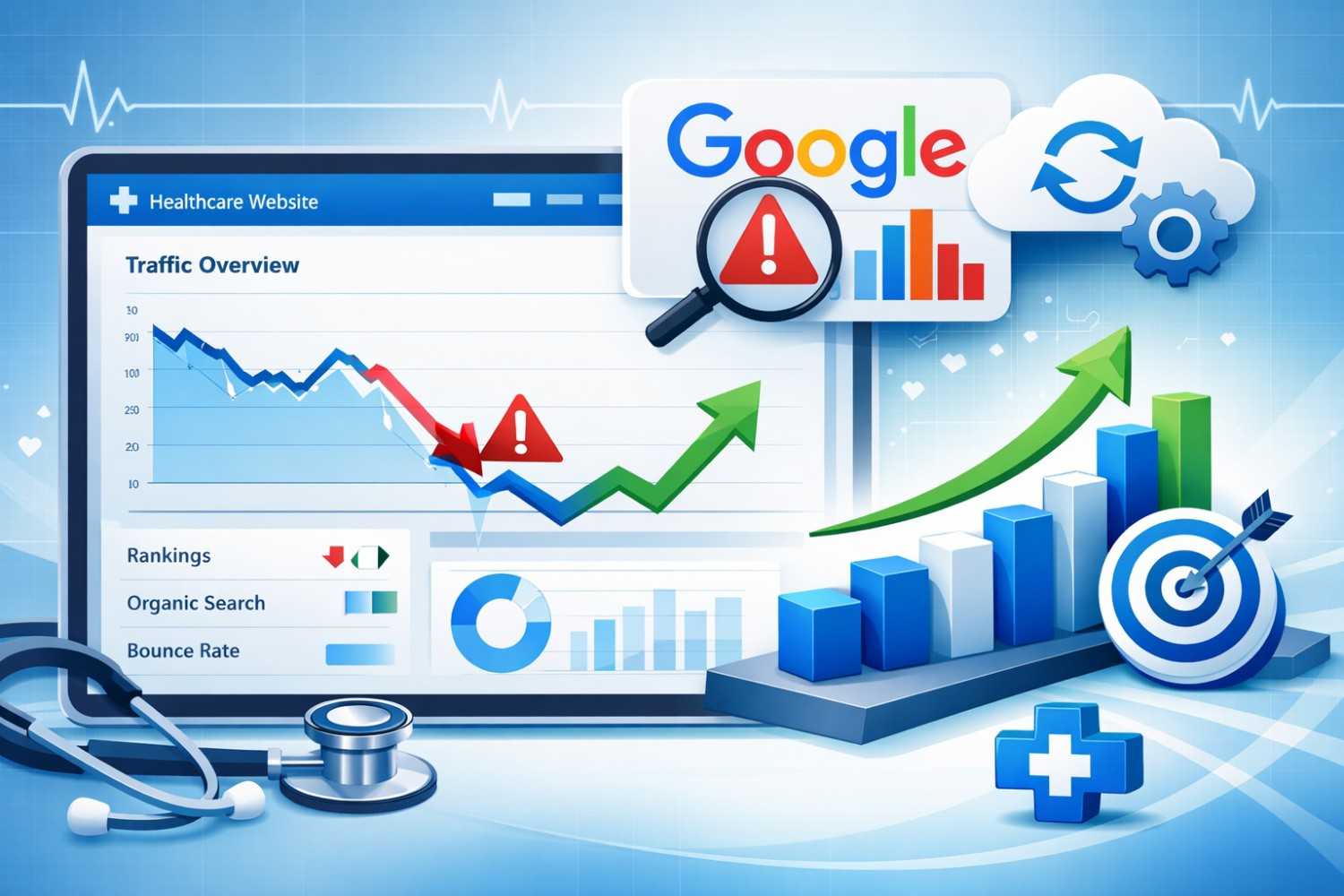

Seeing your traffic numbers plummet overnight is every practice manager's nightmare. If you’ve noticed a healthcare website ranking drop after a Google update, you aren't alone. Healthcare is categorized by Google as YMYL (Your Money or Your Life), meaning the algorithm applies the world’s strictest quality standards to your content.
A drop in search rankings after a Google core update can be especially disruptive for healthcare websites. Because medical topics fall under YMYL, ranking systems apply stricter standards for accuracy, trust, and usefulness.
When rankings fall, it’s usually not a penalty. It’s a re-evaluation of how well your content meets updated quality expectations—especially around E-E-A-T (Experience, Expertise, Authoritativeness, and Trustworthiness), technical performance, and user intent.
The good news? These drops aren’t permanent. By diagnosing the specific cause—whether it’s thin content, technical Core Web Vitals issues, or weak backlink profiles—you can recover lost rankings and often come back stronger.
Quick Answer: Healthcare sites usually lose rankings after a Google update because of thin content, weak E-E-A-T signals, or Core Web Vitals issues — not a manual penalty. Fixing these typically restores rankings in 3-6 months.
Jump to:
- Why healthcare sites lose rankings
- Algorithm update vs. manual penalty
- Diagnosing your ranking loss
- Step-by-step recovery guide
- FAQ
Is Your Practice Visible Where Patients Are Actually Looking?
Get a free audit of your Google Business Profile, website, and AI search visibility — see exactly what’s costing you patients.
1. Why Healthcare Websites Lose Rankings After Core Updates
Google core updates adjust how the algorithm evaluates content quality across the web. Healthcare sites are impacted more strongly because incorrect or low-quality medical information can directly affect human health decisions.
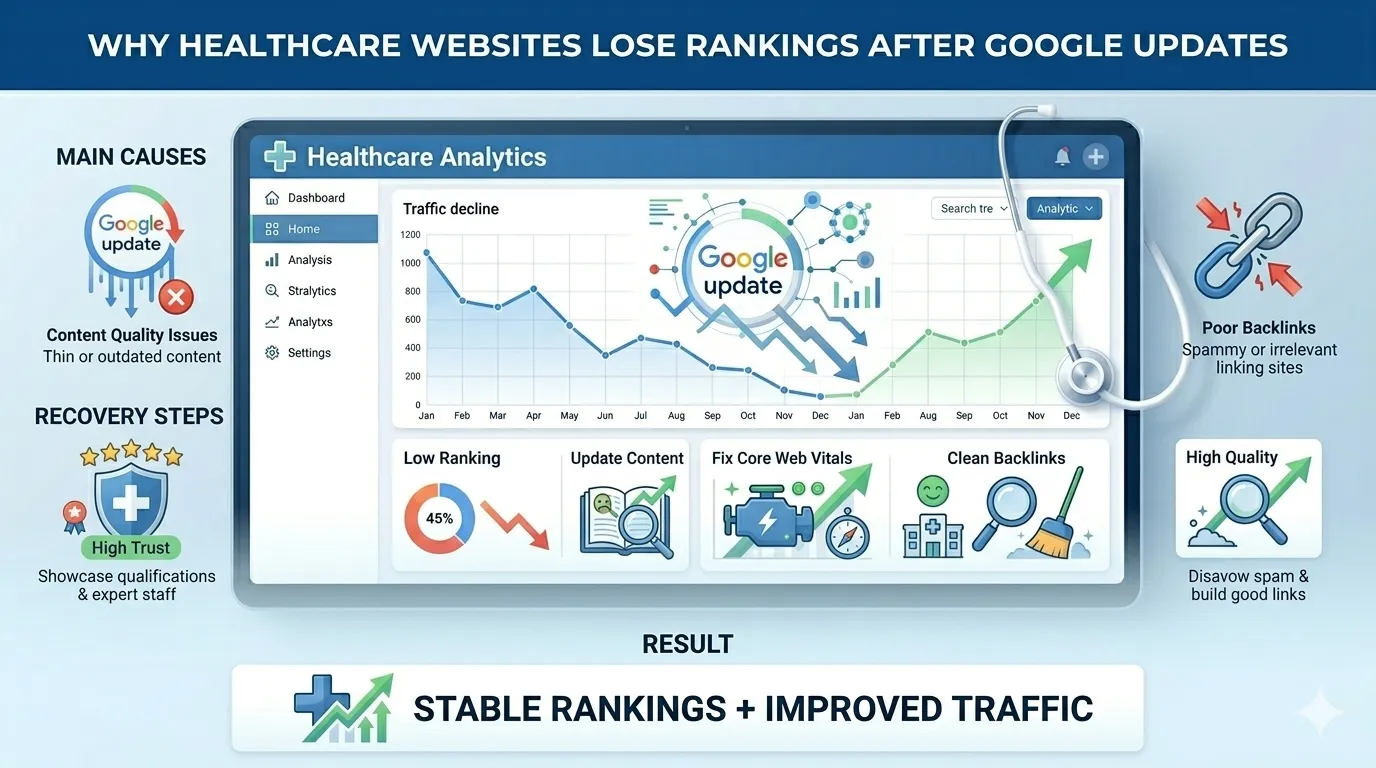
A medical website traffic drop after a Google update usually happens due to three main areas: content quality, technical health, and trust signals.
1.1 Content Quality and Helpful Information
Google prioritizes content that clearly answers user intent with depth and accuracy. Pages that are:
- Thin or overly general
- Written mainly for keywords instead of users
- Lacking medical clarity, structure, or depth
tend to lose visibility after updates.
The Helpful Content system ensures that pages written only for SEO (keyword stuffing or low-value content) get demoted.
Healthcare content is expected to be clear, accurate, and evidence-based, not just optimized for search terms.
1.2 E-E-A-T (Experience, Expertise, Authoritativeness, Trust)
E-E-A-T is not a direct ranking factor, but it strongly influences how Google evaluates quality—especially for YMYL topics.
Sites often lose rankings when they lack:
- Clear author identity or medical credentials
- Medical review process or update dates
- Transparent editorial policies
- Trust signals like citations and organization details
If users and Google cannot verify who created the medical content, trust decreases significantly.
1.3 Technical Performance and User Experience
Technical SEO issues also impact rankings:
- Slow loading pages
- Poor mobile usability
- Layout shifts during loading (Core Web Vitals issues)
- Intrusive pop-ups or ads
If your site fails Core Web Vitals, it signals poor user experience and lowers trust in your website.
2. Algorithm Change vs Manual Penalty
It’s important to distinguish between:
Algorithm Update Impact (Most Common)
- No penalty notification in Google Search Console
- Rankings shift across many pages
- Competitors rise even if your content is unchanged
This means Google has re-evaluated your content against new quality standards.
Manual Action (Rare)
- Clear notification in Google Search Console
- Usually caused by policy violations like spam links or deceptive content
Most healthcare SEO drops are algorithmic, not penalties.
3. Diagnosing Ranking Loss
To understand your drop:
- Check if traffic loss matches a known Google Core Update date
- If yes → likely E-E-A-T or content quality issue
- If gradual → likely technical SEO or competition increase
Comparison Table: Before vs. After SEO Recovery
4. Step-by-Step Recovery Guide
Recovering from a healthcare website SEO ranking loss requires structured improvements.
4.1 Audit Your E-E-A-T
Ensure every medical page includes:
- Author bio with credentials (MD, PhD, RN, etc.)
- Links to professional profiles or hospital pages
- “Medically reviewed by” section with date
4.2 Improve Content Depth and Quality
Review pages that lost rankings for:
- Missing symptoms, causes, treatments
- Lack of clarity for non-expert users
- Outdated medical information
Strong healthcare content:
- Explains conditions clearly
- Uses structured headings and FAQs
- Supports claims with trusted sources (CDC, WHO, Mayo Clinic, journals)
4.3 Clean Up Backlink Profile
A weak or spammy backlink profile reduces trust.
- Remove links from irrelevant or spam sites
- Avoid link farms and paid spam networks
- Focus on natural medical or industry backlinks
4.4 Fix Core Web Vitals & Technical SEO
Focus on:
- LCP: fast loading main content
- FID: quick response to user actions
- CLS: stable page layout
Also ensure:
- Mobile-first design
- Optimized images
- Minimal unnecessary scripts
5. Best Practices for Long-Term Stability
To prevent future YMYL SEO ranking fluctuations:
- Update medical content regularly
- Maintain author transparency
- Avoid keyword stuffing
- Use structured medical schema markup
- Focus on user intent, not just rankings
- Perform regular SEO audits
Staying Ahead: The Role of Expert Support
SEO is no longer a "set it and forget it" task. For many clinics, the complexity of staying compliant with Google’s evolving standards is overwhelming.
Partnering with a specialized healthcare advertising agency allows you to focus on patients while experts handle the technical nuances of SEO recovery after a Google update. Whether you need local seo for healthcare or a complete site rebuild from a healthcare digital marketing agency, professional oversight is the best insurance against ranking drops.
Conclusion
A healthcare website ranking drop after a Google update is not a penalty—it’s a quality re-evaluation.
Recovery depends on improving:
- Strong E-E-A-T signals
- Better content depth
- Technical performance
- Backlink quality
When these are fixed, rankings typically recover and stabilize over time.
Ready to Stop Losing Patients to Competitors Who Rank Higher?
Rankingeek Marketing Agency builds the SEO, AEO, and GEO infrastructure that gets clinics, pharmacies, and healthcare practices found — and booked.
FAQ
Q. How long does it take to recover traffic after a Google update?
A. Recovery usually isn't instant. Once you make the necessary changes (improving E-E-A-T, fixing speed), it can take 3 to 6 months for Google to recrawl your site and restore your rankings.
Q. Can I just delete the pages that lost ranking?
A. Not necessarily. It is often better to "prune" or improve them. If a page is irrelevant, delete it. If it’s about a core service, rewrite it to be the best resource on the web for that topic.
Q. Does social media traffic help my SEO?
A. While social signals aren't a direct ranking factor, high engagement on social media can lead to more brand searches and natural backlinks, which do help your SEO.
Q. Why do competitors rank higher with less content?
A. Because Google values quality, authority, and Core Web Vitals, not just volume.
Q. What is YMYL?
A. "Your Money or Your Life” content that impacts health, safety, or finances.