
.png)



Driving traffic to a clinic website through SEO and paid advertising is only half the battle. If the landing pages those visitors encounter fail to convert, every marketing dollar spent on acquisition is partially wasted. Healthcare conversion rate optimization — the systematic practice of improving the percentage of website visitors who take a desired action — is often the highest-leverage, lowest-cost growth lever available to healthcare organizations.
The average medical website conversion rate for appointment booking pages sits between 2-5%. Clinics that apply structured clinic landing page CRO methodologies consistently achieve rates of 8-15% or higher — translating the same advertising budget into two to three times as many booked appointments. This guide presents 12 specific, actionable landing page fixes grounded in healthcare UX optimization research and real-world clinical marketing performance.
Why Healthcare Landing Pages Underperform
Many clinic websites are created by developers who may not fully understand the patient experience factors that influence healthcare conversions. While these sites often appear polished, they can overlook key patient concerns such as trust, fear around appointments, insurance confusion, and uncertainty about the care experience, which may reduce engagement and booking rates.
Effective healthcare funnel optimization requires understanding that healthcare decisions are not impulsive purchases. They involve emotional stakes, practical logistical concerns, and a degree of vulnerability that does not exist in most consumer contexts. Every element of a landing page must be designed to reduce friction and build the specific kind of trust that motivates a first appointment booking.
The 12 Landing Page Fixes
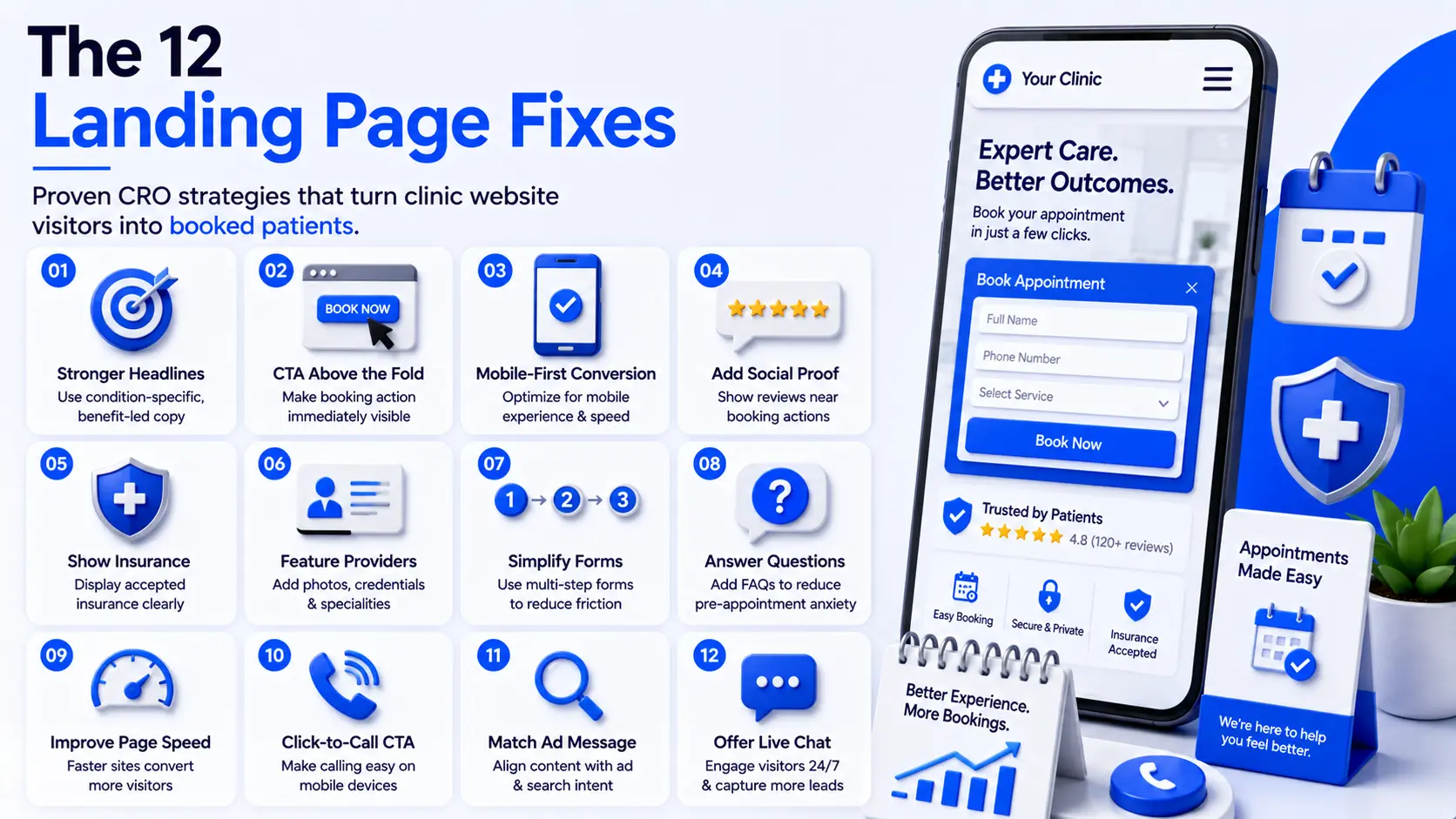
Fix 1: Replace Generic Headlines With Condition-Specific, Benefit-Led Copy
Headlines like "Welcome to Our Clinic" or "Compassionate Care You Deserve" communicate nothing actionable. High-converting clinic landing page CRO replaces these with specific, problem-solution framing: "Same-Day Appointments for Knee Pain Relief" or "Board-Certified Cardiologist Accepting New Patients in [City]." The headline must confirm to the visitor, within two seconds, that they are in exactly the right place.
Fix 2: Place the Booking CTA Above the Fold on Every Page
The single most common patient booking optimization failure is burying the appointment booking call-to-action below significant scrolling distance. The primary CTA — a phone number, an inline booking form, or a prominent button linking to a scheduling tool — must be immediately visible without any scrolling on both desktop and mobile devices.
Fix 3: Optimize for Mobile Conversion, Not Just Mobile Display
Most healthcare searches occur on mobile devices, yet the majority of clinic websites are still designed with desktop as the primary experience. True healthcare UX optimization for mobile means tap-to-call phone numbers, booking forms with minimal field count, fonts legible without zooming, and CTAs sized for thumb navigation. A page that displays correctly on mobile but requires excessive scrolling or data entry is not optimized — it is merely functional.
Fix 4: Add Social Proof Proximate to the Booking Action
Patient reviews and testimonials significantly improve doctor appointment booking CRO when positioned immediately adjacent to booking actions rather than isolated on a separate testimonials page. A verified Google review rating displayed directly above a booking form reduces hesitation and provides the social validation that many prospective patients need before committing to a first appointment.
Fix 5: Display Insurance Acceptance Prominently
Confusion around insurance coverage is a common reason why potential patients leave appointment pages before taking action. Providing an easy-to-read list of accepted insurance providers, or clearly mentioning accepted major plans with access to detailed information, can help reduce hesitation and improve conversion rates on healthcare websites.
Fix 6: Feature Provider Credentials and Photos on Service Pages
Anonymous service pages that describe clinical offerings without identifying the treating providers miss a critical healthcare funnel optimization opportunity. Prospective patients want to know who will be caring for them. Embedding provider photos, specialty credentials, and brief personal bios on service-specific landing pages humanizes the practice and builds the personal connection that motivates booking commitment.
Fix 7: Implement Multi-Step Booking Forms Instead of Long Single Forms
Long appointment request forms with 8-12 fields create significant patient journey optimization friction, particularly on mobile devices. Replacing these with progressive multi-step forms — where each screen asks only 2-3 questions — reduces perceived effort and measurably improves form completion rates. The first screen should ask only for the appointment type and preferred date, with demographic details collected in subsequent steps.
Fix 8: Add Structured FAQ Sections to Address Pre-Appointment Anxiety
What happens during a first visit? How long will I wait? Do I need a referral? These questions represent the specific pre-appointment anxieties that prevent clinic website design CRO from converting high-intent visitors. Dedicated FAQ sections on service and provider pages that directly answer these questions reduce the informational gap that causes prospective patients to leave without booking.
Fix 9: Test Page Load Speed as a Conversion Variable
Every second of additional page load time reduces conversion rates by measurable percentages. Health website A/B testing consistently confirms that page speed is not merely a technical metric — it directly influences whether a prospective patient remains engaged through the booking completion process. Core Web Vitals scores below acceptable thresholds are conversion rate problems, not just SEO problems.
Fix 10: Use Click-to-Call as the Primary Mobile CTA
For many patient segments — older adults, those with urgent care needs, first-time patients — speaking with a staff member before booking is a non-negotiable preference. Patient booking optimization for these segments should prioritize click-to-call as the primary mobile CTA, not digital form submission. Tracking call conversions with Google Ads call tracking or a dedicated tracking number provides the attribution data needed to accurately measure healthcare ad ROI.
Fix 11: Align Landing Page Content With the Specific Ad or Search Query
One of the most consistently impactful healthcare conversion rate optimization improvements is achieving message match between paid search ads and their destination landing pages. A prospective patient who clicks an ad for "same-day orthopedic consultation" and lands on a generic orthopedics service page experiences a jarring disconnect that sharply reduces conversion probability. Dedicated, query-specific landing pages that mirror the ad messaging deliver the continuity that converts.
Fix 12: Implement Strategic Live Chat for Off-Hours Engagement
Significant volumes of healthcare website traffic occur outside normal office hours, when staff are unavailable to answer phone inquiries. Implementing clinic website design CRO strategies such as AI-assisted live chat or intelligent chatbots that can capture prospective patient information, answer common questions, and schedule callbacks ensures that late-evening and weekend traffic is not permanently lost.
Healthcare CRO Fix Impact Summary
Conclusion
Investing in healthcare conversion optimization allows organizations to generate better results from existing traffic instead of relying solely on higher advertising budgets. This guide highlights 12 practical improvements aimed at solving usability issues, trust concerns, and common obstacles that affect patient conversions.
Implementing these improvements through structured health website A/B testing — rather than relying on intuition — ensures that every change is validated against real patient behavior data before being rolled out at scale. The compounding effect of systematic clinic landing page CRO typically produces conversion rate improvements of 40-150% within six months of consistent implementation.
For healthcare organizations ready to transform website traffic into a reliable patient acquisition engine, Rankingeek Marketing Agency, a Best Healthcare Digital Marketing Agency, delivers comprehensive medical website conversion audits and full-service patient booking optimization programs designed specifically for the unique conversion dynamics of clinical practice environments.
Frequently Asked Questions
1. What is healthcare conversion rate optimization?
Healthcare conversion rate optimization is the systematic process of increasing the percentage of clinic website visitors who complete a desired action — most commonly booking an appointment or submitting a contact inquiry. It involves analyzing visitor behavior data, identifying barriers to conversion, and implementing and testing evidence-based improvements to landing pages, forms, and user flows.
2. How is A/B testing used in healthcare website optimization?
Health website A/B testing involves simultaneously showing two versions of a landing page to different visitor segments to determine which version produces higher conversion rates. In healthcare, common A/B tests include headline variations, CTA button placement and copy, form length and structure, social proof positioning, and page layout. Tests should run for a minimum of 2-4 weeks with sufficient traffic volume to achieve statistical significance before drawing conclusions.
3. How long does it take to see results from healthcare CRO?
Initial improvements from high-impact, low-effort fixes such as above-fold CTA placement and mobile optimization are typically measurable within 30-60 days. More complex clinic landing page CRO programs involving multi-step form redesign, comprehensive healthcare UX optimization, and systematic A/B testing produce their most significant results over a 3-6 month implementation timeline, with compounding improvements thereafter.
4. What is the average conversion rate for medical practice websites?
Industry benchmarks for medical website conversion rates on appointment booking pages typically range from 2-5% for un-optimized sites and 8-15% or higher for practices that have implemented structured patient booking optimization programs. Rates vary by specialty, market competitiveness, traffic quality, and the complexity of the appointment request process.
5. How does patient journey optimization differ from general website CRO?
Patient journey optimization accounts for the unique emotional and practical considerations that healthcare consumers bring to the conversion process — trust concerns about a new provider, anxiety about medical procedures, insurance and cost uncertainty, and the desire for personal connection before committing to care. General CRO focuses primarily on friction reduction, while patient journey optimization additionally addresses the trust-building and reassurance signals that are uniquely critical in clinical contexts. This is why healthcare funnel optimization must be approached with healthcare-specific expertise rather than generic e-commerce CRO methodology.