
.png)

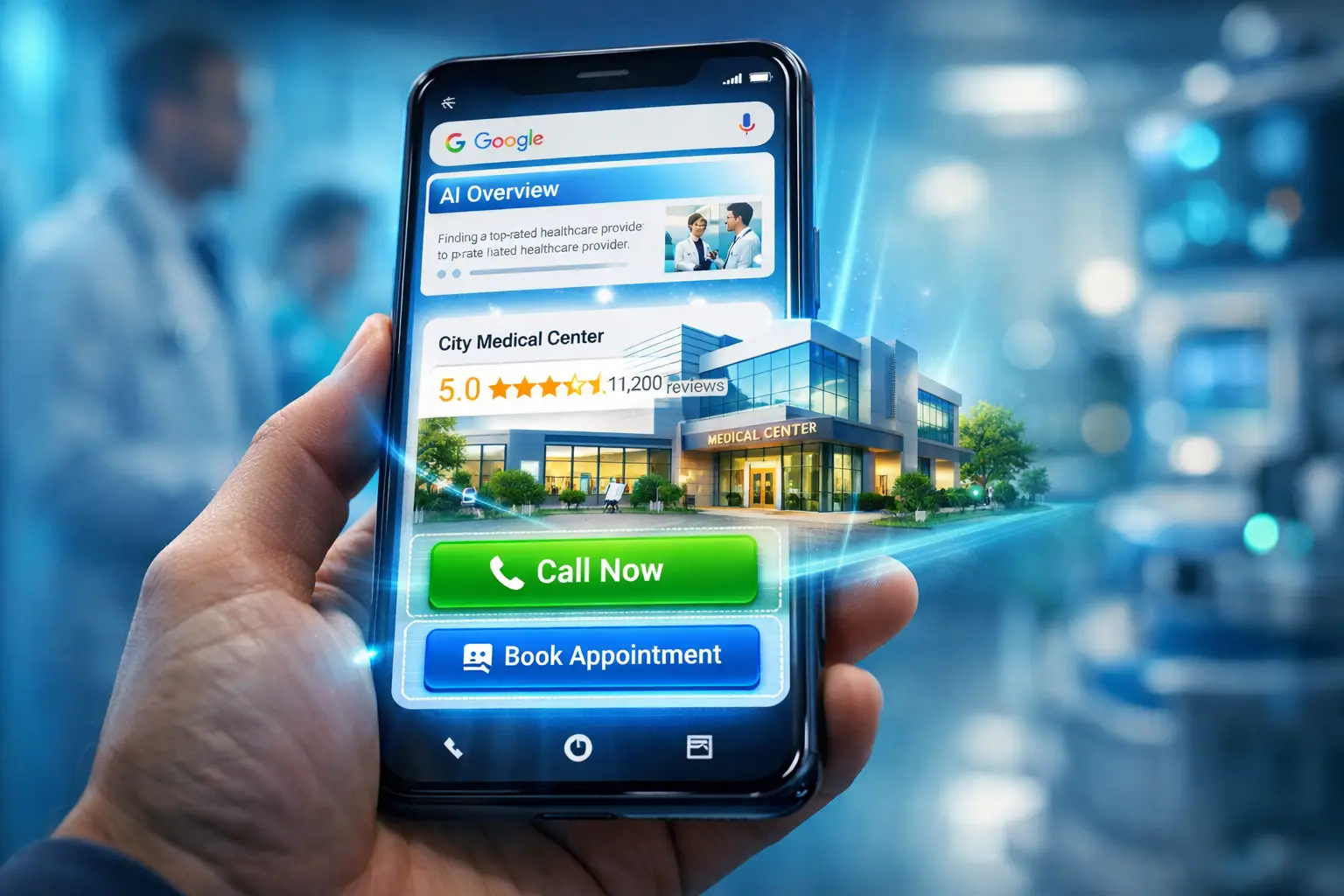

Google's AI Overview delivers answers directly on the Search Engine Results Page (SERP), making traditional website traffic an incomplete success measure. To secure patient bookings, healthcare practices must optimize their online presence for frictionless entry and direct conversion on the SERP itself. This transforms Google into the new digital front door, demanding a focus on metrics like the emerging Citation-to-Call Ratio.
The landscape of patient acquisition zero-click search presents a paradox: high visibility without corresponding website traffic. Patients now get answers without visiting your website. This shift forces a complete rethink of digital strategy. For independent practice owners, medical marketing managers, hospital digital strategy teams, and specialist physicians, the imperative is clear: influence the AI, not just rank for it. The objective: convert interest into bookings directly from the SERP, leveraging Google's robust Google platform as the primary interface for patient engagement healthcare digital marketing agency.
Securing Patient Bookings: Your SERP Presence in a Zero-Click World
Healthcare providers face a pressing challenge today: the dwindling relevance of website clicks as a primary conversion metric. Patients increasingly get their questions answered directly on Google, often through Google AI Overviews and rich snippets. This reality necessitates a strategic shift from driving clicks to facilitating direct patient engagement and conversion on the SERP. The digital front door for practices in 2026 now lives within Google's Google platform, not solely on your homepage, as industry experts confirm.
To thrive in this zero-click environment, healthcare practices must ensure their information is not only present but also actionable and deeply integrated across Google properties. This optimization includes featured snippets medical, Knowledge Graph optimization, and robust structured data for healthcare. Google's AI consumes these elements, synthesizing comprehensive answers that include your practice as an authoritative source. Structured data, for instance, clearly communicates service offerings, accepted insurance plans, and appointment availability directly to Google, making it easier for AI to present this crucial information upfront. Specialist physicians, particularly those in high-margin fields like surgery or fertility, can use this to pre-sell their expertise. They achieve this by ensuring their unique procedures and positive outcomes are explicitly highlighted in AI summaries. Such a proactive approach ensures that when a patient searches for a specific condition or treatment, your practice's relevant services and demonstrable experience appear immediately, reducing the need for further clicks and accelerating the patient journey towards booking.
Pro-Tip: Integrating Voice Search Optimization Healthcare
The rise of smart speakers and virtual assistants makes voice search optimization healthcare crucial. Patients often ask direct questions, such as "find a dermatologist near me who accepts Blue Cross." Ensuring your structured data includes exact insurance providers, precise service descriptions, and location information will make your practice discoverable through these conversational queries. This directly contributes to a higher AI citation rate for medical practices, increasing the likelihood of Google's AI mentioning your practice as a relevant option. Furthermore, focusing on long-tail keywords that mimic natural speech patterns improves your chances of appearing in voice search results, guiding patients directly to your booking pathways integrated within Google's platform. This seamless experience is key to patient decision process in the age of AI, allowing your practice to intercept patient intent at the earliest possible stage.
Google AI Overview: Crafting a Direct Booking Strategy
The advent of a Google AI Overview booking strategy marks a profound shift in how patients select healthcare providers. Instead of clicking through to websites, patients now expect frictionless entry, demanding essential information like insurance verification and estimated wait times appear directly on the SERP, as industry experts observe. This means your AI Overview strategy must prioritize accessibility and immediate utility, effectively performing crucial functions traditionally handled by your website.
Medical marketing managers require a new metric to demonstrate ROI in this zero-click world: the Citation-to-Call Ratio, a key insight from experts. This metric tracks how often your practice is cited in an AI Overview or other SERP features, leading directly to a phone call or an on-SERP booking. It replaces traditional Click-Through Rate (CTR) as the primary indicator of effective digital engagement, offering a more accurate measure of true patient acquisition. To improve this ratio, practices must ensure their Google Business Profile patient conversion is optimized to capture direct bookings or calls. Optimization includes maintaining accurate and up-to-date service listings, hours, contact information, and integrating direct booking links where available. For hospital digital strategy teams, ensuring seamless integration of their larger health system's services and appointment availability into AI Overviews is critical for designing the overarching digital front door healthcare 2026. Success involves standardizing data across all hospital departments and affiliated practices, presenting a unified, easy-to-navigate interface directly on Google.
Read More: Why Your Current Marketing Agency’s ‘Keyword Strategy’ Is Failing in the Age of AI Overviews
Driving Conversion with Local Service Ads for Doctors
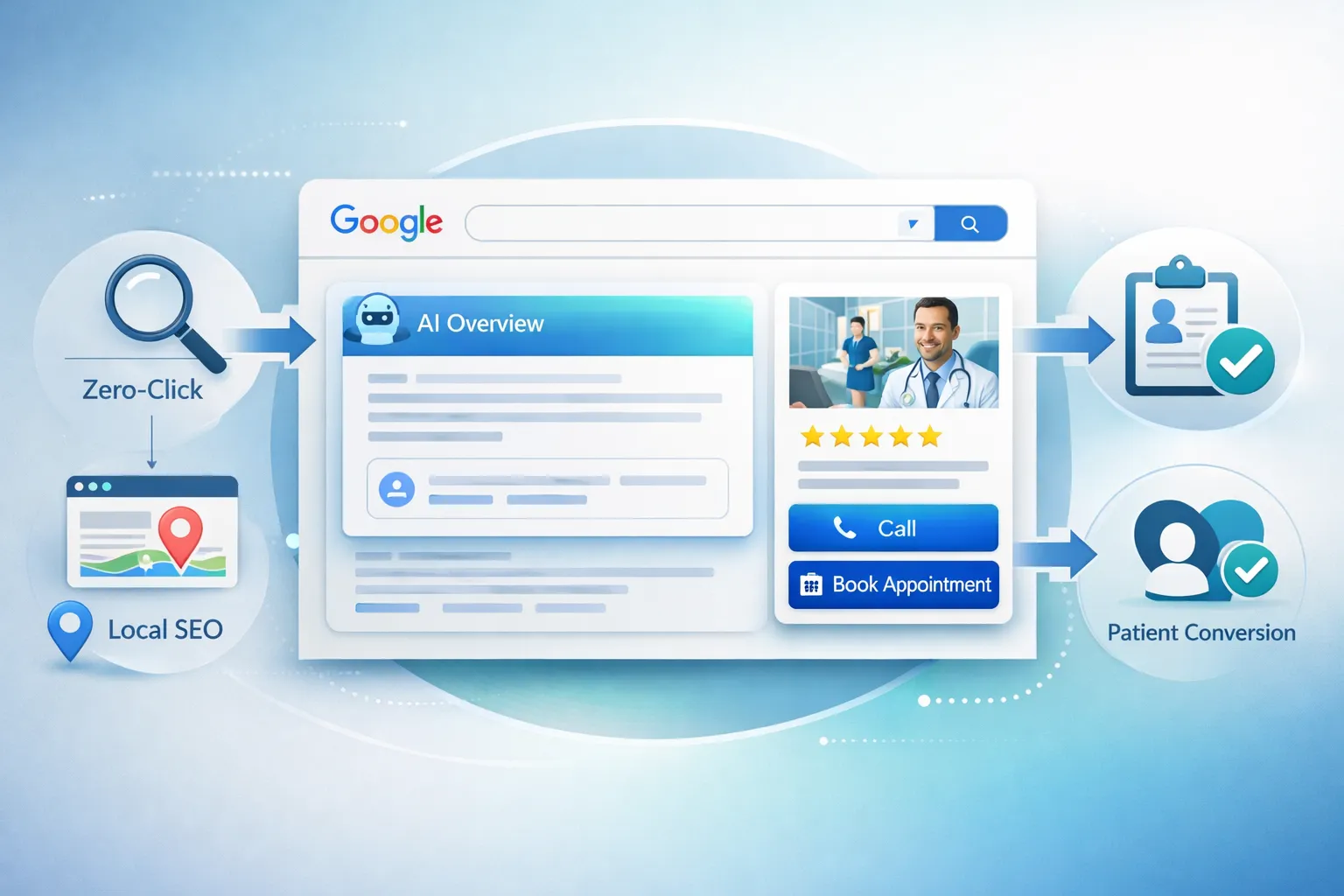
Beyond organic visibility, Local Service Ads for doctors offer a powerful direct booking mechanism. These ads appear at the very top of local search results, often above traditional organic and paid listings, and feature "Google Guaranteed" badges, building immediate trust. For independent practice owners, investing in LSA for doctors ensures your services are presented to highly intent-driven local patients, often with direct call buttons or booking options. This is a crucial component of any conversion funnel optimization healthcare strategy in a zero-click world. It reduces patient steps from search to appointment, aligning perfectly with the frictionless entry expectation experts outline. Leveraging these ads, combined with meticulous Google Maps optimization for clinics, amplifies medical practice visibility exactly where and when it matters most, making your practice the obvious choice for local patients seeking immediate care.
Implementing Healthcare AEO (Answer Engine Optimization) for AI Influence
Healthcare AEO (Answer Engine Optimization) is not just about ranking for keywords; it is about being the direct answer Google's AI provides. This means crafting content specifically designed to inform, persuade, and facilitate action directly on the SERP. Google AI Overviews in 2026 will increasingly favor "Clinical Evidence Stacks," content pieces directly linking to authoritative sources like PubMed or NIH data, over generic wellness advice. Specific sources Or confident statements This shift is already visible across Google’s AI Overviews and evolving search behavior. For all healthcare providers, this implies a higher standard of content creation focused on scientific rigor and verifiable claims.
Practices must invest in developing content that is not only factually accurate but also demonstrably evidence-based. This includes blog posts, service pages, and FAQs that cite peer-reviewed studies or government health organizations. For example, a specialist physician explaining a new surgical technique should link to relevant clinical trials, reinforcing their expertise and credibility. Such a commitment to evidence-based content directly bolsters your practice's EEAT (Experience, Expertise, Authoritativeness, Trustworthiness) signals, which Google's AI heavily weighs. By proactively creating "Clinical Evidence Stacks," you pre-package your expertise for the AI. This ensures that when it synthesizes an answer for a patient, your practice is cited as a reliable, authoritative source. This significantly increases your AI citation rate for medical practices, a critical component of the new Citation-to-Call Ratio. Medical marketing managers should champion this content strategy, shifting resources from generic blog posts to rigorously researched, citation-rich educational materials. This approach also allows for sophisticated patient journey mapping, as you can anticipate common questions and pre-populate Google with your expert answers, guiding patients seamlessly towards booking.
Designing the Digital Front Door Healthcare 2026 on the SERP
The concept of the digital front door healthcare 2026 has fundamentally evolved. It no longer resides solely on your website; it has effectively migrated to the SERP itself, a shift validated by industry experts. Patients expect to verify insurance, check wait times, and understand service specifics before they ever click to your site. This paradigm shift requires a comprehensive strategy that prioritizes on-SERP information delivery and seamless booking pathways. For large health systems, this means ensuring consistency and accuracy across dozens or even hundreds of interconnected listings and profiles.
To design an effective digital front door on the SERP, practices must optimize every touchpoint that appears in a search result. This includes meticulously managing your Google Business Profile patient conversion, ensuring all information is current, services are clearly defined, and high-quality images showcase your facility. Furthermore, proactively soliciting and managing patient reviews through online reputation management healthcare is paramount. Positive reviews, especially those that mention specific services or doctors, are powerful signals of trust and quality for both human patients and Google's AI. A strong online reputation directly influences whether a patient chooses to call or book an appointment directly from the SERP. Hospital digital strategy teams must centralize data management to ensure that all patient-facing information, from department-specific wait times to specialist availability, is accurately reflected and easily accessible via Google properties. Such a commitment to real-time, comprehensive information directly on the SERP minimizes patient friction and maximizes the likelihood of immediate booking, making the path from search to appointment as smooth as possible.
Optimizing Google Business Profile Patient Conversion and Local Strategy
Your Google Business Profile patient conversion is arguably the most critical component of your digital strategy in the zero-click era. It is the primary vehicle through which patients will find your practice, ascertain vital information, and initiate contact or booking without visiting your website. A fully optimized and actively managed Google Business Profile (GBP) is essential for independent practice owners and specialist physicians looking to convert local searches into actual appointments.
This optimization goes beyond merely claiming your listing. It involves regular updates to hours, services, and photos. Crucially, leveraging the "Posts" feature on GBP allows practices to share updates on new services, COVID-19 protocols, or even appointment availability, effectively turning your GBP into a dynamic communication channel. Engaging with reviews through proactive online reputation management healthcare is also vital. Responding to both positive and negative feedback demonstrates responsiveness and patient-centricity, building trust directly on the SERP. Integrating direct booking links or call-to-action buttons on your GBP facilitates the easy booking patients expect, allowing them to schedule appointments directly from their search results – a key expert observation. Furthermore, a strong GBP forms the backbone of effective local SEO for healthcare. By ensuring your practice's name, address, and phone number (NAP) are consistent across all online directories and platforms, you bolster your local search rankings and improve your chances of appearing in the coveted "Local Pack" results, which are increasingly influenced by AI. For smaller practices, a dedicated healthcare digital marketing agency can provide the expertise needed to manage these complex, interconnected local SEO and GBP strategies, ensuring maximum medical practice visibility and conversion rates.
Information Table: Evolving Patient Acquisition Metrics & Strategies
Key Takeaways
To secure patient bookings in the zero-click era, prioritize SERP-native strategies. Focus on optimizing your Google Business Profile for direct conversion and ensure your content features "Clinical Evidence Stacks" to influence AI Overviews. The new success metric is the Citation-to-Call Ratio, reflecting direct engagement from Google's new digital front door. Embrace AEO to provide frictionless patient access.
FAQ
What is the Citation-to-Call Ratio and why is it important now?
The Citation-to-Call Ratio is a new metric replacing traditional CTR. It measures how often your practice appears in AI Overviews or other SERP features, leading directly to a phone call or on-SERP booking. Experts confirm its importance, as it accurately reflects patient acquisition in a zero-click environment where website visits are less common.
How does the "Digital Front Door" shift impact my website strategy?
The "Digital Front Door" now lives on the SERP. Patients expect insurance verification and wait times before visiting your site, a key insight from industry experts. Your website remains important for depth, but initial patient conversion efforts must focus on providing immediate, actionable information directly on Google properties like your Google Business Profile.
What are "Clinical Evidence Stacks" and why are they favored by Google AI?
"Clinical Evidence Stacks" refer to content linking to authoritative sources like PubMed or NIH data. Industry experts highlight their importance. Google AI Overviews favor them because they demonstrate high EEAT (Experience, Expertise, Authoritativeness, Trustworthiness), ensuring the information provided to patients is scientifically rigorous and trustworthy.
How can Local Service Ads (LSAs) benefit my practice in this new environment?
Local Service Ads for doctors appear at the top of local search results with "Google Guaranteed" badges, providing immediate trust and visibility for local patients. They offer direct call buttons and booking options, making them a highly effective tool for capturing high-intent patients directly from the SERP, aligning with frictionless entry.
What role does Online Reputation Management play in AI-driven patient acquisition?
Online reputation management healthcare is critical because positive reviews and responsive engagement on platforms like Google Business Profile signal trust and quality to both prospective patients and Google's AI. A strong reputation directly influences the AI citation rate for medical practices and encourages direct calls or bookings from the SERP, impacting your Citation-to-Call Ratio.