
.png)



Every dental clinic competing for new patients in 2025 faces the same uncomfortable reality: if you're not showing up in local search results, a competitor down the street is getting those calls instead. On-page SEO is the discipline that changes that equation, and organic search already drives 57% of new patient inquiries for dental practices. That number alone should make this a priority.
Key Takeaways
- Organic search drives 57% of new patient inquiries, making dental website ranking a direct patient acquisition lever.
- On-page SEO covers everything optimized directly on your site: content, title tags, meta descriptions, and technical foundations.
- Google holds dental content to stricter standards through its E-E-A-T and YMYL frameworks.
- Most practices see noticeable results within 3 to 6 months, with compounding gains building over 6 to 12 months.
Why Dental Practices Can't Ignore On-Page SEO
The way patients find a dentist has fundamentally changed. They don't ask a neighbor first. They open Google, type something like "dentist near me accepting new patients," and book an appointment within minutes. If your dental clinic isn't optimized to appear in those searches, you're invisible at the exact moment a patient is ready to act.
The 57% figure tells you something important: paid ads and word-of-mouth combined still don't match what organic search delivers in raw patient volume. On-page SEO directly shapes how search algorithms read, categorize, and rank your website. Get it right, and you earn consistent online visibility without paying per click. Get it wrong, and even a beautifully designed site sits on page three of Google, collecting dust.
Local patients are searching right now. The question is whether they're finding you.
What On-Page SEO Actually Means for Your Dental Website
On-page SEO refers to everything you optimize directly on your website, including content, meta descriptions, title tags, header structure, image alt text, and page speed. The goal is to help search engines better understand your site's content and its relevance to specific patient searches, which translates into improved SERP rankings and more qualified traffic.
This is different from off-page SEO, which covers external signals like backlinks, local citations, and Google My Business reviews. Both matter, but on-page optimization is the foundation. Without it, off-page efforts have nowhere solid to land.
Think of it this way: off-page SEO tells Google that people trust you. On-page SEO tells Google what you actually do, where you do it, and who you serve. A complete healthcare marketing and growth strategy needs both, but on-page work comes first. It's what makes every other effort more effective over time.
Five Essential On-Page Elements That Drive Patient Traffic
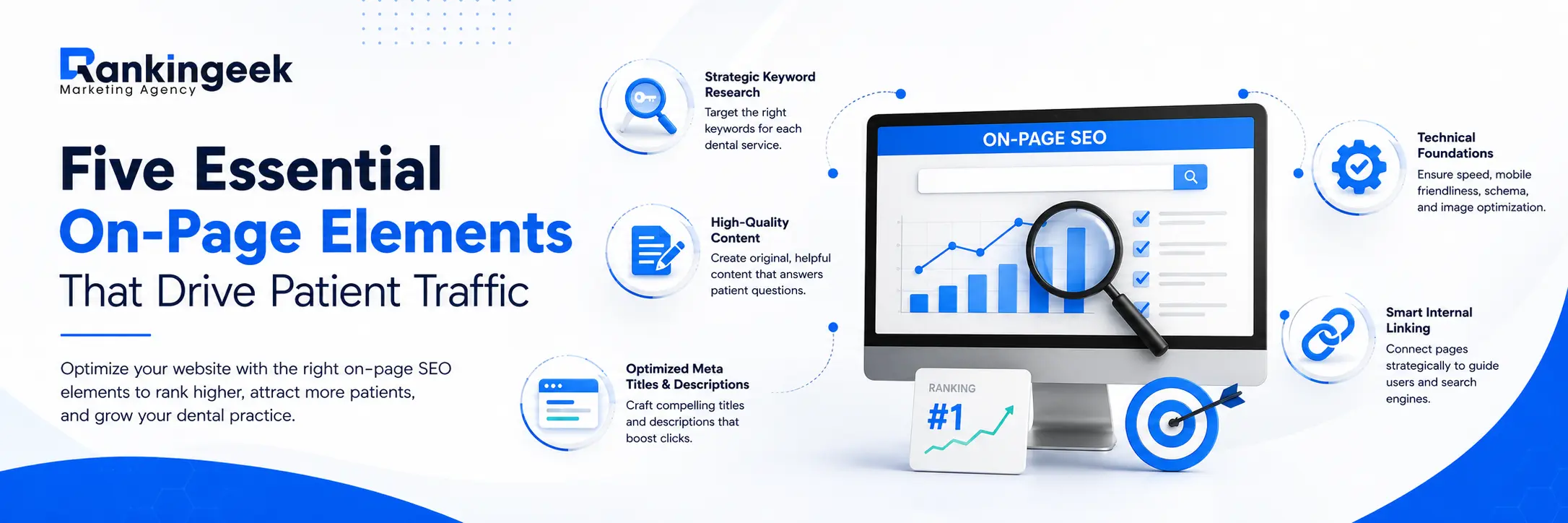
Strategic Keyword Research Mapped to Dedicated Service Pages
Most dental websites make one costly mistake: they list every service on a single page. Dental SEO best practices consistently recommend creating a dedicated page for each core service, whether that's dental implants, Invisalign, teeth whitening, or routine cleanings. Each page targets its own set of keywords and gives search engines a clear signal about what that page covers.
Local keywords matter just as much as service keywords. Weaving location-specific terms into page content, title tags, and meta descriptions is what connects your site to local search intent. A page titled "Dental Implants in Austin, TX" will consistently outperform a generic "Implants" page for patients searching in that area.
High-Quality, Original Content That Answers Patient Questions
Content quality is non-negotiable. Dental SEO blog makes the case clearly: high-quality, original, informative content that addresses patient needs and concerns is what separates practices that rank from those that don't. Thin, generic copy won't cut it with modern search algorithms.
Write for patients first. Answer the questions they actually type into Google. What does a root canal feel like? How long do implants last? Is Invisalign covered by insurance? Content optimization built around real patient concerns earns both rankings and trust.
Meta Titles and Descriptions Optimized for Click-Through
Even when you rank, a weak title tag or meta description loses the click. These elements appear directly in search results and function as your first advertisement to a potential patient. Well-crafted meta titles and descriptions help search engines understand your content while also compelling users to choose your result over a competitor's.
Every page needs a unique, specific meta title under 60 characters and a meta description that includes a local keyword and a clear reason to click.
Technical Foundations: Speed, Mobile, Schema, and Image Alt Text
Technical SEO isn't glamorous, but it's load-bearing. A mobile-friendly site is now a baseline requirement, not a bonus, given that most local searches happen on phones. Page speed directly affects both user experience and rankings. Image alt text helps search engines understand visual content and improves accessibility. Schema markup gives Google structured data it can use to generate rich results, which increases your practice's visibility in the SERP beyond a standard blue link.
For practices that want a site built with these technical elements properly integrated from the start, healthcare web development specialists can ensure nothing gets missed.
Internal Linking That Guides Users and Search Engines
Internal links do two jobs simultaneously. A well-structured internal linking system connects your service pages, blog content, and contact page in a way that makes the entire site stronger, not just individual pages.
Healthcare SEO Requires More: E-E-A-T and YMYL Compliance
Dental content isn't treated the same way as a recipe blog or a product review site. Google classifies health-related content as YMYL (Your Money or Your Life), meaning it holds this content to a significantly higher standard because inaccurate information could genuinely harm someone. That classification applies directly to every page on your dental website.
The E-E-A-T framework (Experience, Expertise, Authoritativeness, and Trustworthiness) is Google's practical response to YMYL content. For a dental clinic, meeting E-E-A-T standards means listing provider credentials prominently, publishing content that reflects genuine clinical expertise, earning mentions and reviews from credible sources, and making it easy for patients to verify who you are and what you do.
Patient testimonials, before-and-after case documentation (with proper consent), and clear practitioner bios all contribute to demonstrating trustworthiness on-page. HIPAA compliance is also a factor here. Any patient data collected through contact forms, chat widgets, or booking systems needs to be handled securely. Weak privacy practices don't just create legal exposure; they erode the trust signals that Google's quality raters are specifically looking for.
Rankingeek's team specializes in HIPAA-compliant healthcare digital marketing that accounts for both the technical and content requirements of E-E-A-T. It's a layer of dental marketing that many generalist agencies overlook entirely.
What Dental SEO Services Actually Cost
SEO pricing for dental practices spans a wide range, and the variation is real. Most single-location practices invest between $1,000 and $3,000 per month for comprehensive SEO services. Here's how the tiers typically break down:
Budget tier ($500 to $1,200/month): Covers basic local optimization, Google My Business management, and foundational on-page work. Suitable for practices in low-competition markets or those just starting to invest in digital. Don't expect aggressive content production or deep technical audits at this price point.
Mid-range ($1,000 to $3,000/month): This is where most practices land. This range typically delivers meaningful, comprehensive services including keyword research, content optimization, technical SEO, and ongoing reporting. It's enough budget to compete seriously in most US markets.
Premium ($2,500 to $5,000+/month): Designed for highly competitive metro markets where multiple well-funded practices are fighting for the same searches.
One consistent warning across dental marketing sources: suspiciously cheap SEO, think $99/month packages, almost always involves shortcuts that can damage your website authority or trigger Google penalties. The cost of recovering from a penalty far exceeds the money saved on a low-quality service.
Realistic Timelines: When You'll See Results
Dental SEO is a compounding investment, not a switch you flip. Patience is genuinely required here.
The earliest measurable gains often come from Google Business Profile optimization rather than organic rankings. Many practices see a 40 to 60% increase in direct calls from Google by month four, with some improvement visible within 6 to 8 weeks of optimizing their profile. That's often the first sign that the strategy is working.
For organic website rankings, expect noticeable improvements within 3 to 6 months of consistent effort. Significant, sustained results, the kind that deliver a reliable flow of new patient inquiries month after month, typically require 6 to 12 months or longer in competitive markets.
Practices that treat SEO as a one-time project and stop after a few months rarely see the full return. The practices that consistently outrank competitors in local search domination are the ones that treat on-page optimization as an ongoing commitment. Patient acquisition through organic search builds momentum slowly, then compounds quickly.
Frequently Asked Questions
What is on-page SEO for dental practices?
On-page SEO for dental practices means optimizing the elements directly on your website, including content, title tags, meta descriptions, header structure, images, and technical performance, to improve how search engines understand and rank your pages. The goal is to match your site's content to the specific searches your target patients are already typing into Google. Done well, it improves both your rankings and the quality of traffic you attract, meaning more patients who are genuinely ready to book.
How much do dental SEO services cost?
Costs vary based on your market, competition level, and the scope of services included. Most single-location dental practices invest between $1,000 and $3,000 per month for comprehensive services, while budget packages start around $500 to $1,200 monthly and premium campaigns in competitive metro markets can reach $2,500 to $5,000 or more. The key is matching your budget to your market's competitiveness, and being cautious of unusually low quotes that often signal low-quality tactics.
How long does it take for dental SEO to work?
Most practices start seeing noticeable improvements within 3 to 6 months, but meaningful, consistent results typically require 6 to 12 months of sustained effort, particularly in competitive areas. Google Business Profile optimization can produce early wins, with some practices seeing up to 40 to 60% more direct calls by month four. SEO builds gradually, and the practices that stay consistent are the ones that see compounding returns over time.
Start Building Your Dental Clinic's Online Authority Today
On-page SEO is the foundation every other dental marketing effort is built on. Without it, paid ads cost more, referrals don't get reinforced online, and your practice growth stalls at whatever word-of-mouth can deliver.
The investment compounds. Optimizations made today continue paying off months from now, and the practices that start sooner build leads that are genuinely difficult for late-movers to close. If you're ready to see where your dental clinic stands and what it would take to dominate your local market, book a free clinic growth audit with Rankingeek. The gap between your current rankings and where you could be is almost always smaller than it looks.