
.png)



Australian clinics competing for patient leads face a challenge that goes well beyond budget. The SEO vs. Google Ads decision is also a compliance decision, shaped by AHPRA, TGA rules, and Google's own healthcare policies. Get either channel wrong, and the cost isn't just wasted ad spend, it's a regulatory penalty.
Key Takeaways
- Both SEO and Google Ads operate under strict compliance rules for Australian clinics, not just performance metrics.
- AHPRA's updated guidelines and Google's April 2026 policy changes restrict what cosmetic and medical practices can say online.
- Google Ads wins on speed to first booking, SEO builds compounding organic growth over time.
- A hybrid digital strategy is the evidence-backed path for most clinics.
Patient Acquisition in Australia: The Rules Change Everything
As of mid-2026, the Australian digital health market was valued at USD 8.9 billion in 2025 and is projected to reach USD 31.1 billion by 2034. That growth signals real patient demand online. Tapping into it requires more than just a budget whereas it demands a compliance-first approach. Successful healthcare marketing in Australia depends on balancing patient acquisition with strict regulatory compliance.
Every digital strategy for Australian clinics operates inside a framework set by AHPRA, TGA requirements, and Google's own healthcare policies. A campaign that works in another industry can get a clinic suspended or fined here. That's the starting point: choosing between SEO and Google Ads isn't about which channel is "better" in the abstract. It's about which channel fits your compliance readiness, your timeline, and your patient acquisition goals right now. The strongest patient acquisition strategies Australian clinics adopt combine compliance, local visibility, and channel selection based on business goals rather than short-term trends.
AHPRA and Google's April 2026 Rules: What Australian Clinics Cannot Do
Compliance isn't a footnote here. It's the foundation. AHPRA's advertising guidelines, with stricter rules effective as of September 2025, impose tighter restrictions on advertising non-surgical cosmetics like Botox and dermal fillers. The absolute ban on testimonials and reviews in clinical advertising applies across every channel: your website, your Google Ads copy, and any content you publish for organic search. There's no workaround.
The financial exposure is real. As of mid-2026, penalties for breaching AHPRA advertising guidelines reach up to $60,000 for an individual practitioner and $120,000 for a body corporate. That makes compliance non-negotiable for any clinic building a patient acquisition system.
Google's own policy tightened further. As of April 2026, Google's Healthcare and Medicines policy bans before-and-after images and personalised insecurity-targeting in cosmetic procedure ads. Australian clinics must also comply with local regulations, including TGA guidelines, and meet certification requirements to run ads in restricted healthcare categories. An ad account suspension doesn't just pause bookings, it can be costly and time-consuming to resolve. Both channels share the same compliance floor. Any digital strategy worth running starts there.
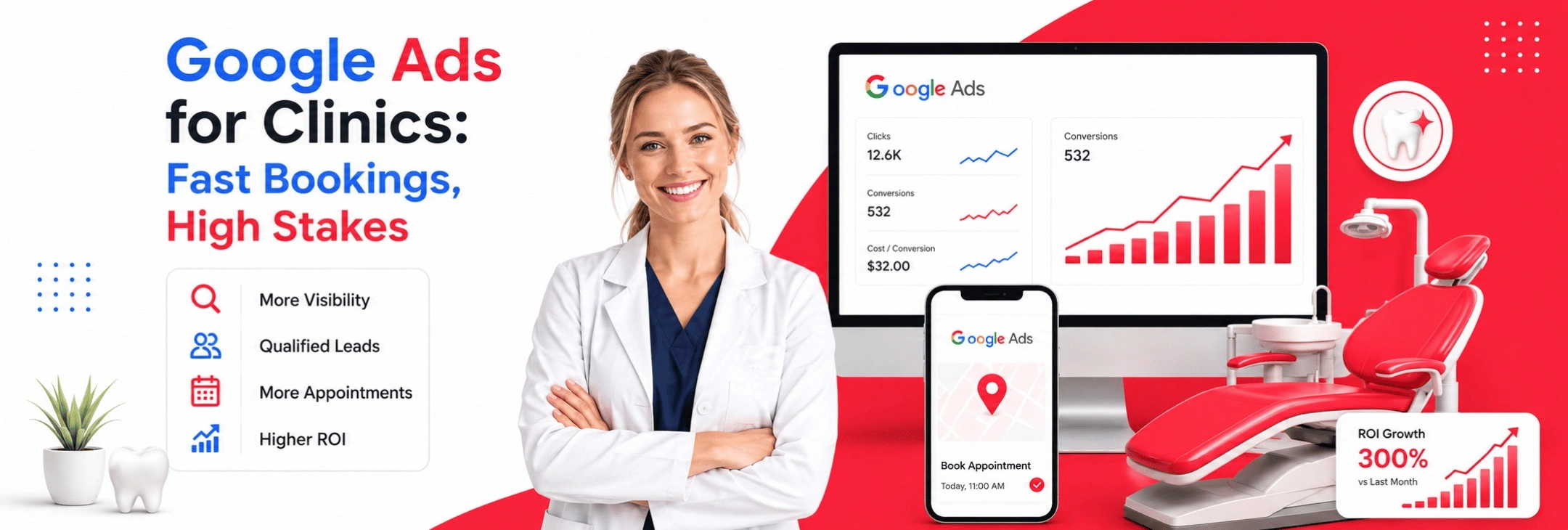
Google Ads for Clinics: Fast Bookings, High Stakes
Google Ads for Australian medical practices remains the fastest way to reach patients who are actively searching for care.
The cost per click reflects that intent. As of March 2026, high-intent emergency dental keywords in Australia can cost between $4 and $16 per click. Cosmetic injectable campaigns carry an added layer of risk: Google's April 2026 policy update means non-compliant ads in this category can trigger account suspension. That's a hard stop on patient leads, not just a dip in conversion rates.
The trade-off is clear enough. Paid advertising gets a clinic in front of patients fast while giving practices measurable conversion rates and booking performance. But the cost per click is ongoing. Stop spending, and the website traffic stops with it. Creative constraints are narrow under the current rules, and every ad needs to be reviewed against both TGA and AHPRA requirements before it goes live. Clinics that skip that review are the ones paying the $60,000 penalty. You can explore what a compliance-ready paid patient acquisition setup looks like at Rankingeek's paid patient acquisition service.
SEO for Healthcare Clinics: Compounding Returns in a Competitive Market
SEO for healthcare clinics in Australia works differently from paid advertising. Organic search traffic doesn't stop when the budget does. A well-built content and local SEO strategy becomes a long-term asset, reducing patient acquisition costs over time rather than accumulating them.
The catch is Australia's highly competitive landscape for healthcare search, where ranking takes consistent investment and authority building. Healthcare is one of Australia's most competitive SEO sectors, partly because Google applies its highest-scrutiny YMYL (Your Money or Your Life) standards to medical content, and partly because practitioner density in major cities is high. Ranking takes time and consistent effort.
AHPRA rules don't disappear in organic search. The testimonial ban applies to website content just as it does to ads. No prohibited claims, no before-and-after patient stories. Compliant content isn't just a legal requirement, it's the foundation of any ranking strategy that survives a Google quality review.
For most clinics, local SEO and Google Business Profile optimisation offer the highest-leverage starting point. Suburb-level and city-level patient searches are where online bookings are won or lost for private practices. Improving online visibility at the suburb and city level helps clinics capture more qualified patient searches over time. That's where brand awareness compounds into actual appointment volume. Rankingeek's local search domination service is built specifically around this model for healthcare practices.
SEO vs. Google Ads: How the Two Channels Compare for Australian Clinics
The table below maps both channels against the criteria that actually matter to clinic owners making a budget decision.
Neither channel is universally superior. Ads win on immediacy and measurable conversion rates. SEO wins on compounding value and lower cost per patient lead over a longer horizon. The real question is which problem your clinic needs to solve first.
Which Channel Fits Your Clinic, and When to Run Both
For digital marketing for doctors Australia, the decision is rarely SEO or Google Ads alone, it's about using each channel at the right stage of clinic growth. A new clinic, or one launching a new service line, typically needs patient leads before organic search has time to build. Google Ads fills that gap. It generates bookings while SEO builds authority in the background.
An established clinic with existing organic traction can reduce paid dependency over time. But pulling ads entirely during an SEO ramp-up period is a risk most practices shouldn't take. The two channels solve different problems at different timescales. A hybrid digital strategy is the evidence-backed recommendation, not a hedge.
Budget allocation depends on clinic maturity and goals. Earlier-stage practices lean paid-heavy. Practices that have built meaningful content and local SEO authority can shift the balance toward organic over time. The best marketing for clinics across Australia reflects this sequencing, not a single-channel bet.
If you want a clear read on where your clinic sits right now and which lever will move the needle fastest, book a free practice growth audit with Rankingeek. It's a no-obligation starting point for building a compliant, ROI-focused patient acquisition system that works inside the rules, not around them.
Frequently Asked Questions
Can a clinic manage Google Ads compliance in-house, or does it require a specialist?
Most clinics benefit from external help. Google's certification requirements for restricted healthcare categories involve documentation and approval processes that carry real suspension risk if handled incorrectly. A specialist familiar with both TGA requirements and Google's approval workflows significantly reduces that risk before a single ad runs.
Does the AHPRA testimonial ban apply to Google Business Profile reviews left by patients?
AHPRA's ban covers testimonials you solicit or publish yourself. Clinics cannot selectively promote or republish patient reviews in advertising. For any questions about how this applies to your specific practice and marketing materials, consult a healthcare lawyer before featuring any patient review in your marketing.
How long does a suspended Google Ads account typically take to reinstate for a healthcare clinic?
Reinstatement timelines vary and aren't guaranteed. The process involves submitting compliance documentation and waiting for review. During that window, all paid patient leads stop entirely, making proactive compliance review before launch far less costly than reactive account recovery.
Are there SEO tactics that are compliant for general GP clinics but restricted for cosmetic practices?
Yes. General GP clinics face fewer content restrictions than cosmetic practices. Cosmetic clinics cannot use before-and-after patient content or outcome-focused claims in any published material, including blog posts. GP clinics have more flexibility with educational health content, though the testimonial ban and YMYL quality standards apply to both.