
.png)

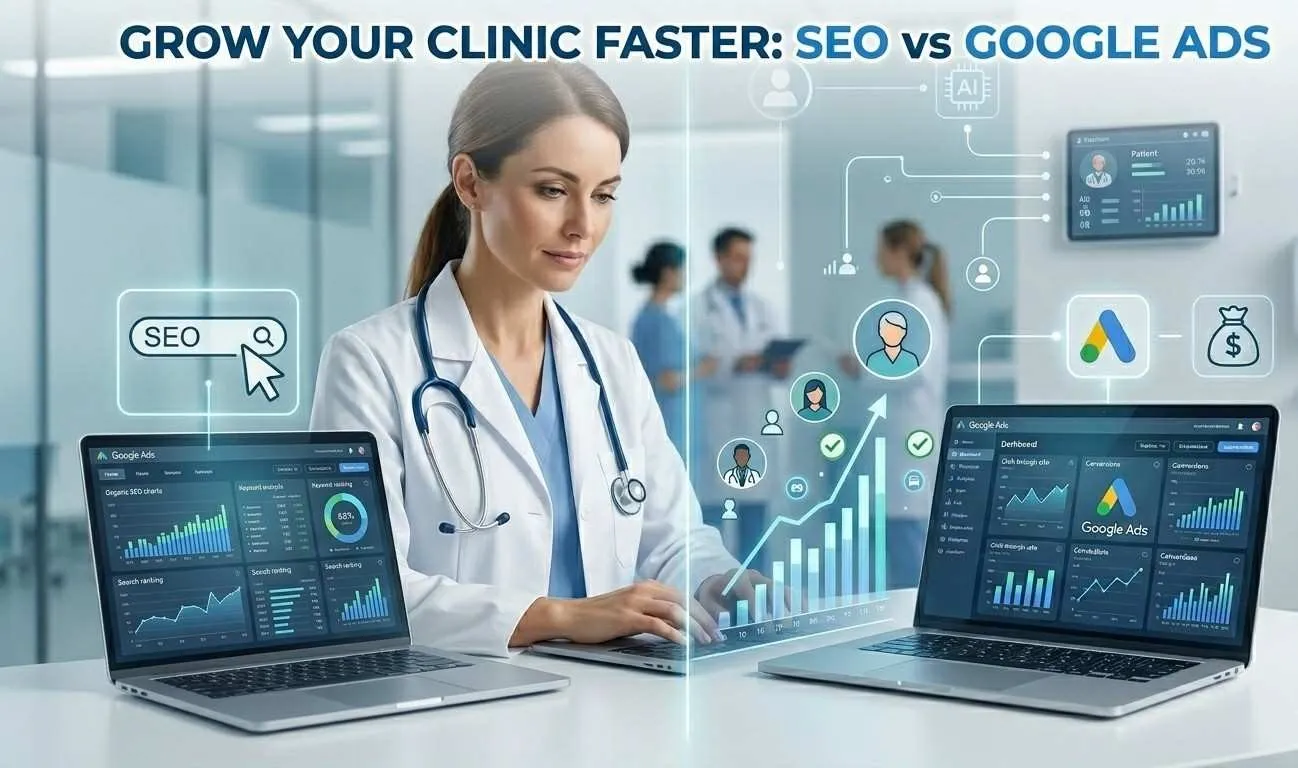

Choosing between organic growth and paid visibility is the ultimate dilemma for modern practice owners. If you want a direct answer: Google Ads is best for immediate patient acquisition and filling urgent gaps in your schedule, while SEO is the superior long-term investment for sustainable growth and the lowest cost-per-patient over time. For most successful clinics in the USA, a hybrid approach—using Ads to fuel the present while SEO builds the future—is the winning strategy.
In the competitive landscape of healthcare marketing USA, understanding how to balance these two powerhouses can be the difference between a thriving waiting room and a silent phone.
Understanding the Core Difference: Speed vs. Sustainability
When we talk about SEO vs Google Ads for clinics, we are essentially comparing "renting" traffic versus "owning" it.
Google Ads: The "Faucet" Strategy
Google Ads for healthcare (see how we run this) works like a faucet. When you turn it on (pay for clicks), the traffic flows instantly. You can target specific symptoms, ZIP codes, and even the time of day. However, the moment you stop paying, the faucet shuts off, and your visibility vanishes.
SEO: The "Digital Real Estate" Strategy
SEO for medical clinics is more like planting an orchard. It takes time to grow, and you won’t see "fruit" in the first week. But once those trees mature, they provide a consistent harvest of organic traffic growth clinics can rely on for years without a direct cost-per-click.
The Pros and Cons of Google Ads for Doctors in USA
Google Ads (formerly AdWords) is a Pay-Per-Click (PPC) model. It is often the first choice for new practices or those expanding into new cities like digital marketing for clinics in New York.
The Benefits of Paid Ads
- Instant Visibility: You can appear at the top of page one within hours of launching a campaign.
- Granular Targeting: You can bid on high-intent keywords like "emergency pediatric clinic" to capture patients who need help right now.
- Predictable Lead Generation: Once your PPC services for clinics Texas are optimized, you can generally predict how many leads you’ll get for every $1,000 spent.
The Drawbacks
- High Cost-Per-Click (CPC): In major hubs like local SEO for clinics in Los Angeles, the cost per click healthcare ads can be expensive due to high competition.
- Ad Blindness: Many savvy users skip the "Sponsored" results and go straight to the organic listings.
- Maintenance Required: You must constantly monitor bids and landing pages to maintain a high conversion rate for clinic websites.
The Power of Local SEO for Medical Practices
If you want to be the "authority" in your region, Local Seo for Healthcare SEO for clinics in USA is your best bet. It focuses on the search engine ranking healthcare algorithms use to determine which practice is the most trustworthy.
Why SEO Wins Long-Term
- Compounding ROI: The ROI of SEO vs PPC shifts dramatically after year one. While PPC costs remain flat or rise, the cost of organic traffic drops as your authority grows.
- Trust and Credibility: Patients view organic rankings as an "earned" spot. Appearing in the "Map Pack" through Google My Business optimization signals that you are a local staple.
- Higher Conversion Rates: Organic visitors often have higher trust in the provider, leading to better lead generation for doctors.
The Challenges of SEO
- The Waiting Game: It can take 6 to 12 months to see significant search engine ranking healthcare improvements.
- Algorithm Shifts: Google frequently updates its rules, requiring a medical marketing agency USA to keep your site compliant.
Comparison Table: SEO vs. Google Ads for Clinics
The Third Option Nobody's Comparing: AI Search Visibility (AEO/GEO)
Here's what the SEO-vs-Google-Ads framing leaves out: by 2026, a growing share of patients aren't starting on Google at all. They're asking ChatGPT, Gemini, or Perplexity “which clinic should I see for X” before they ever run a traditional search — and neither your organic ranking nor your ad campaign controls whether your practice gets named in that answer.
This is Answer Engine Optimization (AEO) and Generative Engine Optimization (GEO) —structuring your content and schema markup so AI systems can find, verify, and cite your practice, the same way you'd structure a page to rank on Google. It isn't a replacement for SEO or Google Ads; it rides on top of your SEO foundation (the same E-E-A-T signals, FAQPage schema, and answer-first content that help you rank also help you get cited), while doing nothing to boost your paid campaigns directly.
For a practice deciding where to invest, that makes the real choice three-dimensional, not two: Google Ads for immediate bookings, SEO for compounding organic visibility, and AEO/GEO to make sure you're still the answer when the search happens somewhere Google isn't.
Practical Examples: Which One Should You Use?
Choosing the right healthcare marketing strategies depends on your current clinic status.
- Example A: The New Clinic. A new dental clinic in California needs patients today to cover overhead. Action: Start with a 70% budget in Google Ads and 30% in SEO.
- Example B: The Established Practice. A well-known physical therapy center in Texas has a steady flow but wants to reduce their $5,000/month ad spend. Action: Pivot to 80% SEO and Google My Business optimization to dominate the local Map Pack organically.
5 Best Practices for HIPAA-Compliant Marketing
Regardless of the channel, HIPAA compliant marketing is non-negotiable in the United States.
- Avoid Retargeting with PHI: Do not use Protected Health Information (PHI) to show follow-up ads to patients who visited specific treatment pages.
- Secure Contact Forms: Ensure your website's lead forms are encrypted and HIPAA-compliant.
- Transparent Privacy Policies: Your website must clearly state how patient data is used.
- No Clinical Data in Tracking: Avoid sending specific diagnostic data to Google Analytics or Meta Pixels.
- Focus on General Education: Use long-term vs short-term marketing content to educate rather than "diagnose" online.
How to Get Started: A Step-by-Step Guide
- Audit Your Website: Use healthcare SEO services United States to ensure your site is fast, mobile-friendly, and has high-quality medical practice branding.
- Set Your Budget: Determine if you have more "time" or "money." If you have money and need patients now, go PPC. If you have time and want a legacy, go SEO.
- Claim Your Local Identity: Optimize your Google Business Profile. This is the foundation of local SEO for medical practices.
- Keyword Targeting: Identify keywords with "commercial intent" (e.g., "doctor near me") and "informational intent" (e.g., "why does my back hurt").
- Track Everything: Monitor your conversion rate for clinic websites to see which channel actually brings in the most new patient appointments.
Conclusion: The Winning "Hybrid" Approach
In the debate of SEO vs Google Ads for clinics, the answer isn't "either/or"—it's "when and how much."
If you want to dominate your local market, use Google Ads for healthcare to capture the immediate, high-intent searches while simultaneously investing in SEO for medical clinics to build an untouchable organic presence. This dual-track strategy ensures you aren't just renting your success, but building a digital asset that grows in value every year.
Your Next Steps:
- Run a Site Audit: Check your current organic rankings for keywords like SEO for clinics in USA.
- Test a Small Ad Budget: Launch a "Search" campaign for your top 3 services.
- Consult a Professional: If you're unsure where to allocate your budget, speak with Healthcare Digital marketing Agency Medical marketing agencies USA that specialize in HIPAA-compliant growth.
FAQ:
Q. Does Google Ads help my SEO rankings?
A. Directly, no. Paying for ads won't move your organic rank. However, the increased traffic and brand awareness can indirectly lead to more searches for your clinic by name, which is a positive signal.
Q. Is SEO or PPC more expensive?
A. In the short term, Google Ads is more expensive because you pay for every click. In the long term, SEO requires a steady investment in content, but the "cost per lead" is usually much lower than PPC.
Q. Can I do SEO for my clinic by myself?
A. You can handle basics like Google My Business optimization and writing blog posts. However, SEO for doctors in California or other competitive states often requires technical expertise to outrank large hospital networks.
Q. What is a good conversion rate for a clinic website?
A. A healthy conversion rate (visitors who call or book) is typically between 3% and 7%. Highly optimized landing pages for specific PPC services for clinics Texas can sometimes reach 10%+.
Q. Should I stop Google Ads once my SEO is high?
A. Not necessarily. Many clinics use "Brand Protection" ads to ensure competitors don't bid on their clinic's name and steal potential patients at the last second.
Q. Where does AI search — ChatGPT, Gemini, AI Overviews — fit into this decision?
A. It sits on top of SEO rather than replacing either channel. AI systems tend to cite practices that already have strong E-E-A-T signals, structured FAQPage schema, and clearly answer-first content —the same fundamentals that support organic SEO rankings. Google Ads spend doesn't influence AI citations at all, so a practice relying only on paid search has no presence in that channel.