
.png)



Virtual care is no longer a pandemic-era convenience — it has become a permanent front door to healthcare. Every month, millions of patients open a search bar instead of a waiting-room door, typing queries like "see a doctor online today," "online therapy that takes my insurance," or "virtual urgent care near me." The platforms that surface first for those searches are quietly winning the next decade of patient relationships, which is exactly why telehealth SEO has become a make-or-break growth lever. Everyone else is paying competitors to acquire patients who were searching for them all along.
This is why virtual care SEO has shifted from a nice-to-have to a core growth function. The economics are simple: a telehealth visit booked through organic search costs a fraction of one acquired through paid channels, and it compounds over time. The challenge is that ranking a virtual care brand looks almost nothing like ranking a local clinic — the rules around geography, intent, and trust are different. This playbook breaks down how to build a search presence that converts.
Why Telehealth Search Behaves Differently
A brick-and-mortar practice competes for one city. A telehealth platform competes for an entire licensure footprint — sometimes a handful of states, sometimes the whole country. That widens the keyword opportunity dramatically, but it also fragments patient intent across three very different moments. Strong telemedicine digital marketing starts by recognizing that virtual care searchers fall into distinct mindsets, and each needs its own page:
- Service intent — patients who already know what they want ("virtual dermatology consultation," "online prescription refill") and are comparing providers.
- Condition intent — patients describing a problem rather than a solution ("telehealth for anxiety," "online doctor for a UTI"), who need education before they trust a booking button.
- Urgency intent — patients who need care now, almost always on a phone, searching things like "talk to a doctor online right now."
The mistake most platforms make is building one generic "Services" page and hoping it ranks for all three. It ranks for none of them well. Winning online doctor SEO means deliberately matching a dedicated, intent-specific page to each layer.
Keyword Strategy for High-Converting Virtual Care Queries
The highest-value telehealth keywords are rarely the highest-volume ones. Broad head terms like "telehealth" are dominated by venture-funded incumbents and aggregators. The smarter play for regional health systems and emerging platforms is the long tail, where intent is sharper and conversion rates are far higher. Effective online healthcare marketing content answers the objections that sit between a patient and their first virtual visit. Before someone books, they almost always want to resolve four anxieties:
- Cost — "how much is an online doctor visit without insurance"
- Coverage — "does my insurance cover a telehealth appointment"
- Capability — "can an online doctor prescribe antibiotics"
- Speed — "how fast can I see a doctor online"
Build content around these explicit concerns and you capture patients who are already at the decision stage, not idly researching. This is where telehealth content marketing earns its return — not in vanity traffic, but in qualified, ready-to-book demand.
The Counterintuitive Power of Local SEO for a "National" Service
It seems backwards to invest in telemedicine local SEO for a service with no physical location. It isn't. The reality is that most telehealth searches carry hidden local intent: patients quietly need to know whether a provider is licensed in their state and whether their plan covers a virtual visit where they live. The platforms dominating virtual clinic Google ranking treat each licensed state as its own micro-market:
- State-specific landing pages that spell out licensure, accepted insurers, and what conditions can be treated virtually in that jurisdiction.
- Google Business Profiles maintained for each service area where the model allows it, capturing map-pack and branded-local visibility.
- State-modified keyword targeting — "online doctor in Texas," "telehealth therapist licensed in New York" — that national competitors routinely ignore.
This granularity lets a focused platform out-rank far larger generalists on the exact searches that produce booked appointments.
Technical SEO That Protects Patient Acquisition
Telehealth sites carry a technical burden most marketing teams underestimate. Booking systems, patient portals, and HIPAA-compliant messaging live behind login walls, and aggressive crawl rules meant to protect those areas can accidentally hide the public marketing pages that need to rank. Two checks deserve standing priority in any digital health SEO 2026 program:
- Crawl access — confirm that service pages, condition hubs, and provider bios are fully indexable and not collateral damage of an over-broad robots.txt or noindex rule.
- Mobile speed — because urgent-care seekers arrive on phones, a slow-loading booking page is a lost patient. Treat Largest Contentful Paint and Cumulative Layout Shift as acquisition metrics, not engineering footnotes. A page that loads a second faster is, in practice, a higher-converting page.
Building Authority Through Condition-Specific Content Hubs
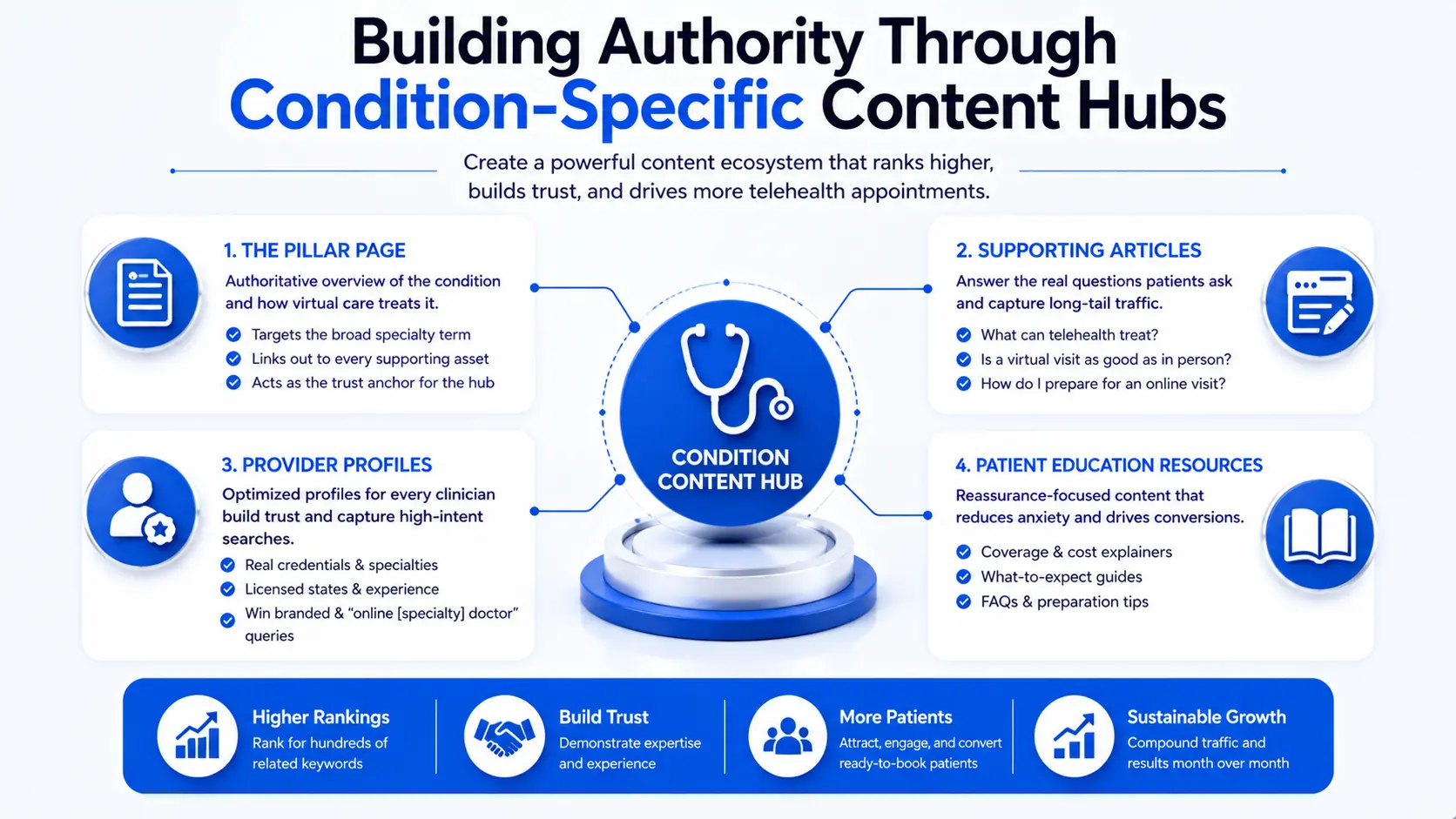
The single highest-leverage organic investment is the condition hub — a tightly structured cluster of content organized around each clinical specialty the platform serves. Done well, it signals depth and trust to both search engines and anxious patients. This architecture is what sustained telehealth patient acquisition looks like — not a single viral post, but an interlinked system that ranks for hundreds of related queries and compounds month over month. A high-performing hub is built from four parts.
The Pillar Page
Start with an authoritative overview of the condition and how virtual care treats it. This page targets the broad specialty term, links out to every supporting asset, and acts as the trust anchor for the entire cluster.
Supporting Articles
Surround the pillar with articles answering the practical questions patients actually type — "what can telehealth treat," "is a virtual visit as good as in person," "how do I prepare for an online appointment." Each one captures a long-tail query and routes the reader back toward the booking flow.
Provider Profiles
Give every clinician a profile optimized for specialty-specific searches. Real credentials, specialties, and licensed states put a trustworthy human in front of cautious patients and win the branded and "online [specialty] doctor" queries competitors leave on the table.
Patient Education Resources
Round out the hub with reassurance-focused content — coverage explainers, what-to-expect guides, and FAQs — that reduces pre-appointment anxiety and quietly pre-sells the visit before the patient ever clicks "book."
Where Paid Search Fits
Organic builds equity slowly; paid search captures demand instantly. The two are complements, not rivals. Telehealth PPC ads are the fastest way to test which messages convert, to own the highest-urgency queries while content authority is still maturing, and to defend branded terms from aggregators bidding on your name. Point paid budget at the searches where intent is unmistakable — "virtual doctor appointment today," "online urgent care now" — and reinvest the conversion data back into your organic roadmap.
Telehealth SEO Strategy Framework
Conclusion
The race for virtual care patients is being decided on the search results page, and it rewards two things above all: speed and specificity. A platform that tries to rank for everything ranks for nothing. A platform that defines its niche — by specialty, by licensed geography, or by patient population — and optimizes relentlessly for it will consistently outperform larger, slower generalists, even on a smaller budget.
The brands that will dominate virtual care over the next few years are building their search foundation now: intent-mapped keywords, state-level local optimization, technically sound and fast-loading pages, and authoritative condition hubs, all reinforced by disciplined paid search. Rankingeek Marketing Agency, a Best Healthcare Digital Marketing Agency, helps telehealth and virtual care organizations design and execute online healthcare marketing strategies that turn search intent into booked appointments.
Frequently Asked Questions
1. What makes telehealth SEO different from traditional healthcare SEO?
Traditional healthcare SEO is heavily anchored to local search optimization for physical locations. Telehealth SEO must simultaneously address local licensing and insurance intent, specialty-specific virtual care searches, and urgency-driven mobile queries. The lack of a fixed physical location also means that virtual care SEO relies more heavily on state-specific content and service-area pages than on Google Business Profile optimization alone.
2. Should telehealth platforms invest in local SEO even though they serve patients remotely?
Absolutely. Telemedicine local SEO is often the highest-ROI investment for virtual care platforms because the majority of patients search with implicit local intent. They want to confirm that a provider is licensed in their state and accepts their insurance. State-specific landing pages and service-area optimization directly address these concerns and significantly improve conversion rates.
3. What types of content drive the most telehealth patient acquisition?
Condition-specific content — articles and landing pages addressing what can be treated via telehealth, how virtual visits work for specific conditions, and what to expect from an online consultation — consistently drives the highest telehealth patient acquisition rates. Provider biography pages optimized for specialty searches and insurance-focused content addressing coverage questions are also high-converting formats in online healthcare marketing.
4. How should telehealth platforms use PPC alongside SEO?
Telehealth PPC ads are best deployed to capture high-urgency, high-intent searches that organic rankings cannot serve immediately, particularly during the initial months of an SEO campaign before organic authority is established. Paid search also provides valuable keyword performance data that should inform the organic content roadmap, ensuring that digital health SEO 2026 investments are directed toward the highest-converting search terms.
5. How long does it take for telehealth SEO to produce measurable results?
Initial technical and local SEO improvements typically yield measurable ranking movement within 60-90 days. Organic content strategies targeting competitive keywords require 4-6 months to achieve meaningful page-one visibility. The most durable virtual clinic Google ranking results come from a sustained, integrated approach combining technical optimization, authoritative content production, and link-building — with meaningful patient acquisition impact becoming clear within 6 months.