
.png)

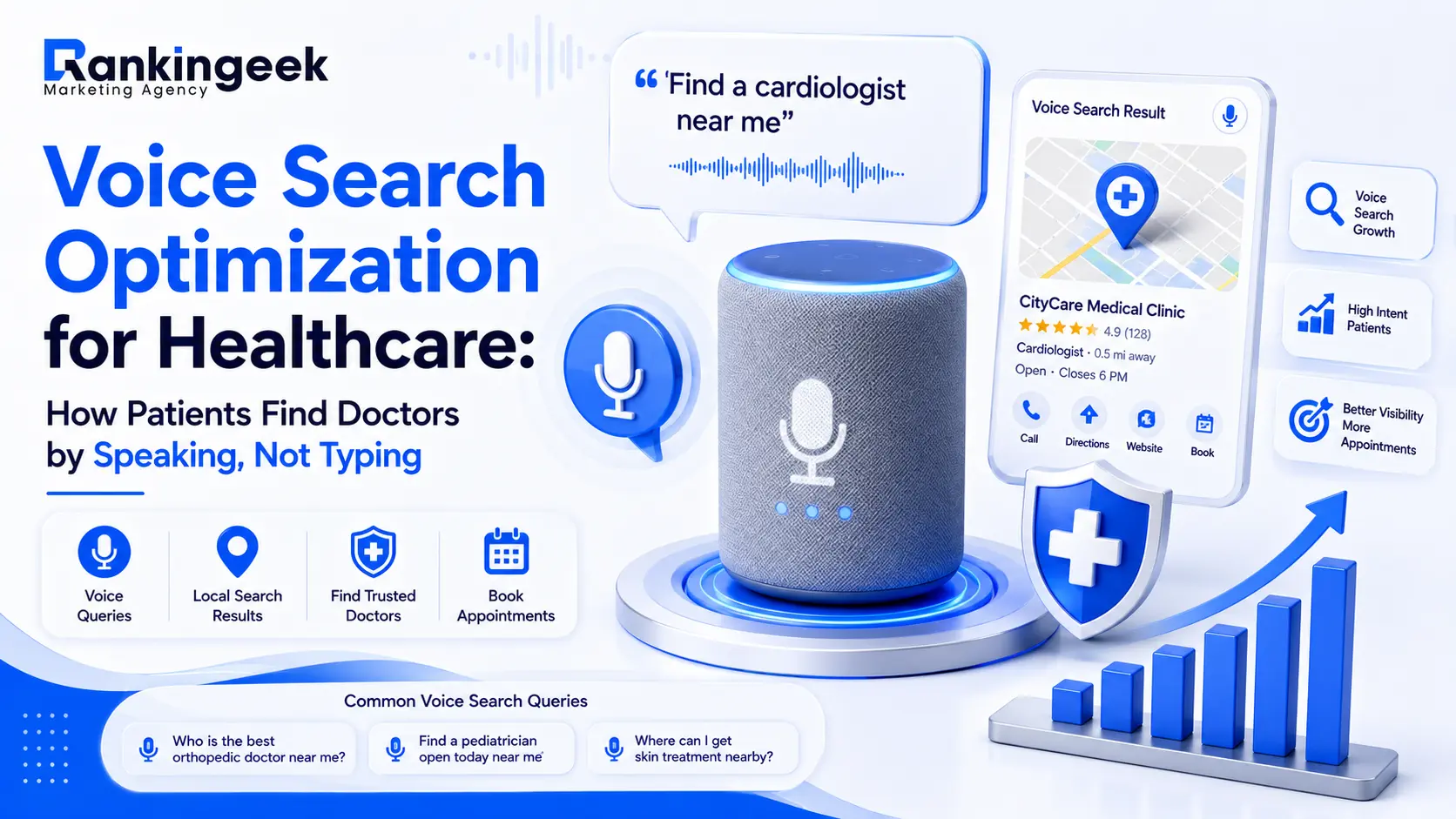

The way patients search for medical care has undergone a fundamental shift. Millions of people now ask their smartphones, smart speakers, and digital assistants health questions using their voice — spoken queries that are longer, more conversational, and fundamentally different in structure from what they would type into a search box. For healthcare providers and medical marketers, understanding and optimising for voice search healthcare SEO is no longer a futuristic consideration — it is a present-day competitive necessity that directly affects patient acquisition.
This guide explores how voice-activated search is reshaping patient discovery behaviour, what it means for your digital content strategy, and precisely what healthcare organisations must do to ensure their services surface when patients ask questions aloud.
The Rise of Voice-Activated Health Queries
Voice search adoption has grown dramatically across all age demographics, but it has become particularly significant in healthcare contexts. Patients with limited mobility, those managing chronic conditions, and individuals experiencing acute symptoms often find it easier and faster to speak a health question than to type it. Queries like "Hey Siri, find a doctor near me who accepts Medicare" or "OK Google, what are the symptoms of Type 2 diabetes?" reflect the conversational, intent-rich nature of voice-activated health searching.
Platforms including Siri healthcare search, Google Assistant doctor search, Amazon Alexa, and Microsoft Cortana each use distinct algorithms and data sources to generate spoken answers. Google Assistant often relies on featured snippets and information from the Knowledge Graph, whereas Siri combines insights from Apple Maps along with web-based search results. Understanding which platform your target patient demographic uses most frequently informs how you prioritise your optimisation efforts.
How Voice Queries Differ from Typed Medical Searches
The structural differences between typed and spoken queries have profound implications for content strategy. A patient typing into a search bar might enter "cardiologist Sydney", whereas the same patient speaking to their device would ask "Who is the best cardiologist near me that bulk bills?" The foundation of medical conversational search lies in asking clear, natural-language questions instead of using short keyword combinations.
Voice query healthcare searches are typically 5 to 10 words longer than their typed equivalents, more likely to begin with who, what, where, when, why, or how, and strongly oriented toward immediate local need. Healthcare websites optimised exclusively for short-form typed keywords are structurally misaligned with how voice search users actually phrase their health enquiries.
Optimising Healthcare Content for Voice Search
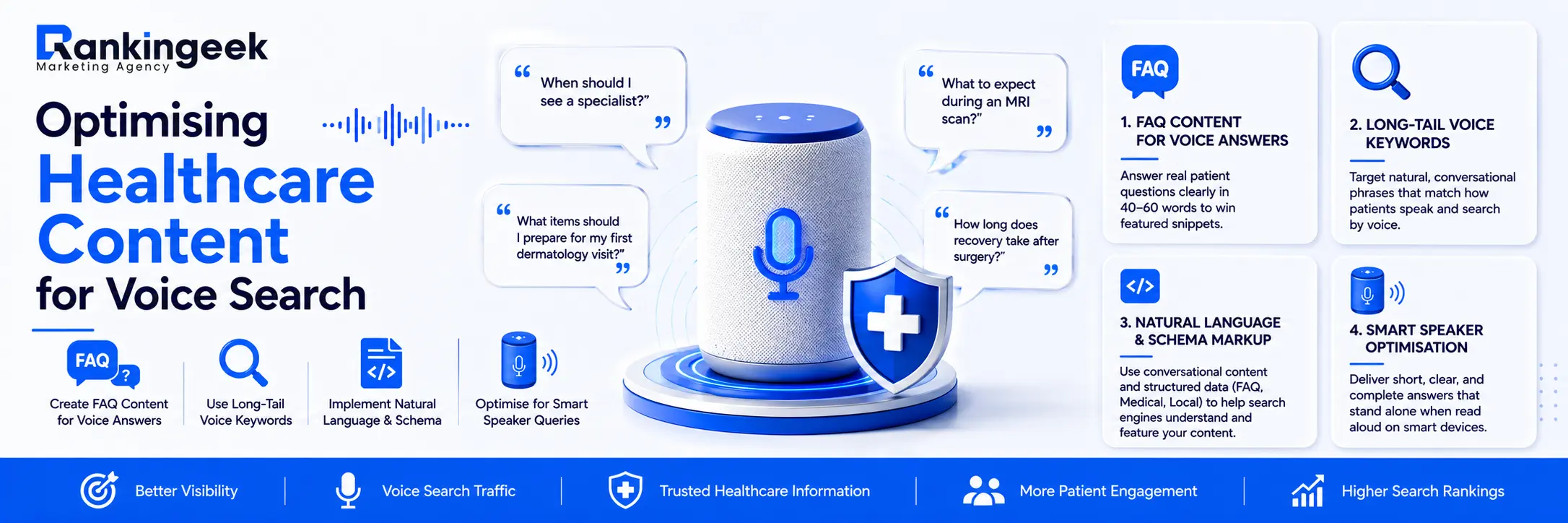
Creating FAQ Content Designed for Voice Answers
FAQ content voice search strategy is arguably the most direct path to voice search visibility in healthcare. Google's voice assistant typically reads aloud the featured snippet — the answer box appearing at the top of standard search results — in response to voice queries. Structuring your content to win these featured snippets dramatically increases the likelihood that your practice or health information will be spoken aloud to patients.
The most effective healthcare FAQ pages are those that ask the precise question a patient would speak aloud and immediately follow with a clear, concise answer of 40 to 60 words. This format mirrors how Google selects featured snippet content and aligns directly with how voice assistants deliver responses. For example, patients may ask questions like, “When should I consider seeing a specialist?” or “What items should I prepare for my first dermatology visit?” reflect genuine patient language and intent.
Long-Tail Voice Keywords in Healthcare Content
Long-tail voice keywords healthcare are the operational currency of voice search optimisation. Unlike short-form keywords, these multi-word phrases are specific, intent-rich, and closely mirror the natural language of spoken patient queries. Examples include phrases like "what to expect during an MRI scan for a claustrophobic patient", "how long does recovery take after laparoscopic cholecystectomy", and "are physiotherapy sessions covered by private health insurance".
Incorporating these long-form conversational phrases naturally throughout your clinical blog content, procedure description pages, and patient education resources creates multiple voice search entry points. Each targeted long-tail phrase represents a potential voice query your content could answer — and each answered query represents a potential new patient contact.
Natural Language SEO and Schema Markup
Natural language SEO medical content reads the way patients actually speak. Replacing overly clinical or keyword-stuffed prose with accessible, question-and-answer style content serves two purposes simultaneously: it improves patient comprehension and it aligns with the conversational patterns that voice search algorithms prioritise.
Implementing structured data — particularly FAQ schema, MedicalCondition schema, and local business schema — signals to search engines how your content should be interpreted and surfaces it for rich results and voice answers. Voice SEO clinic strategies that combine structured data markup with natural language content create a powerful compound effect that significantly improves voice search discoverability.
Optimising for Smart Speaker Health Queries
Smart speaker health queries present a distinct optimisation challenge because they are delivered without any visual interface — the voice assistant's response is the only output the user receives. This means the content you optimise for smart speaker discovery must be independently useful when read aloud, without supporting images, links, or visual formatting.
Brevity, clarity, and immediate utility are the hallmarks of effective smart speaker health content. Answers should be self-contained — a patient asking their smart speaker about post-surgical wound care should receive a complete, actionable answer without needing to navigate to a webpage. This content style is increasingly critical as smart speaker adoption grows across both consumer households and hospital patient room environments.
Voice Search Optimization: Healthcare Channel Comparison
Conclusion
Voice search is not a passing trend — it reflects a fundamental shift in how patients interact with information technology when they have health needs. Healthcare providers that optimise for voice search healthcare SEO today are building a strategic advantage that will compound as voice adoption continues to grow across every device category. By investing in FAQ content voice search strategies, targeting long-tail voice keywords healthcare, implementing structured data, and writing in genuinely conversational search medical language, your organisation positions itself precisely where patients are increasingly looking for answers.
For healthcare organisations looking to develop and execute a comprehensive voice and local SEO strategy, Rankingeek Marketing Agency is a best-in-class healthcare digital marketing agency with proven expertise in voice search optimisation, structured data implementation, and patient-centric content strategy.
Frequently Asked Questions (FAQs)
1. What is voice search healthcare SEO and why does it matter now?
Healthcare voice search SEO focuses on improving medical website content and online visibility so it can appear in results generated by voice-enabled platforms such as Google Assistant, Siri, and Alexa. Its importance continues to grow as more patients, especially older adults and individuals with mobility challenges, rely on voice commands to search for healthcare services.
2. How do voice search queries differ from standard healthcare keyword searches?
Voice queries are structurally different from typed searches. Voice query healthcare searches are typically 5–10 words longer, begin with question words (who, what, where, when, how), and express complete, natural language questions. Content optimised only for short typed keywords will often miss the voice search audience entirely.
3. Which type of content works best for attracting voice search traffic?
FAQ-style pages are highly effective for capturing healthcare-related voice searches. Search engines often pull short, clear responses from featured snippets to answer spoken questions. Organizing content in a simple question-and-answer structure can improve the chances of appearing in these prominent voice search results.
4. How does Google Assistant select which healthcare website to feature?
Google Assistant pulls its voice responses primarily from the featured snippet position in standard search results. Winning the featured snippet requires clear, structured content that directly answers the user's question, appropriate FAQ or HowTo schema markup, and sufficient overall page authority. Combining these elements gives healthcare content the best chance of being selected for Google Assistant doctor search responses.
5. Are smart speakers used for serious health queries?
Yes. Research shows that smart speaker health queries include a significant proportion of serious topics — symptoms, medications, post-procedure care, mental health resources, and emergency guidance. Healthcare providers and patient education platforms that optimise for smart speaker delivery ensure their information reaches patients in the moment of greatest need.
6. How quickly can voice search optimisation produce visible results?
Results from voice SEO clinic strategies typically emerge within 8 to 16 weeks of implementation, though this varies considerably based on existing site authority and competition. Featured snippet rankings can shift within weeks of publishing well-optimised FAQ content. Local voice search visibility tied to Google Business Profile improvements can be even faster.