
.png)



Healthcare providers face an urgent imperative: they must acquire patients efficiently while building enduring online trust. A combined Answer Engine Optimization (AEO) and Paid Ads strategy offers a robust Healthcare Marketing Strategy, capturing immediate patient inquiries and securing long-term visibility within AI-powered search. This approach is crucial for a definitive Patient Acquisition Strategy.
Many healthcare businesses today find prospective patients actively searching for solutions. Yet, providers often struggle to appear consistently when and where it matters most. Relying solely on a single digital marketing channel is increasingly ineffective. It risks missed opportunities, inconsistent patient flow, and a failure to build the long-term digital authority necessary for sustained growth in a competitive environment. Rapid technological shifts and evolving patient behaviors demand a multi-pronged approach.
Patient Acquisition and Search Evolve
The quest for effective Patient Acquisition Strategy in healthcare has dramatically reshaped through technological advancements and shifting consumer expectations. Patients no longer simply type keywords into a search bar; their Healthcare Search Trends reveal a deeper, more conversational, and trust-driven journey. Many now begin with symptom-based searches, seeking answers to complex medical questions. This often leads to Zero-Click Searches, where information appears directly in search results without requiring a website visit (Search Engine Journal). The rise of AI Overviews and Search Generative Experience means search engines increasingly provide synthesized answers. This emphasizes the critical need for content directly addressing patient queries comprehensively and authoritatively (Search Engine Land).
Healthcare businesses cannot depend solely on paid ads or only on SEO. Paid ads deliver immediate patient inquiries. However, traditional SEO alone struggles to fully capture the nuances of generative AI search. This necessitates a strategic blend, leveraging the strengths of both. Patients seek information, reassurance, and validation before making critical healthcare decisions, driving trust-focused decision-making. For instance, a patient experiencing persistent headaches might search for "symptoms of migraine vs tension headache" before looking for "neurologist near me." Their journey involves multiple touchpoints: understanding their condition and evaluating potential providers based on expertise and credibility. Ignoring these changing behaviors means missing significant Healthcare Lead Generation opportunities. Providers must adapt their Healthcare Digital Marketing to meet patients at every stage of this complex journey. Moving beyond simple keyword matching, they genuinely answer patient needs. This involves optimizing for traditional search queries and structuring content for easy understanding and presentation by Answer Engine Optimization (AEO) platforms, ensuring valuable information reaches the patient directly in a digestible format.
Delivering Immediate Results with Paid Ads for Healthcare
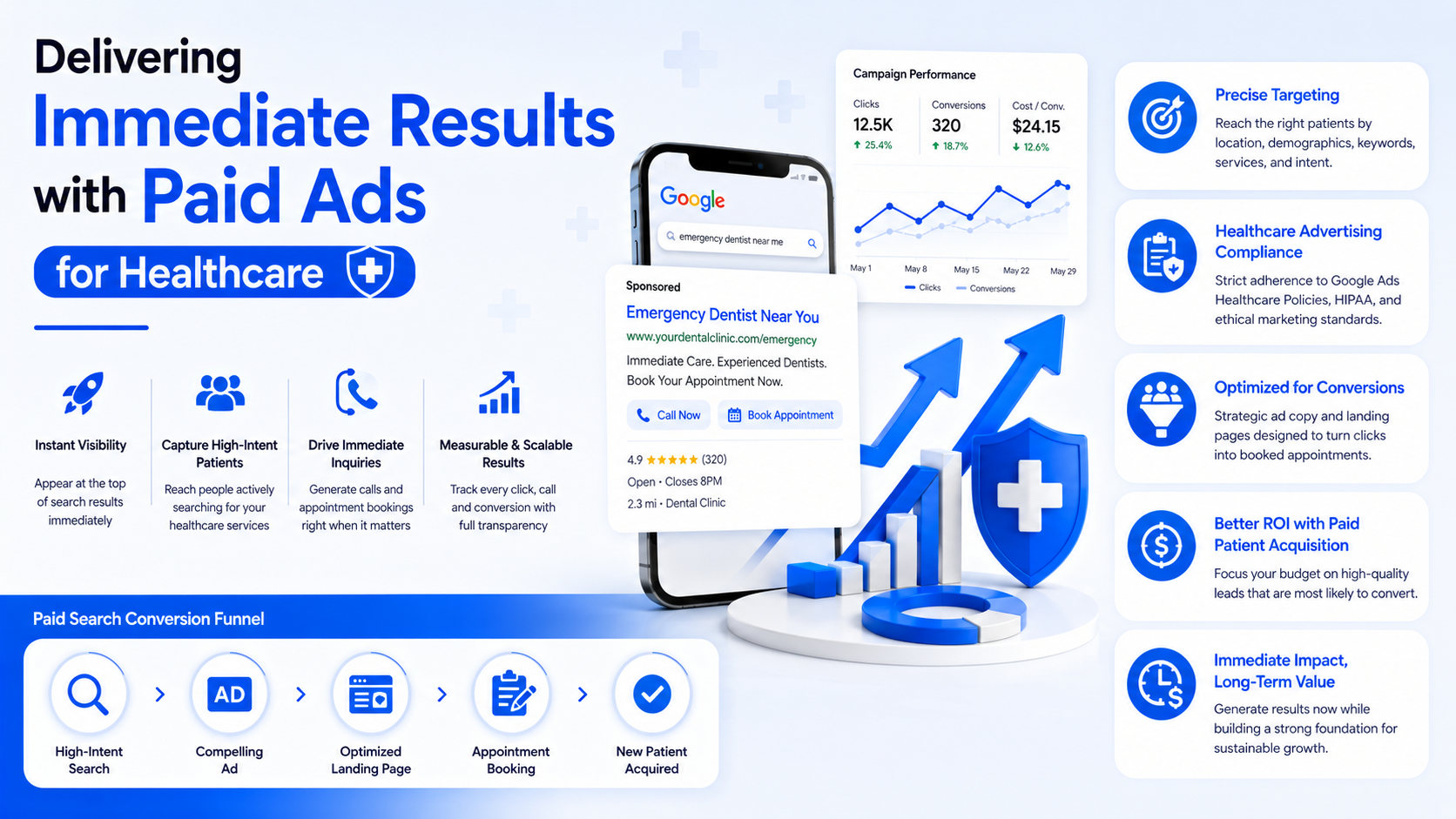
For healthcare providers needing immediate patient inquiries and swift visibility, Paid Ads for Healthcare are an indispensable tool, forming the "first punch" in our strategic approach. Platforms like Google Ads for Healthcare allow clinics and hospitals to appear at the top of search results almost instantly, directly capturing demand from patients actively seeking services. This direct response capability is crucial for addressing acute needs or promoting new services where time-to-market is critical. For example, a dental clinic launching a new emergency dental service can use targeted Google Ads for Healthcare to reach individuals searching for "emergency dentist near me" or "urgent dental care" within their service radius. These ads provide a direct pathway to conversion, leading to immediate phone calls or appointment bookings.
The effectiveness of paid campaigns hinges on a well-defined Paid Search Conversion Funnel. This involves crafting compelling ad copy, targeting specific demographics and geographic areas, and directing users to optimized landing pages designed for seamless appointment scheduling or information requests. Through precise targeting, healthcare businesses reach specific patient segments, such as those searching for a particular specialist, a specific medical procedure, or even individuals in certain life stages or with specific health conditions. This ensures marketing spend focuses on the most promising leads, significantly improving Paid Patient Acquisition. For instance, a fertility clinic targets ads specifically to couples searching for "IVF treatment options" or "fertility clinic reviews" in their area.
Success in Healthcare Advertising Compliance is paramount. Google Ads Healthcare Policies are stringent, particularly regarding sensitive health information and misleading claims. Ads must be factual, non-deceptive, and respect patient privacy. This often requires careful crafting of ad copy and landing page content to avoid policy violations that could lead to ad disapproval or account suspension. All advertising must adhere to Healthcare Marketing Regulations such as HIPAA, ensuring patient data protection and ethical communication. Ignoring these regulations risks not only legal repercussions but also erodes patient trust. While paid ads offer speed and precision for Healthcare Lead Generation, their impact is finite. Visibility ceases the moment the budget runs out, highlighting the need for a complementary long-term strategy. The immediate nature of paid ads serves as a vital bridge, bringing in revenue and patients while the longer-term visibility from AEO matures.
Building Long-Term Trust and Visibility with AEO for Healthcare

While paid ads deliver immediate results, AEO for Healthcare is the essential "second punch." It builds enduring visibility, authority, and trust, underpinning a robust Healthcare Digital Marketing strategy. AEO moves beyond traditional SEO, optimizing content not just for keywords, but for direct answers to complex patient questions within the Search Generative Experience, AI Overviews, and other answer engine formats. This is particularly vital for Healthcare SEO Services, where comprehensive, authoritative answers hold high value for both patients and search engines. A patient searching for "causes of chronic back pain" expects a detailed, trustworthy explanation, not just a list of keywords.
Central to effective AEO for Healthcare is demonstrating E-E-A-T: Experience, Expertise, Authoritativeness, and Trustworthiness. For a healthcare provider, this means showcasing the credentials of their medical staff, publishing evidence-based content, and ensuring the accuracy and safety of all medical information. For example, a cardiology practice should not only have articles on heart health but also prominently feature the qualifications and experience of their cardiologists, linking to peer-reviewed publications or professional society memberships. This builds a powerful foundation of credibility. Such credibility is crucial for SEO for Healthcare Industry and for patients making critical health decisions. Content developed for AEO purposes anticipates patient questions, providing clear, concise, and trustworthy answers easily extracted by AI-powered search engines.
To enhance visibility in AI Overviews, implementing Structured Data for Healthcare is non-negotiable. Schema markup, for instance, allows search engines to understand the context and relationships of content, such as doctor profiles, service listings, conditions treated, and appointment booking information. When a patient searches for "best pediatricians in [city]," properly marked-up provider profiles can directly surface in rich snippets or answer boxes, providing direct, actionable information. This kind of optimization supports Semantic Search Optimization, where search engines understand the intent and context behind a query, rather than just matching keywords. By providing rich, contextually relevant, and well-structured information, healthcare organizations ensure their expertise is front and center when patients need answers, fostering long-term patient acquisition and brand loyalty without the continuous cost of paid advertising. This enduring presence establishes the provider as a trusted resource, attracting patients organically and enhancing the overall Healthcare Marketing Strategy.
The Synergistic "One-Two Punch": Integrating AEO and Paid Ads for a Dominant Healthcare Marketing Strategy
The true power for dominating both immediate needs and long-term search trends lies in the intelligent integration of AEO for Healthcare and Paid Ads for Healthcare. This "One-Two Punch" strategy ensures continuous patient engagement, capitalizing on immediate demand while simultaneously building an authoritative digital presence. Expert insights confirm this integrated approach outperforms single-channel strategies by creating a self-reinforcing cycle of visibility and trust. For instance, a hospital might use Google Ads for Healthcare to promote its new minimally invasive surgery center, driving immediate patient inquiries. At the same time, its AEO strategy would publish in-depth educational content, patient testimonials, and expert Q&As about the procedure, answering common questions and building trust over time.
Healthcare providers can significantly align educational content with paid campaigns to improve conversions and credibility. Imagine a scenario where a patient clicks on a paid ad for "urgent care near me." Instead of just a booking form, the landing page also features an AEO-optimized article answering "When should I go to urgent care vs. the ER?" or "What conditions does urgent care treat?" This immediately builds credibility by providing valuable information, reassuring the patient, and increasing the likelihood of conversion. The paid ad captures the immediate need, while the integrated AEO content nurtures trust and provides comprehensive answers, making the patient feel more informed and confident in their choice. This approach not only boosts conversion rates but also lowers ad costs over time, as higher engagement and lower bounce rates signal relevance to Google, potentially improving Quality Score.
Furthermore, insights gleaned from paid campaigns can directly inform and refine the AEO strategy. High-performing keywords in Google Ads for Healthcare campaigns, particularly those with strong conversion rates, indicate topics where patients have immediate, high-intent needs. This data can prioritize AEO content creation, ensuring the development of deep, authoritative articles, FAQs, and explainer videos around these proven topics. Conversely, strong AEO content that ranks well and garners significant organic traffic can be repurposed or highlighted in paid ad copy, lending additional authority and relevance to campaigns. This dynamic feedback loop is essential for a truly effective Healthcare Marketing Strategy. For a comprehensive Hospital Marketing Strategy, this means using paid ads to fill immediate appointment slots for specialized services while using AEO to establish the hospital's overall reputation for excellence and patient-centered care, driving long-term organic growth and referrals. The "One-Two Punch" creates a resilient and highly effective approach to digital patient acquisition, ensuring a continuous flow of patients both now and into the future.
Strategic Implementation and Compliance in Healthcare Digital Marketing
Implementing the AEO + Paid Ads "One-Two Punch" requires a methodical and compliant approach to Healthcare Digital Marketing. The focus must consistently remain on ethical and compliance-friendly healthcare marketing. This means every piece of content, every ad, and every landing page must adhere to rigorous standards set by regulations like HIPAA in the US, along with platform-specific rules like Google Ads Healthcare Policies. Misleading claims, unsubstantiated medical advice, or inadequate patient privacy safeguards can severely damage a practice's reputation and lead to significant legal and financial penalties. For example, any patient testimonials used in marketing must have explicit, written consent and adhere to privacy guidelines.
A crucial first step in implementation involves thorough Patient Journey Mapping. Understanding the complete patient journey, from initial symptom awareness to post-treatment follow-up, allows providers to strategically place both paid ads and AEO content at relevant touchpoints. For instance, a prospective patient might start their journey with a general symptom search (AEO target), then look for specialists (AEO and Paid Ads target), compare providers based on reviews and expertise (AEO), and finally, search for "appointment booking [clinic name]" (Paid Ads target). Mapping these stages helps tailor messages and content to meet specific needs at precise moments, optimizing the Paid Patient Acquisition funnel and enhancing long-term engagement.
Here are practical pro-tips for integrating AEO and Paid Ads effectively:
- Audit Existing Content: Identify gaps in AEO coverage by reviewing high-performing Google Ads for Healthcare* keywords and common patient questions. Prioritize creating in-depth, E-E-A-T compliant content to answer these comprehensively.
- Leverage Ad Performance Data: Use conversion data from paid campaigns to refine AEO content strategy, focusing on topics that consistently lead to patient inquiries. Conversely, use top-ranking AEO content to craft more compelling and authoritative ad copy.
- Optimize Landing Pages for AEO: Ensure landing pages for paid ads are not just transactional but also feature Semantic Search Optimization elements, providing valuable information and demonstrating E-E-A-T* to build trust and improve quality scores.
- Implement Structured Data: Use Structured Data for Healthcare schema markup for doctor profiles, services, locations, and conditions treated across your website. This improves visibility in AI Overviews* and rich snippets, supporting both organic and paid efforts.
- Prioritize Compliance and Ethics: Regularly review all marketing materials against Healthcare Advertising Compliance guidelines and Healthcare Marketing Regulations. Ensure patient privacy is paramount and all claims are substantiated and accurate. Trust remains the cornerstone of Healthcare Lead Generation and Hospital Marketing Strategy*.
By meticulously planning and executing this integrated strategy, healthcare businesses create a robust digital presence that not only captures immediate patient volume but also cultivates lasting trust and authority, positioning them as leaders in their respective fields.
Also Read: Google Ads for Healthcare: How Clinics and Hospitals Can Run Profitable Campaigns
Key Takeaways
The "One-Two Punch" strategy combines Paid Ads for Healthcare with AEO for Healthcare to achieve comprehensive patient acquisition. Paid ads deliver immediate patient inquiries and Healthcare Lead Generation. AEO builds long-term trust and visibility in Search Generative Experience and AI Overviews by focusing on E-E-A-T and Structured Data for Healthcare. This synergistic approach ensures continuous patient flow and a dominant Healthcare Marketing Strategy that respects compliance and ethics.
Comparison Table: AEO vs. Paid Ads in Healthcare Digital Marketing
FAQ
Q1: How does AEO differ from traditional SEO for healthcare, especially with AI Overviews?
AEO for healthcare focuses on optimizing content to directly answer patient questions within Search Generative Experience and AI Overviews, not just ranking for keywords. Traditional SEO aims for website visibility in standard search results. AEO ensures content is structured for AI to extract and present direct, comprehensive answers, aligning with Semantic Search Optimization and E-E-A-T.
Q2: What are the key compliance considerations for paid ads in healthcare?
Healthcare Advertising Compliance is critical. Advertisements must adhere to Google Ads Healthcare Policies and Healthcare Marketing Regulations like HIPAA. This means avoiding misleading claims, protecting patient privacy, obtaining proper consent for testimonials, and ensuring all medical information is accurate and substantiated. Transparency and ethical communication are paramount for Paid Patient Acquisition.
Q3: Can a small clinic effectively use the AEO + Paid Ads strategy, or is it only for large hospitals?
Yes, a small clinic can absolutely benefit from this strategy. While large hospitals may have larger budgets, the principles remain the same. A small clinic can start with highly targeted Google Ads for Healthcare for immediate needs. Simultaneously, it can create focused AEO content around its specialties to build local trust and authority. This approach emphasizes strategic allocation, not just budget size, for an effective Healthcare Marketing Strategy.
Q4: How do AI Overviews impact patient acquisition for healthcare providers?
AI Overviews directly present synthesized answers at the top of search results, potentially reducing clicks to websites. For patient acquisition, this means providers must optimize their content for Answer Engine Optimization (AEO). This ensures their authoritative, E-E-A-T-driven information is what AI summarizes. Appearing in AI Overviews establishes immediate credibility and direct answers, crucial for Healthcare Lead Generation in a zero-click environment.
Q5: Why is E-E-A-T crucial for healthcare digital marketing?
E-E-A-T (Experience, Expertise, Authoritativeness, and Trustworthiness) is vital in Healthcare Digital Marketing because patients' health and well-being are at stake. Search engines prioritize content from demonstrably credible sources. Showcasing qualified professionals, evidence-based information, and transparent practices builds patient trust, improves Healthcare SEO Services, and significantly influences patient decision-making and loyalty, directly supporting Patient Acquisition Strategy.