
.png)

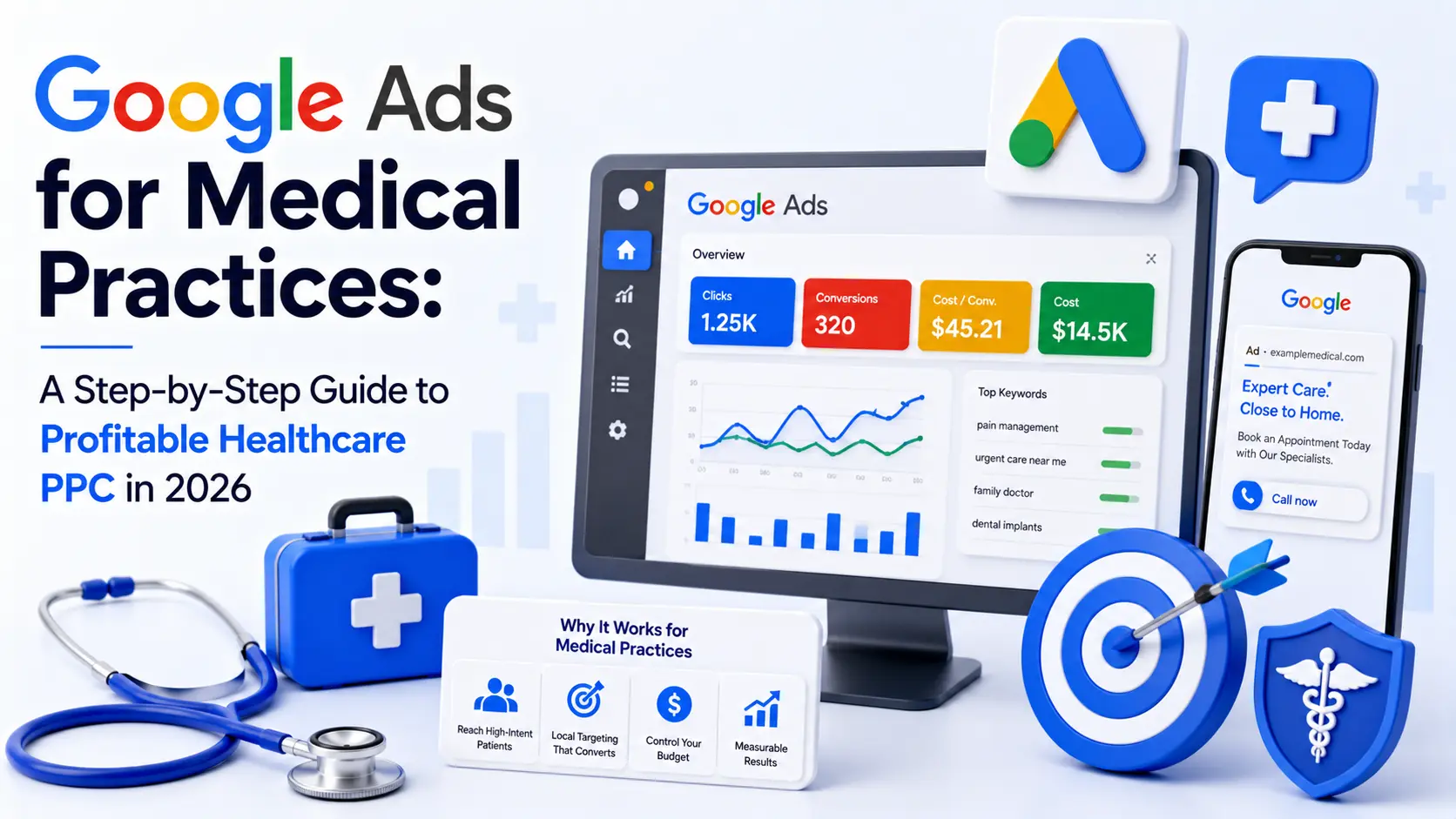

It is 11 PM and someone three miles from your practice is typing "urgent care open now" into their phone. The results load, they tap one of the first two listings, and by morning that appointment belongs to whoever showed up in that half-second. Paid search is the only channel that lets you be there for it. Organic will get you there eventually. Ads get you there tonight.
Paid search remains one of the most immediate and controllable patient acquisition channels available to healthcare practices. For practices that need measurable results without waiting months for organic SEO to mature, Google Ads medical practice campaigns deliver precisely targeted visibility at the exact moment a prospective patient is searching for the services you provide.
However, healthcare PPC campaigns operate within a uniquely complex environment. Google imposes specific ad policies for healthcare advertisers, patient acquisition economics differ fundamentally from e-commerce, and the regulatory landscape around clinical claims in advertising demands careful compliance management. This guide provides a step-by-step framework for building healthcare paid search strategy that is not only profitable but fully aligned with patient care ethics and advertising standards.
None of that makes paid search a set-it-and-forget-it channel. Most of the money wasted in healthcare PPC does not disappear through a bad keyword or a low bid — it disappears through the gap between a click and a booked patient, and most practices never measure that gap directly.
Our breakdown of why Google Ads burn budget without producing bookings covers the most common ways that gap opens up, and how to close it before you spend another dollar.
How Google Ads Actually Works for Clinics and Hospitals
Healthcare paid search — medical PPC, healthcare pay-per-click, whatever your agency calls it — runs on an auction that fires the instant someone searches. You pay only when a person clicks. Three things decide whether your ad appears and where it sits:
- Your maximum bid — the ceiling you will pay for one visitor
- Quality Score — Google’s read on how relevant your ad and landing page are to the query
- Ad extensions — the phone numbers, locations and service links that expand your listing
Bid alone does not win the auction. A practice bidding less with a tightly relevant landing page routinely outranks a competitor paying more to send traffic to a generic homepage. That is why the structural work in Steps 3 and 6 pays for itself before you ever raise a budget.
For a hospital or multi-specialty group, this mechanism is what makes department-level advertising possible. Cardiology, orthopedics, pediatrics and behavioral health can each run against their own queries with their own budgets, instead of competing for room inside one blunt campaign.
The Patient Journey Starts With a Search
Most patients search before they choose a provider — industry research commonly puts the figure above 70%. Much of that searching happens under pressure: mid-symptom, immediately after a diagnosis, or when someone wants a second opinion before committing to a procedure. Paid search intercepts that moment with a precision no billboard or broadcast spot can match.
Why Healthcare Providers Are Moving Budget Into Paid Search
1. Visibility on day one
SEO compounds over months. A campaign launched this morning can appear for "knee replacement surgeon in [city]" this afternoon, before your organic rankings have moved at all.
2. Targeting you can actually control
You can narrow delivery by city, zip code or radius; by device; by hour and day of week; by age and household income; and by keywords tied to a specific condition or specialty. Very little else in a healthcare marketing budget offers that level of control.
3. Numbers you can defend in a budget meeting
Daily and monthly caps are hard limits, not estimates. With conversion tracking configured properly you can state your cost per booked appointment to the dollar — which is usually the number that gets a marketing budget approved or cut.
4. Ground you lose by not showing up
In most metro markets the top ad positions absorb the bulk of clicks on commercial healthcare queries. If competitors are bidding on your core services and you are not, that share transfers to them every day the campaign stays off.
Local Service Ads: Pay-Per-Lead Visibility With a Trust Badge Built In
Standard Search campaigns are not the only paid option worth running. Google's Local Service Ads (LSAs) sit above regular search results for eligible healthcare categories and operate on a pay-per-lead model rather than pay-per-click — you pay when a qualified patient actually contacts you, not for every click that goes nowhere.
As of late 2025, Google consolidated the old “Google Guaranteed” and “Google Screened” badges into a single “Google Verified” checkmark, and starting in August 2026, LSAs are migrating directly into the Google Ads platform as a new Performance Max campaign type. That badge is doing real work: patients read it as third-party proof that your license, insurance and background checks are current, which lowers the trust barrier before they have even opened your website.
LSAs give up granular control over targeting, bidding and ad copy in exchange for that trust signal and pay-per-lead pricing, which is why most practices run standard Search alongside them rather than choosing one over the other — LSAs for broad local capture, Search for the specific, high-margin service lines where message precision earns its keep. Because LSA eligibility and ranking lean heavily on your Google Business Profile, this is also where Local Search Domination work and paid search stop being separate line items and start reinforcing each other.
Also Read: Google Business Profile for Doctors: Complete Optimization Guide 2026
Step 1: Understanding Google Healthcare Advertising Policies
Before investing a single dollar in doctor Google Ads 2026 campaigns, every healthcare practice must understand Google's specialized policies for medical advertisers. Google requires that certain healthcare ad categories — including addiction treatment services, pharmaceutical products, and clinical trial recruitment — obtain explicit certification before running ads. Practices that bypass these requirements risk account suspension with no recourse.
For the majority of general medical practices, the most critical compliance requirements involve accurate representation of services, avoidance of misleading health claims, and adherence to local regulations governing healthcare advertising. Ad copy must reflect only services actually offered by the practice, and landing pages must contain accurate, non-misleading descriptions of treatments and expected outcomes.
What Google Restricts Outright
- Prescription drug promotion — certification required, and only in approved countries
- Clinical trial recruitment — permitted with verification, but with limits on how you can target
- Personalized advertising — restricted for sensitive categories including mental health, fertility and addiction treatment
- Before-and-after imagery — disallowed in most health-related ad formats
- Outcome guarantees — any ad claiming assured results will be disapproved
The Compliance Problem That Is Not in the Policy Manual
Google Ads does not collect Protected Health Information, but the way your conversion tracking talks to your website and CRM absolutely can. A standard client-side pixel firing on a condition-specific landing page can transmit protected data to a third party without authorization, and the penalty exposure sits with your practice, not with whoever manages the account. That is a technical build rather than a campaign decision, so it is covered separately in our guide to HIPAA-compliant healthcare PPC — worth reading before you launch rather than after.
AI Max for Search: A New Compliance Variable in 2026
Google's AI Max layer adds a second compliance question on top of tracking. Once enabled on a Search campaign, AI Max can expand your keywords into related queries it judges relevant — including, for a healthcare account, symptom-related searches you never targeted — and it can rewrite your headlines and descriptions in real time based on what it learns from the page it sends the click to.
For most industries that is simply reach. For healthcare, an AI-written headline that drifts into an outcome claim or an unapproved condition match is exactly the kind of thing Google's own policy team disapproves ads for. Before enabling AI Max on a healthcare account, lock in text guidelines that block claim language such as cure, treat, guarantee and prevent, exclude specific drug and symptom terms, and disable automatic final URL expansion until every landing page it could route to has been compliance-reviewed.
Also Read: Why 80% of Clinic Ads Fail (And How Smart Targeting Fixes It)
Step 2: Define Your Goals and KPIs Before You Build
Campaigns fail at this step more often than any other, usually because nobody wrote the goal down. Common objectives for healthcare providers:
- More new-patient appointments
- Launching a specific specialty or new service line
- Filling capacity at a newly opened location
- Building demand for elective work — LASIK, implants, cosmetic procedures
Then match the measurement to the objective. Chasing appointments means tracking form completions and inbound calls. Building awareness for a new service line means impression share and click-through rate. Mixing the two produces a monthly report where nothing looks conclusive and no decision gets made.
Step 3: Campaign Architecture for Medical Practice PPC
Effective clinic PPC management begins with a logical, granular campaign structure. Organizing campaigns by clinical service line — rather than lumping all services into a single campaign — allows for precise budget allocation, service-specific ad copy, and clean performance data that actually informs optimization decisions.
Service-Based Campaign Structure
A well-structured medical ad agency account for a multi-specialty practice might include separate campaigns for primary care, orthopedics, cardiology, and preventive health screenings. Each campaign contains tightly themed ad groups built around specific procedure or condition keywords. This structure ensures that search queries about knee replacement surgery do not trigger ads for cardiac stress tests — a common error that inflates cost-per-click and reduces conversion rates.
Building the Keyword List
Three keyword types carry most of the value in healthcare search, and they behave differently enough that they deserve separate ad groups:
Negatives matter as much as targets. Start with jobs, salary, careers, free, home remedy, DIY and symptoms, then keep adding from the search terms report every week. Informational query volume in healthcare is enormous, and every one of those clicks bills at specialty rates while producing nothing.
Match Type Strategy for Healthcare Keywords
In healthcare search ads, match type strategy directly impacts both reach and cost efficiency. Broad match targeting for high-volume healthcare terms often captures irrelevant traffic from informational queries with no patient acquisition intent. A disciplined approach for most medical practices combines exact match targeting for high-intent conversion terms, phrase match for specialty and condition combinations, and a robust negative keyword list that excludes informational queries, competitor brand terms, and irrelevant medical terminology.
Step 4: Setting and Managing Medical Google Ads Cost
Healthcare is among the most expensive paid search verticals. Medical Google Ads cost for competitive specialties — orthopedic surgery, fertility treatment, bariatric surgery — frequently exceeds $30-75 per click in major metropolitan markets. For practices to achieve a positive healthcare ad ROI, cost-per-acquisition must be evaluated against the lifetime value of a patient, not just the value of a single appointment.
Patients who first connect through paid search for orthopedic care often require ongoing treatments, therapy sessions, or future procedures. By evaluating the full lifetime value of a patient, healthcare organizations may find that PPC campaigns with high click costs can still generate substantial profitability over time.
Bid Strategy Selection for Healthcare Campaigns
New Google Ads medical practice campaigns should begin with manual CPC bidding to establish baseline performance data before transitioning to smart bidding strategies. Target CPA and Target ROAS bidding require a minimum of 30-50 conversion events per month to function reliably. Practices with lower appointment volumes often achieve better results with enhanced CPC, which preserves manual control while applying machine learning adjustments at the auction level.
Weigh this against the Local Service Ads model covered above. LSA leads commonly run in the roughly $50 to $150 per lead range across healthcare categories — a very different economic shape from a $30-75 orthopedic click that may or may not turn into a lead at all. Neither model is universally cheaper; the right split depends on how much of your budget you want tied to guaranteed contact versus qualified traffic you still have to convert yourself. Our guide to tracking every marketing dollar back to a patient walks through how to build that comparison properly.
Step 5: Creating High-Converting Healthcare Ad Copy
Healthcare ad copy must balance two competing requirements: it must be compelling enough to earn clicks from patients with urgent needs, and it must comply with Google's prohibitions against misleading health claims. The most effective medical practice advertising copy focuses on specific, verifiable differentiators — same-day appointments, board-certified specialists, in-network insurance acceptance, multilingual staff — rather than vague claims about quality or expertise.
For specialties with strong geographic competition, such as Google Ads for dentists in urban markets, ad extensions are essential for standing out in a crowded SERP. Location extensions displaying proximity, call extensions enabling one-tap calling from mobile, and structured snippet extensions highlighting specific services all contribute meaningfully to click-through rate and healthcare ad ROI.
What Strong Healthcare Ad Copy Looks Like
Knee Pain Keeping You Down? | Board-Certified Orthopedic Specialists | Same-Week Appointments | Call [City Orthopedic Center]
It works because it leads with the patient’s problem rather than the practice’s credentials, then answers the two questions every prospective patient has — are you qualified, and how soon can I be seen. The credential comes second, where it reassures rather than boasts. No superlatives, nothing to substantiate, nothing for Google to disapprove.
Step 6: Design Landing Pages That Convert
Sending ad traffic to your homepage is the most expensive habit in healthcare PPC, and one of the most common. Every ad should land on a page built for the query that triggered it.
- Answer the search directly — the headline should echo what the person typed
- Put a phone number and booking form above the fold
- Load in under three seconds on a phone, where most of this traffic arrives
- Show trust signals: patient reviews, board certifications, accreditation marks
- Strip out navigation that gives the visitor somewhere else to go
A page that answers the query directly will convert several times better than a homepage at identical click cost. For multi-location practices this is also where location-specific pages earn their keep — a page for "cardiologist in [neighborhood]" consistently outperforms a generic city-level page.
Speed is not a nice-to-have on this list — it is a gate. Conversion rates fall sharply once mobile load time crosses the three-second mark, and a slow landing page also drags down the Quality Score that determines what you pay per click in the first place. Compress images, cut third-party scripts you do not need, and test the actual page on a mid-range phone over mobile data, not just on office wifi.
Trust signals do the rest of the work once the page loads. A visible star rating, a handful of specific patient outcomes, and recognizable insurance or accreditation logos above the fold answer the unspoken question every new visitor has — can I trust this practice with something as personal as my health — before they ever reach the booking form.
Also Read: The Anatomy of a High-Conversion Landing Page
Step 7: Configure Conversion Tracking
Without tracking you are optimizing on clicks, and clicks are not patients. At minimum, track appointment form submissions, calls generated from both the ad and the landing page, and chat or virtual consultation bookings. Google’s native call tracking and a GA4 integration cover most of what a practice needs without expensive third-party tooling.
One caveat before you configure any of it: if the page names a condition, revisit the compliance note in Step 1 first. Tracking is precisely where privacy exposure is created.
Step 8: Remarketing Without Violating Patient Privacy
A visitor who reads your knee replacement page and leaves without booking is exactly the person remarketing is built for — except in healthcare, the standard retail playbook of following that person around the internet with an ad about knee replacement can turn a browsing session into a HIPAA problem. Once a personal identifier is paired with a specific health condition, that pairing is protected health information, whether or not the practice running the ad thinks of it that way.
The safer version of healthcare remarketing works off behavior rather than condition. Segment the site into zones by sensitivity — general informational pages in one bucket, condition-specific and treatment pages in another — and build remarketing audiences only from the general zone, or from actions like “started the booking form” rather than “visited the fertility page.” Contextual and cohort-based targeting, which place ads against page content or group-level signals instead of an individual's browsing history, are worth testing anywhere the tracking picture is less than perfectly clean.
This is the same category of risk covered in Step 1 — the exposure sits with the practice, not the platform. Our guide to HIPAA-compliant healthcare PPC walks through the technical build in more detail, including how to keep condition-level detail out of the data that ever reaches an ad platform.
Specialty and Setting Playbooks
For Hospitals and Multi-Specialty Systems
For health systems and hospital networks, healthcare advertising agency strategy involves additional complexity: coordinating campaigns across multiple service lines and locations, maintaining brand consistency while allowing service-line customization, and managing the interaction between enterprise-level health system brand campaigns and individual physician or specialty practice campaigns.
The practical rule is separation. A cardiology campaign bidding on "heart failure treatment" should never share a budget with one bidding on cosmetic dermatology. The two have nothing in common in cost, conversion rate or urgency, and pooling them means the cheaper clicks quietly consume the budget the expensive service line needed.
For Independent Clinics and Private Practices
Work locally and specifically. Radius targeting of roughly 10 to 20 miles suits most markets, tighter in dense urban areas. Lead with the differentiators that decide a local choice: extended hours, telehealth availability, multilingual staff, same-day appointments, in-network insurance.
For Urgent Care and Walk-In Clinics
Bid by the clock. Demand concentrates in evenings and weekends, and the searcher is usually on a phone and ready to act within the hour. Raise bids during those windows and put call extensions front and center — this audience calls, it does not fill in forms.
For Elective and Aesthetic Procedures
Longer consideration cycles mean educational copy outperforms hard urgency for LASIK, dental implants and cosmetic work. Performance Max is worth testing here to extend reach across Search, Display, YouTube and Gmail — but only once you have enough conversion data to feed it.
For Telehealth and Virtual Care Providers
Telehealth removes the radius constraint that shapes every other playbook here, which changes the targeting math completely. Instead of a 10 to 20 mile radius, campaigns should target by state licensure boundary, since a virtual visit is only bookable where the provider is legally credentialed to practice.
Ad copy should lead with the convenience angle a local clinic cannot match — same-day virtual appointments, no-commute care, evening and weekend availability — while landing pages need to answer the two questions telehealth-specific patients ask before anyone else: is this actually covered by my insurance, and what does the technology require on my end.
Also Read: Telehealth SEO: How to Market Virtual Care Services and Attract Online Patients
Ongoing Optimization: Turning Spend Into Patient Growth
Launching is the easy part. Returns in healthcare PPC come from what happens in the account every week afterward.
Weekly
- Read the search terms report and add negatives
- Pause keywords and ad variants that are spending without converting
- Check Quality Scores and fix the landing page issues behind the low ones
Monthly
- A/B test new ad copy
- Adjust bids by location, time of day and device against conversion data
- Check Auction Insights for competitor movement
- Compare CPA against patient lifetime value — not against last month’s CPA
The Change That Usually Pays Most
The highest-return move available to most healthcare accounts is structural rather than tactical. Splitting one lumped "dental care" or "medical services" campaign into separate campaigns by clinical service line tightens ad relevance, which lifts Quality Scores, which pulls down cost-per-click on the high-intent terms and cost-per-booked-appointment along with it. It is unglamorous work and it reliably outperforms any amount of bid tinkering.
The 5-Minute Rule: Why Lead Response Speed Decides Your ROAS
None of the optimization above matters if the lead sits in an inbox for four hours. Response-time research across industries puts the drop in contact likelihood at roughly 80% once five minutes have passed without a reply, and a healthcare front desk juggling check-ins, phones and billing rarely beats that window on a walk-in-heavy afternoon.
This is a genuine ROAS lever, not a customer-service nicety — a click that converts to a lead but never gets a fast, human response is functionally the same as a click that never converted at all, and it is billed the same either way.
Also Read: The Capacity Problem: How to Scale Patient Intake Without Breaking Your Front Desk
Healthcare PPC Performance Benchmarks by Specialty (2026)
The Metrics That Actually Drive Decisions
Impressions, clicks and CTR are useful for diagnosis. These are the numbers that should decide where next month’s budget goes:
Getting More From the Same Budget
- Start with search campaigns only. Display and YouTube need more creative and more data before they earn their place; search delivers the highest intent from day one.
- Build location-specific landing pages for multi-location practices rather than routing everything to a city-level page.
- Use ad scheduling to concentrate spend in the hours your front desk can actually answer the phone.
- Enable call recording where it is legally permitted, and use it to find where front desk handling is losing booked appointments.
- Hold 10 to 15% of budget on brand keywords to stop competitors bidding on your name.
- Audit monthly. Healthcare search shifts with seasonal illness patterns, news cycles and new treatment awareness, and keyword performance moves with them.
- Test Local Service Ads alongside standard Search if your category is eligible — pay-per-lead pricing and the Google Verified badge can lower your blended cost per booked patient.
- Review AI Max settings monthly if enabled. Automated keyword and creative expansion drifts over time, and a setting that was compliant at launch is not guaranteed to stay that way as the AI learns.
None of these levers replace a working budget — they make the budget you already have work harder. Practices that are still trying to grow strictly by increasing spend usually have more room in structure and process than in the bid itself. See how to scale your clinic without scaling ad spend for the fuller playbook.
Conclusion
A well-executed Google Ads medical practice strategy is one of the most powerful and measurable tools in a healthcare organization's patient acquisition arsenal. By building a disciplined campaign architecture, managing medical Google Ads cost against lifetime patient value, creating policy-compliant ad copy, and continuously optimizing based on conversion data, healthcare practices can achieve a consistently positive healthcare ad ROI regardless of competitive market conditions.
Done poorly, paid search drains a budget quietly and produces a report nobody can act on. Done well, it becomes the most predictable patient acquisition channel a practice has — the one line in the marketing budget where you can name the cost of the next appointment before you spend it.
The practices that dominate paid search in their markets in 2026 are those that treat healthcare paid search strategy as a data science discipline — not a set-and-forget expense. For practices seeking expert management of their healthcare PPC campaigns, Rankingeek Marketing Agency, a Best Healthcare Digital Marketing Agency, delivers specialty-specific PPC strategy and ongoing campaign management that produces measurable, accountable patient growth.
Also Read: How to Get More Patients for Your Clinic: 15 Proven Strategies in 2026
Frequently Asked Questions
How much should a medical practice budget for Google Ads?
Budget requirements vary significantly by specialty and market. A general practice in a mid-sized market might achieve meaningful patient acquisition with $1,500-3,000 per month. Competitive surgical specialties in major metros often require $8,000-20,000 monthly to achieve competitive impression share. The starting point should always be modeling medical Google Ads cost against the lifetime value of a new patient in the target specialty, then working backward to an acceptable cost-per-acquisition.
Do healthcare practices need special certification to run Google Ads?
It depends on the service category. Most general medical and dental practices can run doctor Google Ads 2026 campaigns without special certification. However, addiction treatment, pharmaceutical advertising, clinical trial recruitment, and certain specialized procedures require Google Healthcare Advertiser certification. Engaging a hospital PPC agency or specialist experienced in healthcare compliance is strongly recommended before launching campaigns.
What is a good conversion rate for healthcare PPC campaigns?
Conversion rates in healthcare search ads depend heavily on how conversion is defined. If conversion is tracked as a phone call or appointment booking form submission, a well-optimized healthcare campaign typically achieves a 6-12% conversion rate. If conversion is tracked as a booked and confirmed appointment, rates are lower but the data is more actionable for healthcare ad ROI calculations.
How do Google Ads for dentists differ from campaigns for other medical specialties?
Google Ads for dentists campaigns typically compete in highly localized markets where proximity is the primary conversion factor. Campaigns should be tightly geotargeted to a 5-10 mile radius around each practice location, with ad copy emphasizing convenience, same-day availability, and insurance acceptance. Dental PPC also benefits strongly from call extensions, since many dental patients prefer booking by phone.
How should healthcare practices measure PPC return on investment?
Accurate healthcare ad ROI measurement requires tracking the full patient journey from initial click through appointment booking, attendance, and treatment completion. Practices should integrate Google Ads conversion tracking with their practice management system, assign appropriate lifetime value to different patient acquisition paths, and calculate cost-per-acquired-patient rather than relying solely on cost-per-click as the primary efficiency metric in clinic PPC management.
How long does it take to see results from medical Google Ads?
Traffic starts within 24 to 48 hours of launch. Meaningful optimization data — enough conversions to judge which keywords, times and locations are worth the spend — usually takes 60 to 90 days. Judging a healthcare campaign at the four-week mark is the most common reason a viable account gets switched off early.
Are Google Ads worth it for a small medical practice?
Yes, provided the targeting is tight. A single-location practice competing on a modest budget wins by narrowing radius, hours and keyword set until the spend concentrates on the queries that actually book appointments. Small budgets fail when they are spread across a broad market, not because they are small.
Should we run Google Ads or invest in SEO?
They solve different problems on different timelines. Ads buy immediate visibility for high-intent searches and can be switched on this week. SEO builds compounding organic presence over months and costs nothing per click once it ranks. Practices that grow fastest run both, using paid search to fund the patient volume while organic matures.
Do we need a healthcare-specific agency, or will a generalist do?
The campaign mechanics are the same across industries. What is not the same is the compliance layer — Google’s healthcare ad restrictions, and the privacy exposure created by conversion tracking on condition-specific pages. A generalist can run the account competently and still configure tracking in a way that creates real liability, because it never occurs to them that the URL itself is the problem.
Should healthcare practices use Local Service Ads or standard Google Ads?
Most eligible practices should run both rather than choosing one. Local Service Ads deliver pay-per-lead pricing and a Google Verified trust badge with minimal control over targeting or creative, which makes them well suited to broad local capture. Standard Search campaigns give up that badge but offer full control over keywords, bidding, and ad copy, which matters most for specific, high-margin service lines. Running both lets each format do the part of the job it is actually good at.
Is remarketing legal for healthcare practices under HIPAA?
Remarketing itself is not prohibited, but the common retail approach of targeting visitors based on the specific condition or treatment page they viewed creates protected health information the moment a personal identifier is linked to that page. Compliant healthcare remarketing builds audiences from general site behavior or non-clinical actions instead, and keeps condition-specific and treatment-specific pages out of any audience-building pixel entirely.