
.png)

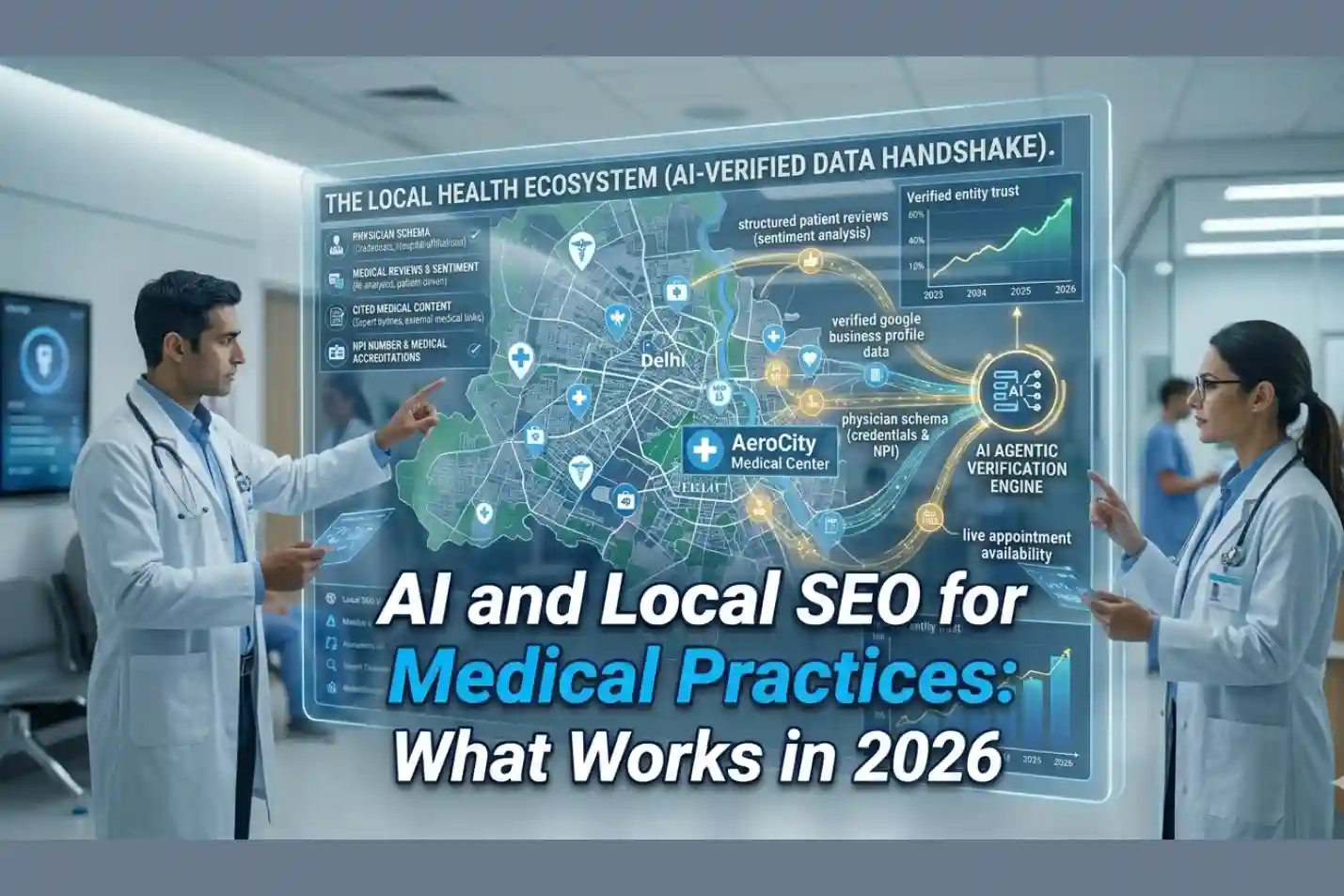

The healthcare landscape has undergone a tectonic shift. In 2026, the traditional "search and click" era was replaced by an "ask and discover" ecosystem. For medical professionals, local SEO is no longer just about appearing in the "Map Pack"—it is about ensuring your practice is the chosen recommendation in an AI-driven world.
As patients increasingly turn to AI assistants like ChatGPT, Gemini, and Google’s evolved AI Overviews, the criteria for AI search visibility have become more rigorous. To remain relevant, medical practices must master a blend of traditional local signals and the new frontier of Generative Engine Optimization (GEO).
How is AI Redefining Search Visibility for Medical Practices?
In 2026, search is no longer a list of blue links; it is a conversation. AI models now act as "agentic assistants" that don't just provide information—they verify credentials, summarize treatment options, and even initiate the booking process.
For a medical practice, AI search visibility means your data is structured such that these AI agents can "read" your expertise and cite you as a primary source. If an AI summary answers a patient’s query about "knee replacement recovery" and cites your clinic, you’ve won the most valuable real estate on the screen.
What are the Modern Local SEO Trends for Doctors in 2026?
1. From Keywords to "Entity Authority"
Gone are the days of stuffing "dentist in Chicago" into every paragraph. AI engines now look for entities—verifiable, interconnected facts about your practice. This includes your NPI number, your affiliations with local hospitals, and your presence in peer-reviewed medical directories. AI doesn't just want to see your name; it wants to see how you fit into the local healthcare ecosystem.
2. Hyper-Local Neighborhood Targeting
AI is now smart enough to distinguish between city-wide searches and neighborhood-specific needs. Content that mentions local landmarks, community health events, or neighborhood-specific health concerns (e.g., "managing seasonal allergies in [Specific Neighborhood Name]") signals to AI that you are the most relevant local authority for a specific micro-location.
3. The Rise of Zero-Click Discovery
Over 60% of searches in 2026 end without a click to a website. Patients get their answers regarding hours, insurance accepted, or symptom summaries directly from the AI interface. To win here, your content must be "citation-ready"—short, factual, and backed by medical consensus so that the AI pulls your clinic's name as the source.
How Can Medical Professionals Optimize for AI-First Local Search?
To stay ahead, your digital strategy must pivot from catering to algorithms to catering to "Answer Engines."
Use Schema.org for Deep Data Accessibility
AI agents cannot "guess" your availability or your specific areas of expertise. Using advanced MedicalBusiness and Physician Schema markup is non-negotiable. This structured data should include your accepted insurances, board certifications, specific procedure codes, and even real-time appointment availability.
Structure Content for "Answer Engine Optimization" (AEO)
When a patient asks, "How long does it take to recover from LASIK?" They want a direct answer. Use a "Question-Header" followed by a concise 40–60 word answer. Then, follow up with deeper clinical details. This "summary-first" approach is exactly what AI models look for when pulling citations for their overviews.
Prioritize Video and Multi-Modal Content
AI search is now multi-modal. Google Lens and AI assistants can "watch" videos to find answers. Create short, doctor-led videos explaining common conditions. Ensure every video has a high-quality transcript and structured VideoObject Schema so the AI can index the spoken content.
Why E-E-A-T is the "Secret Sauce" for Medical SEO in 2026
Google’s E-E-A-T (Experience, Expertise, Authoritativeness, and Trustworthiness) has reached its peak importance for healthcare.
- Experience: Showcase "day-in-the-life" content or case-based insights that AI cannot replicate.
- Expertise: Every blog post must have a "Medically Reviewed By" byline with a link to a credentialed profile.
- Authoritativeness: Earn mentions from local news outlets, medical associations, and university health systems to prove your standing in the field.
- Trustworthiness: Manage your reputation. In 2026, AI analyzes the sentiment of your reviews, not just the star rating. A high volume of reviews mentioning specific successful outcomes carries more weight than a generic 5-star rating.
Is Google Business Profile (GBP) Still Relevant for Doctors?
Absolutely. In fact, your Google Business Profile acts as the "source of truth" for AI engines. If your website and your GBP disagree, the AI will likely ignore both.
Essential GBP Updates for 2026
Treat your GBP like a high-authority social feed. Post weekly updates about new medical technology, community health tips, or holiday hours. Ensure your "Service Level Detail" is granular; don't just list "Pediatrics"—list "Pediatric Wellness Exams," "Newborn Care," and "Adolescent Mental Health." Finally, monitor the interactive Q&A section closely, as AI often pulls direct answers for local queries from these community-driven questions.
Strategic Content: What Should Doctors Write About?
The goal is to build "Content Clusters" that establish you as the topical authority in your niche. Instead of generic pages like "Our Cardiology Services," focus on specific patient journeys.
For example, a high-performing piece of content would be "The Patient's Guide to Preparing for a Stress Test in [City]" or "How [Practice Name] Uses AI-Driven Imaging for Painless Cavity Detection." By focusing on the patient's specific concerns and the neighborhood context, you create "high-intent" content that AI engines prioritize for local recommendations.
Common Mistakes to Avoid in 2026 Medical SEO
- Ignoring Technical "Blind Spots": If your site uses heavy Javascript that AI bots can't crawl, you’re invisible to the very engines you are trying to reach.
- Using Generic Stock Photos: AI vision models can now recognize stock imagery. Use real photos of your staff, your office, and your equipment to build "Entity Trust."
- Neglecting Mobile-First Design: With voice search and AI assistants dominating mobile, your site must load instantly and be perfectly accessible on small screens.
- Inconsistent NAP Data: If your Name, Address, or Phone number differs between your website, Yelp, and Healthgrades, AI will lose trust in your data and stop recommending you.
Securing Your Practice's Future in the AI Era
The transition to AI-driven search isn't just a technical update; it’s a fundamental change in how patients find and trust medical care. By 2026, the clinics that thrive will be those that treat their digital presence as a verified medical record—structured, authoritative, and deeply rooted in the local community. Don’t let your practice get lost in the noise of outdated algorithms. Whether you need to overhaul your technical schema, refine your E-E-A-T signals, or dominate local "answer engine" results, the time to act is now.
Ready to boost your AI search visibility and grow your patient base? Contact us now to schedule a comprehensive 2026 Local SEO audit and ensure your practice remains the top choice in your neighborhood.
FAQ: AI and Medical SEO
Does AI content help or hurt medical SEO?
Purely AI-generated content often lacks the "Experience" and "Trust" required for medical SEO. However, using AI to help structure or research doctor-vetted content is a winning strategy.
How do I get cited in Google's AI Overviews?
Focus on "Answer-First" formatting. Use clear H2/H3 tags and provide direct, factual answers to common medical questions in the first paragraph of your pages.
Is backlinking still important in 2026?
Yes, but quality has replaced quantity. One link from a local hospital or a major medical journal is worth more than 1,000 generic directory links.