
.png)

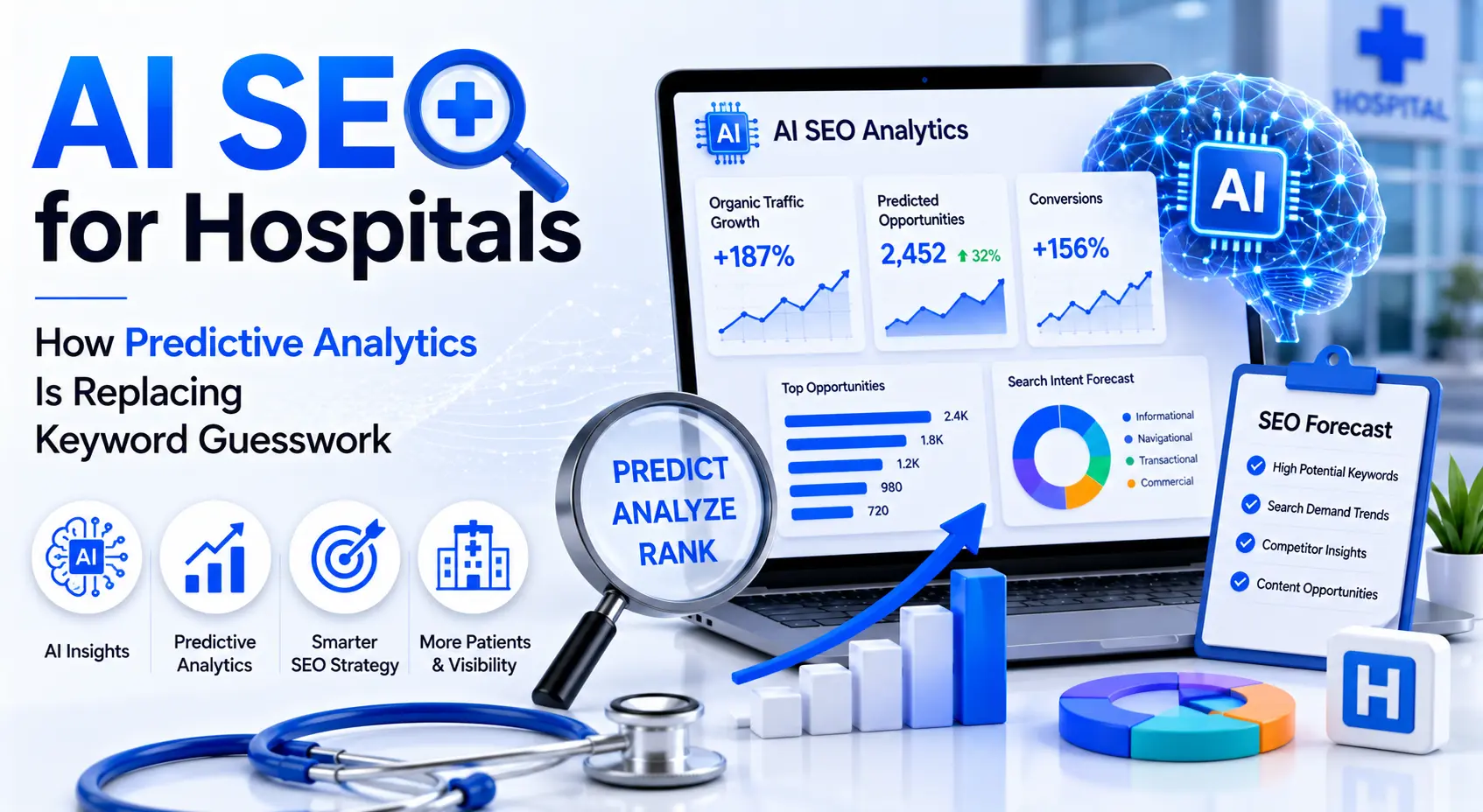

Hospital marketing departments once operated with a fundamental limitation: they could analyze what patients searched for in the past, but they had no reliable way to anticipate what they would search for next. That limitation is disappearing. AI SEO for hospitals — powered by machine learning, predictive analytics, and natural language processing — is transforming how health systems identify content opportunities, optimize patient-facing pages, and allocate digital marketing resources.
This article examines how hospital AI marketing teams are deploying predictive analytics to move beyond reactive keyword targeting toward genuinely anticipatory content and technical SEO strategies.
The Limitations of Traditional Healthcare Keyword Research
Conventional AI keyword research medical approaches rely on historical search volume data — what patients searched last month or last year. This retrospective model has inherent blind spots. Seasonal disease patterns, emerging health concerns, and shifts in clinical terminology mean that yesterday's keyword data may be a poor guide to tomorrow's patient intent.
More critically, traditional keyword research treats all queries as equivalent units of search volume without accounting for the complex patient journey, regional disease prevalence data, population health trends, or the relationship between clinical service lines and local community health needs. Predictive SEO healthcare addresses these limitations by integrating multiple data sources to anticipate demand before it fully materializes in search data.
How Predictive Analytics Is Transforming Hospital SEO
Machine Learning Models for Content Demand Forecasting
Machine learning healthcare SEO models can be trained on a combination of internal data (hospital appointment trends, patient inquiry patterns, referral source analytics) and external data (CDC disease surveillance feeds, Google Trends signals, social media health topic velocity, regional epidemiological data) to forecast which clinical topics are likely to see search demand growth in the coming weeks and months.
For a large health system, this predictive capability means content teams can be creating and optimizing respiratory illness content in September rather than scrambling to respond in November after patient volumes surge. The competitive advantage is substantial: pages with domain authority and content depth are indexed and trusted well before high-volume seasonal search periods peak.
NLP Healthcare Content Optimization
NLP healthcare content optimization — using natural language processing tools to analyze the semantic structure of high-performing health content — allows hospital digital marketing teams to move beyond keyword-density optimization toward genuine semantic comprehensiveness. NLP tools identify the concepts, entities, and related questions that top-ranking content covers, revealing gaps in existing hospital web pages that prevent them from ranking for condition-specific queries.
In hospital AI content strategies, NLP evaluations frequently highlight that well-ranking medical content explores an entire health topic rather than just the primary condition. This includes discussing symptoms, contributing factors, testing methods, treatment choices, follow-up care, and patient assistance options. Pages with deeper, well-rounded information often achieve stronger visibility than basic keyword-focused content.
AI-Driven Patient Acquisition: From SEO to Conversion
Automated SEO for Healthcare Efficiency
Automated SEO healthcare tools powered by AI can continuously audit hospital websites for technical issues — crawl errors, broken internal links, slow-loading clinical pages, missing schema markup — at a scale no human team could sustain. More advanced implementations use predictive models to prioritize which technical issues are most likely to impact patient-facing visibility and conversion, allowing small digital teams to focus remediation effort where it will generate the greatest return.
For AI technical SEO hospital programs, this means moving from quarterly technical audits to continuous monitoring and automated alerting, with machine learning models distinguishing between technical anomalies that have negligible ranking impact and those that demand immediate attention.
AI-Driven Patient Acquisition and the Patient Journey
The most sophisticated AI driven patient acquisition platforms integrate SEO performance data with CRM and appointment booking data to trace the complete patient journey from first search to scheduled appointment. By understanding which content pages, search terms, and local listing interactions precede conversions, hospital marketing teams can make data-driven decisions about content investment, service line prioritization, and paid media allocation.
Hospital digital marketing AI platforms increasingly offer closed-loop attribution — connecting the search content that introduces a patient to the health system with the appointment type they ultimately book. This level of visibility was impossible with traditional SEO analytics and changes the strategic conversation from 'did our traffic grow' to 'which content investments generated which service line revenue.'
Conclusion
AI SEO for hospitals is not a future technology — it is a present competitive differentiator. Health systems that deploy predictive SEO healthcare tools and machine learning healthcare SEO models are already outpacing competitors still relying on retrospective keyword data and manual content strategies. The combination of NLP healthcare content optimization, automated SEO healthcare monitoring, and AI driven patient acquisition attribution creates a virtuous cycle: better content, better visibility, better data, and better investment decisions.
Rankingeek Marketing Agency, a Best Healthcare Digital Marketing Agency, helps hospitals and integrated health systems implement hospital AI marketing frameworks that move beyond keyword guesswork toward genuinely predictive, data-driven digital strategies that align content investment with patient acquisition outcomes.
Frequently Asked Questions
Q1. What data sources do predictive SEO models use for healthcare?
Predictive SEO healthcare models typically integrate Google Trends data, CDC and WHO epidemiological feeds, internal appointment and inquiry data, regional population health databases, social media health topic signals, and historical search performance data to forecast emerging content demand.
Q2. Is AI SEO for hospitals only viable for large health systems?
While large systems have more internal data to train predictive models, AI SEO for hospitals of all sizes benefits from NLP content optimization and automated technical SEO monitoring. Mid-sized community hospitals can access enterprise-grade AI SEO capabilities through specialized healthcare digital marketing platforms without building proprietary models.
Q3. How does NLP improve hospital content quality?
NLP healthcare content tools analyze the semantic structure of high-ranking pages to identify the concepts and related questions that comprehensive content covers. This helps hospital content teams build pages that satisfy the full scope of patient query intent rather than targeting isolated keywords.
Q4. What is the ROI timeline for AI-driven patient acquisition programs?
AI driven patient acquisition programs typically show measurable improvement in organic traffic quality within 90 days and attributable appointment-booking uplift within four to six months, depending on the competitiveness of the service line and the baseline content maturity of the hospital website.
Q5. Can AI SEO tools replace healthcare content writers?
No. AI content optimization hospital tools augment human content strategy by identifying opportunities and gaps, but the creation of clinically accurate, E-E-A-T-compliant healthcare content still requires human medical expertise and editorial judgment. AI excels at analysis and prioritization; human writers and clinicians remain essential for content quality and compliance.