
.png)

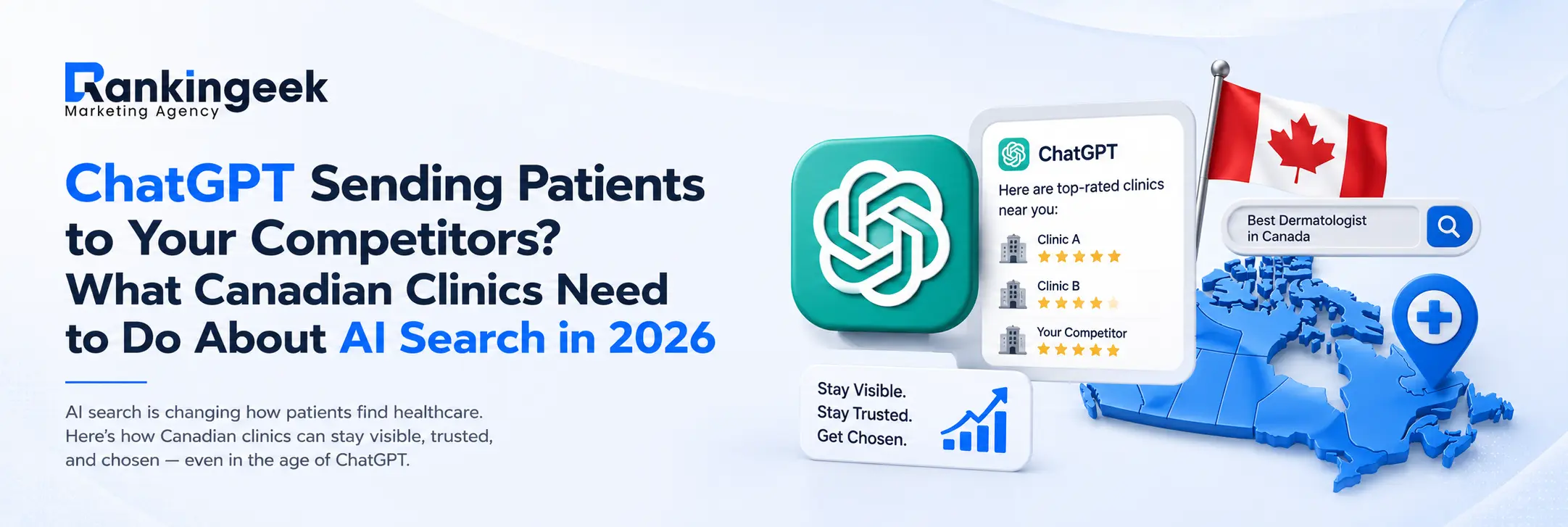

A patient in Toronto wakes up at 2 a.m. with a throbbing jaw. She doesn't open Google and scroll through ten blue links anymore. She opens ChatGPT and types: “best dentist near me for emergency root canal.” In seconds, the AI names three clinics, summarizes their services, and tells her which one takes new patients. If your practice isn't one of those three, you never existed in that conversation — and you'll never know the booking you lost.
This is the quiet shift reshaping healthcare marketing across Canada. More than half of Canadians now say they turn to AI search results from Google or platforms like ChatGPT for health information, and Google's AI Overviews already appear on the vast majority of healthcare queries. For clinic owners, the question is no longer whether patients use AI to find care. It's whether your clinic is the one the AI recommends — or your competitor down the street.
Why Isn't My Clinic Showing Up in AI Search?
If you've noticed a slow decline in online patient enquiries despite steady effort on your website, AI search is a likely culprit. Traditional SEO earned you a spot in a list of links. But answer engines and generative search platforms don't hand patients a list — they hand them a decision. When ChatGPT, Gemini, Claude, or Perplexity answers “which physiotherapy clinic in Vancouver treats sports injuries?” it names a small number of practices and moves on. There is no page two.
Most clinics are invisible in these answers for three fixable reasons:
- No structured data. Without schema markup and FAQPage structure, AI models struggle to read what you do, where you are, and who you treat.
- Content written for humans only. Beautiful copy that buries the answer three paragraphs down gives answer engines nothing clean to extract.
- Weak entity and authority signals. AI models cite sources they can verify — clear practitioner credentials, consistent business details, and trusted references. Vague sites get skipped.
How Do Patients Find Doctors Using ChatGPT in Canada?
The patient journey has split in two. For quick health questions — symptoms, conditions, what a treatment involves — patients increasingly ask an AI directly, often outside clinic hours. Seven in ten healthcare conversations on ChatGPT happen when practices are closed. For the final step, actually booking, patients still lean on Google's local map pack and your Google Business Profile.
That means AI search optimization for clinics in Canada isn't about replacing local SEO — it's about winning both moments. The patient discovers you through an AI recommendation, then confirms you through local search. Miss the first moment and you never get to the second.
A Real-World Example
Consider two family clinics in the same Ottawa neighbourhood. Clinic A has a modern website and ranks decently on Google. Clinic B looks plainer but structures every service page with clear questions and answers, marks up its FAQs, and keeps its provider credentials and location details consistent across the web. When a prospective patient asks Gemini “family doctor accepting new patients in Ottawa,” the AI can cleanly parse Clinic B and names it. Clinic A — prettier, but unstructured — doesn't make the answer. Design didn't decide the outcome. Machine-readability did.
SEO vs. AEO vs. GEO: What's the Difference for Clinics?
Three overlapping disciplines now govern whether patients find you. Traditional SEO still matters, but Answer Engine Optimization (AEO) and Generative Engine Optimization (GEO) are where the newest ground is won. Here's how they compare for a Canadian healthcare practice:
The takeaway: a modern clinic marketing strategy in 2026 covers all three. SEO keeps you visible in classic search, AEO gets you into featured snippets and Google AI Overviews, and GEO makes you the clinic that ChatGPT, Gemini, Perplexity, and Claude actually recommend by name.
What Canadian Clinics Need to Do About AI Search
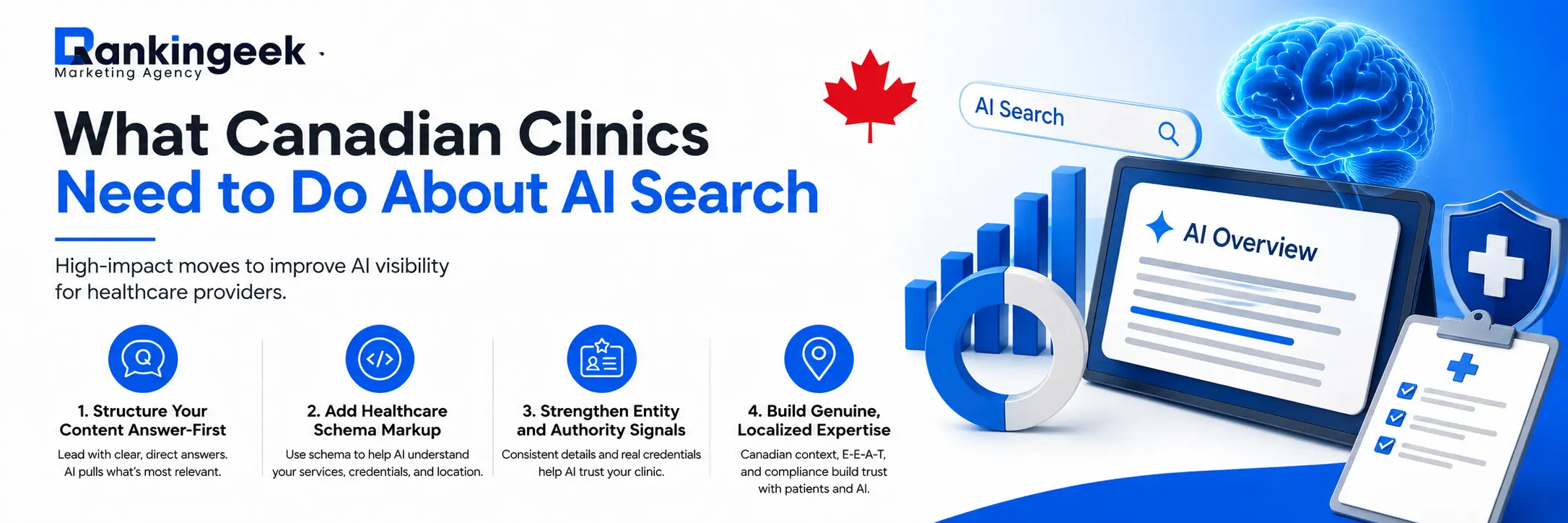
You don't need to overhaul everything at once. These are the highest-impact moves to improve AI visibility for healthcare providers, in the order that tends to pay off fastest:
1. Structure Your Content Answer-First
Lead each key section with a direct, standalone answer to a real patient question, then expand. Answer engines extract the first clear response they find. A question-based heading followed by a two-sentence answer is far more likely to be pulled into an AI Overview than a keyword-stuffed paragraph.
2. Add Healthcare Schema Markup
Implement FAQPage, MedicalClinic, and Physician schema markup so AI systems can reliably read your services, credentials, and location. Structured data is the single most overlooked lever in clinic AI visibility — it turns your site from something a model guesses at into something it can trust and cite.
3. Strengthen Entity and Authority Signals
Keep your clinic name, address, and phone number identical everywhere online. Connect each practitioner to real credentials, professional memberships, and consistent profiles. These entity signals tell generative engines your content is clinically sound rather than marketing fluff.
4. Build Genuine, Localized Expertise
Generic content doesn't earn citations. Content that reflects real Canadian context does — provincial nuances, local patient concerns, and honest detail about your services. This is also where Experience, Expertise, Authoritativeness, and Trustworthiness (E-E-A-T) and compliance intersect: demonstrating that your practice respects PIPEDA and provincial rules like PHIPA in Ontario builds the trust both patients and AI models look for.
The Real Risk of Ignoring AI Search
The cost of waiting isn't dramatic — it's quiet, which makes it dangerous. You won't see a crash in your analytics. You'll see a slow erosion: fewer new patient bookings, softer enquiry numbers, a sense that marketing “just isn't working like it used to.” Meanwhile, the clinics that adapted early are being named in the AI answers your prospective patients read every day.
AI search visibility compounds. The clinic that gets cited becomes the clinic that gets cited more, because AI models reinforce sources they already trust. Every month you stay invisible, that gap widens — and it gets harder and more expensive to close later.
Stop losing patients to AI search you can't see.
Make Your Clinic the One AI Recommends
The good news: the clinics winning in AI search aren't the biggest or the ones with the flashiest websites. They're the ones whose content is structured, credible, and machine-readable — and that's entirely achievable with the right strategy. Canadian healthcare has a genuine window right now, because most practices haven't adapted yet. Early movers get to own the answer.
That's exactly the work we do at Rankingeek Marketing Agency. We help Canadian clinics get found and recommended across ChatGPT, Google AI Overviews, Gemini, Perplexity, and Claude through healthcare-specific SEO, AEO, and GEO services — built around your services, your province, and Canadian privacy rules.
We don't guess at AI search — we install the SEO, AEO, and GEO infrastructure that gets Canadian clinics found and booked. See what that could look like for your practice.
Frequently Asked Questions
Is ChatGPT recommending clinics to patients in Canada?
Yes. AI tools name specific practices based on the content they can read online, so clinics with clear, structured information are far more likely to be recommended.
How do I get my clinic to appear in ChatGPT and AI search?
Structure your content answer-first, add healthcare schema markup, and keep your business details and credentials consistent everywhere online.
What is the difference between SEO, AEO, and GEO for clinics?
SEO targets classic search rankings, AEO targets direct answers in AI Overviews and snippets, and GEO gets you cited by AI platforms like ChatGPT and Gemini.
Does AI search actually affect patient bookings?
Yes, gradually. Patients often discover clinics through AI recommendations first, so if you're not in the answer, you lose them before the booking stage.
Can AI search optimization comply with PIPEDA and PHIPA?
Yes. It focuses on your public marketing content, not patient data, so it respects PIPEDA and provincial rules like PHIPA in Ontario.
How long does it take to see results from AEO and GEO?
Schema and answer-first fixes can influence AI visibility within weeks, while authority signals compound over several months.
Is traditional local SEO still worth it for clinics?
Absolutely. Patients still book through Google's map pack and your Business Profile, so the best approach combines local SEO with AEO and GEO.