
.png)



Duplicate business listings SEO is a problem most clinic owners don't know they have until rankings stall and the appointment calendar thins out. As of October 2025, over 70% of patients choose clinics that appear on the first page of Google search results, making local visibility a direct patient acquisition lever. Healthcare is categorised as a YMYL (Your Money or Your Life) topic, so Google applies stricter E-E-A-T scrutiny to every trust signal your clinic puts out. One silent data conflict can suppress your entire profile.
Key Takeaways
- Google's guidelines prohibit multiple Business Profile listings for the same business at the same location, duplicates mislead customers and will be marked as duplicates or suspended.
- As of July 2025, duplicate listings can decrease local search visibility by up to 25% by splitting ranking authority across weak profiles.
- Healthcare clinics face tighter algorithm scrutiny because inconsistent NAP data directly damages E-E-A-T signals.
- Three legitimate resolution paths exist: claiming and merging via Google Support, using "Suggest an Edit" on Maps, or removing a self-created duplicate from your account.
Two Types of Duplicates That Hurt Clinic SEO
Not every duplicate problem lives on Google Maps. Two distinct issues can undercut your clinic's online visibility at the same time.
Google Business Profile duplicates are multiple map listings tied to the same physical address. They show up when a practice goes through a rebrand, and someone creates a fresh profile instead of updating the old one. Accidental creation is common, and so is the scenario where a practitioner sets up a separate listing at the clinic's address without realising it conflicts with the primary profile.
Website duplicate location pages are a separate but equally damaging problem and demonstrate why duplicate content hurts SEO for healthcare websites. Creating near-identical location pages on a clinic's website for different nearby cities without unique content is considered duplicate content and is penalised by Google. Those pages won't rank and can drag down the domain's overall authority. Where similar content is unavoidable, properly implemented canonical tags help search engines understand which page should receive ranking credit.
Both issues stem from the same instinct: trying to appear in more places. The result is the opposite. Understanding how duplicate listings affect local search helps explain why clinics often lose visibility even when they continue collecting positive patient reviews.
The SEO Damage Duplicates Cause: Rankings, Reviews, and Trust
Here's where the real cost shows up:
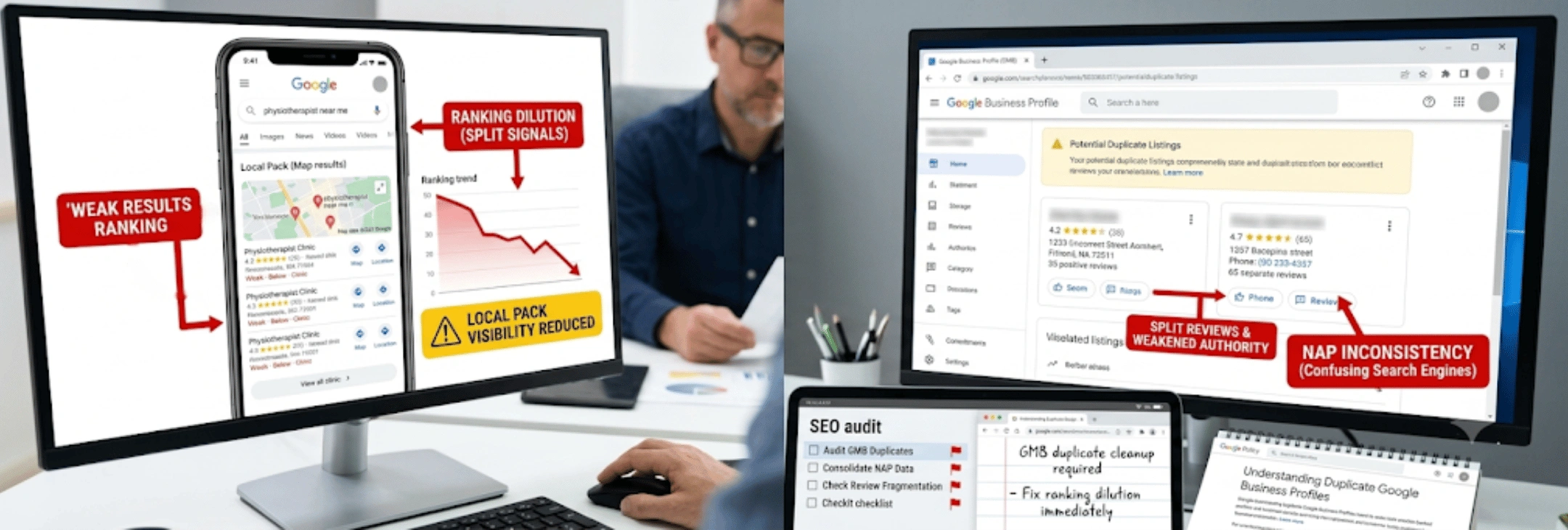
NAP inconsistency is the first casualty. When your Name, Address, and Phone number appear differently across two or more listings, search engines can't confirm your clinic is a single, legitimate entity. Inconsistent NAP data caused by duplicate listings confuses search engines, leading to a loss of trust and lower rankings in the Local Pack. For a healthcare practice already operating under YMYL scrutiny, that's a compounding problem.
Split reviews are the next hit. Duplicate listings divide patient reviews across multiple profiles, which weakens the clinic's overall rating and prominence in local search results. Consolidated reviews on one profile signal far more authority than the same total scattered across several thin ones.
Ranking dilution is measurable. As of July 2025, duplicate listings can decrease local search visibility by up to 25%. Instead of concentrating authority into one strong profile, the algorithm splits its signals across multiple weak ones. None of them rank as well as a single consolidated listing would, making it harder to secure prominent positions on the SERP for local healthcare searches.
Suspension risk is the ceiling on how bad this gets. As of July 2026, if a clinic repeatedly violates Google Business Profile policies by intentionally creating duplicate listings to manipulate rankings, Google can stack restrictions or suspend the profile entirely. A suspended profile doesn't just rank poorly. It disappears from Google Search and Maps, taking every review and every booked appointment path with it. Local SEO specialists who work with healthcare clients audit for exactly these issues early, and the local SEO services at Rankingeek are built around catching them before they escalate.
Three Legitimate Paths to Fix Google My Business Duplicate Listings
Before doing anything, verify and fully optimise the primary profile. Duplicate listings dilute trust signals and can trigger verification issues, so getting the primary listing in order first is the right sequence. Although the platform is now called Google Business Profile, many clinic owners still search for solutions using the term Google My Business duplicate listings.
Option 1: Claim and merge via Google Support. When the duplicate has its own verified status or a meaningful review count, merging is the better call. Claiming and merging the duplicate via Google Support is the path that retains reviews, consolidating both profiles into the primary one. This takes longer and requires clear documentation that both listings represent the same physical location.
Option 2: Suggest an Edit. On Google Maps, locate the duplicate listing and use the "Suggest an edit" feature to flag it as "Duplicate of another place." This is a straightforward option for unverified or unclaimed listings.
Option 3: Remove from account. If the clinic accidentally created the duplicate itself and it has no reviews or appointment data worth keeping, removing it directly from the account is the cleanest fix. No merge needed.
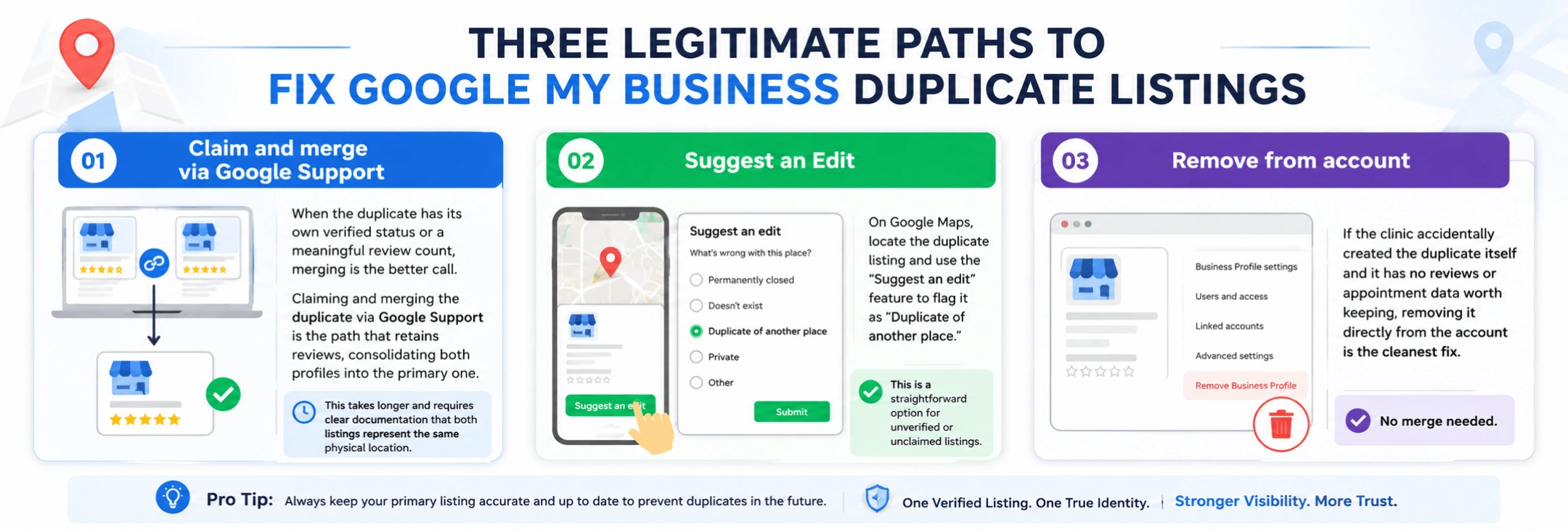
All three are the legitimate resolution paths recognised for handling duplicate Google Business Profile listings. There are no shortcuts that bypass this process without risk.
Managing Multiple Real Locations Without Creating Duplicate Problems
Running multiple clinic locations is a different situation entirely. Each legitimate physical address is entitled to its own Google Business Profile. Google's official guidelines state that businesses can only have one Business Profile per location, so the key is keeping each profile tied to a genuinely distinct address. This is where managing multiple clinic locations SEO requires a clear system rather than ad hoc decisions.
For the clinic website, location pages need genuinely unique content to avoid the duplicate content penalty. That means distinct staff bios, neighbourhood-specific service descriptions, and real patient context that reflects that community. Get the healthcare web development infrastructure right once, and it protects every location page you add later. Adding accurate schema markup for each location further helps search engines understand your clinic's business information and services.
NAP consistency across all directories is non-negotiable. A single source of truth for your clinic's name, address, and phone number, applied uniformly across every citation, keeps the algorithm's trust signals aligned. Geotargeting works only when the data it's reading is clean. Consistent citation building across trusted Canadian business directories reinforces Google Business Profile signals and reduces the chances of conflicting business information appearing online.
What a Clean, Consolidated Listing Actually Delivers for Patient Acquisition
The business case for fixing duplicates is straightforward. Businesses with a complete and accurate Google Business Profile are 70% more likely to attract location visits from consumers compared to those with inconsistent or incomplete data. For a private practice, a location visit is a booked appointment.
A single high-review-count profile outperforms several thin ones in the Local Pack. This is more than just a ranking theory; it's how duplicate listings directly lead to fewer calls, form fills, and patients walking through the door.
Regular audits also help clinics stay resilient against future algorithm updates that place greater emphasis on business data accuracy. The maintenance habit that protects these gains is simple: audit for new duplicates regularly. Data conflicts can emerge without any action on the clinic's part. Catching them early costs far less than recovering from a suppressed or suspended profile.
If you want to know exactly where your clinic stands presently, book a free practice growth audit. This audit surfaces hidden duplicates, NAP conflicts, and other gaps in your local search infrastructure before they cost you another month of patient acquisition.
Frequently Asked Questions
How can I check if my clinic has duplicate business listings?
The easiest way is to search your clinic's name, address, and phone number on Google Search and Google Maps. You should also check major Canadian directories such as YellowPages, Canada411, Yelp, and healthcare-specific directories. If you find multiple listings with the same location but different details, review and correct them to prevent local SEO issues.
Can duplicate listings affect online appointment bookings?
Yes. Duplicate listings can confuse potential patients by displaying different phone numbers, business hours, or booking links. When patients encounter conflicting information, they may choose another clinic instead, resulting in fewer appointment requests and lower patient trust.
Will changing my clinic's name or branding create a duplicate Google Business Profile?
Not if it's done correctly. If your clinic undergoes a rebrand, you should update the existing Google Business Profile instead of creating a new one. Creating a second profile for the same location may trigger duplicate listing issues and reduce your local search performance.
How often should Canadian clinics audit their business listings?
Most local SEO experts recommend auditing your business listings at least every three to six months, or immediately after changes such as a clinic relocation, rebranding, phone number update, or ownership change. Regular audits help maintain consistent business information across online directories and reduce the risk of duplicate listings appearing.