
.png)

.webp)

In an industry where credibility is currency, a well-crafted healthcare content marketing strategy is no longer optional — it is the foundation of sustainable digital growth. Healthcare organizations that dominate search results in 2026 are not simply publishing more content; they are building structured, expert-led ecosystems that signal deep topical authority healthcare to both search engines and patients.
Google's emphasis on E-E-A-T healthcare content — Experience, Expertise, Authoritativeness, and Trustworthiness — has fundamentally reshaped what it means to rank in the medical space. For healthcare marketers, clinicians, and digital strategists, understanding how to align medical content marketing with these evolving standards is the difference between invisible content and industry-defining authority.
Why Topical Authority Matters More Than Ever in Healthcare SEO
Traditional SEO tactics focused on keyword density and backlink volume are no longer sufficient in the YMYL content healthcare category — short for Your Money or Your Life. Google applies its highest scrutiny to healthcare content because inaccurate medical information can cause real harm. This means your health content strategy 2026 must prioritize depth, accuracy, and demonstrable expertise above all else.
Topical authority is earned when a website comprehensively covers every dimension of a subject area, from foundational concepts to advanced clinical nuances. Rather than writing isolated blog posts, leading healthcare organizations build healthcare pillar pages — authoritative, long-form resources that serve as the hub of interconnected content clusters.
The Architecture of a High-Authority Healthcare Content Cluster
A well-structured content cluster begins with a pillar page targeting a broad topic, such as "Type 2 Diabetes Management," supported by cluster articles addressing specific subtopics: medication adherence, dietary guidelines, complication prevention, and patient monitoring. Each cluster article internally links back to the pillar, signaling to Google that your site offers comprehensive coverage rather than scattered information.
This architecture directly supports healthcare blog SEO by creating a logical semantic web that search engine crawlers can easily map. More importantly, it provides genuine value to the healthcare professionals and patients seeking authoritative guidance.
Building E-E-A-T Into Your Content Foundation
For any healthcare content marketing strategy to succeed in 2026, E-E-A-T must be embedded at the structural level — not treated as an afterthought. Here is how to operationalize each component:
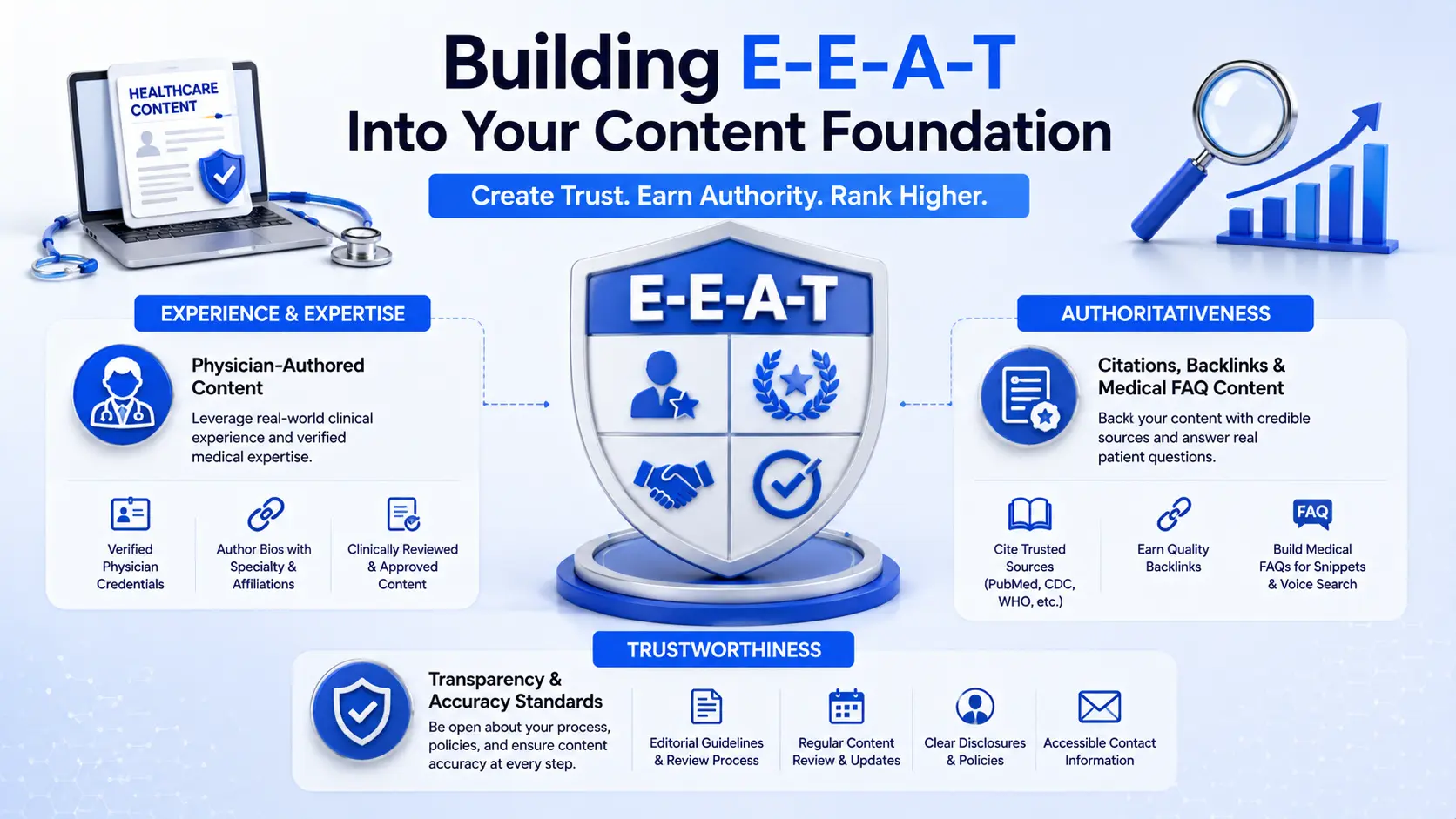
Experience and Expertise: The Role of Physician-Authored Content
One of the most powerful signals in modern healthcare SEO is physician-authored content SEO. When a board-certified cardiologist authors an article on heart failure management, Google's quality raters can verify that claim against publicly available credentials. This creates a compounding trust advantage that no amount of generic AI writing can replicate.
Practical implementation steps include establishing structured author bios with specialty, board certifications, and institutional affiliations; linking author profiles to external verification sources such as Doximity or hospital staff pages; and ensuring every clinical claim is reviewed and approved by licensed practitioners before publication.
Authoritativeness: Citations, Backlinks, and Medical FAQ Content
Authority in the medical space is built through rigorous citation practices. Every statistic, treatment recommendation, or clinical guideline referenced in your content should link to peer-reviewed sources — ideally PubMed, CDC, WHO, or major academic medical centers. Additionally, well-structured medical FAQ content that anticipates and answers the specific questions healthcare professionals and patients search for is a proven strategy for earning featured snippets and voice search visibility.
Trustworthiness: Transparency and Accuracy Standards
Content reliability is not limited to factual accuracy alone. It also depends on openly sharing editorial guidelines, review timelines, disclosure policies, and contact information. Healthcare organizations that clearly explain how their content is created and reviewed often gain a competitive advantage over those that treat transparency as an afterthought.
Developing a Scalable Healthcare Content Calendar
Consistency is a core pillar of medical content marketing success. Healthcare organizations that publish sporadically struggle to maintain the topical momentum required for sustained ranking improvements. A strategic content calendar should align publishing frequency with available expert reviewers, prioritize evergreen clinical topics alongside time-sensitive health awareness events, and balance educational resources for patients with technical content targeting referring physicians.
Keyword research for healthcare content should extend beyond volume metrics to include search intent mapping. A query like "heart failure treatment options" serves a very different audience than "heart failure clinical trial eligibility criteria." Your health content strategy 2026 must categorize content by intent — informational, navigational, and transactional — and optimize accordingly.
Measuring Topical Authority Growth: Key Performance Indicators
A sophisticated healthcare content marketing strategy requires equally sophisticated measurement. Beyond traditional metrics like organic traffic and bounce rate, healthcare marketers should track topical coverage scores using tools such as MarketMuse or Clearscope; keyword cluster ranking distribution to identify coverage gaps; featured snippet acquisition rates for medical FAQ content; and conversion rates from content-driven patient education pages to appointment bookings.
Healthcare Content Marketing Strategy: Core Components at a Glance
Conclusion
A results-driven healthcare content marketing strategy in 2026 demands more than consistent publishing — it requires a systematic commitment to expertise, structural depth, and measurable topical authority. By building healthcare pillar pages around core clinical themes, elevating physician-authored content SEO practices, and embedding E-E-A-T healthcare content principles at every level, healthcare organizations can achieve the kind of search visibility that translates directly into patient trust and practice growth.
The organizations that treat content as a clinical asset — governed by the same rigor applied to patient care — will own the digital health landscape of tomorrow. If you are ready to build a content architecture that earns authority and converts visitors into patients, partnering with a specialist is the most efficient path forward. Rankingeek Marketing Agency, recognized as a Best Healthcare Digital Marketing Agency, helps healthcare brands develop and execute content strategies that rank, resonate, and deliver measurable ROI.
Frequently Asked Questions
1. What is topical authority in healthcare SEO?
Topical authority refers to the degree to which a website is recognized by search engines as a comprehensive, expert resource on a specific subject area. In healthcare, it is built by creating interconnected content clusters — including healthcare pillar pages and supporting articles — that together cover every dimension of a clinical topic with accuracy and depth.
2. How important is physician-authored content for healthcare rankings?
Extremely important. Physician-authored content SEO directly supports Google's E-E-A-T evaluation framework, which scrutinizes YMYL content healthcare with particular rigor. Articles authored or reviewed by licensed medical professionals rank more reliably and sustain their positions longer than content without verifiable clinical oversight.
3. How many pieces of content are needed to establish topical authority?
There is no fixed number, but a meaningful content cluster typically requires a cornerstone pillar page of 2,000+ words supported by 8–15 cluster articles, each addressing a specific subtopic. The focus should be on comprehensive coverage of searcher intent rather than raw volume. A structured medical content marketing roadmap will help prioritize the most impactful topics first.
4. What types of content perform best for healthcare blog SEO?
In terms of healthcare blog SEO performance, the highest-impact formats include condition overview pages with clinical depth, treatment comparison guides, medical FAQ content targeting specific patient questions, symptom checker content, and clinician-focused educational articles. All of these formats benefit from structured data markup to enhance search visibility.
5. How should a healthcare organization approach health content strategy in 2026?
A modern health content strategy 2026 should prioritize intent-mapped content clusters over isolated blog posts, mandate medical review for all clinical content, invest in author credentialing and transparency, and continuously audit content gaps using topical coverage tools. Aligning content output with patient journey stages — from awareness through decision — maximizes both SEO performance and conversion rates.