
.png)



Running a great clinic isn't enough anymore. Over 77% of Canadians open Google before they book any medical appointment, and if your practice isn't in front of them at that moment, someone else is. The frustrating part? Most clinics we speak with have excellent care, warm staff, and years of experience — they're just invisible online.
Here's what most miss: when someone in Toronto twists an ankle on a Sunday afternoon, they don't call a friend for a referral. They type "walk-in clinic near me" and tap whichever result shows up first on the map. If you're not in that top three, you've already lost them. This guide walks through exactly how a specialized healthcare digital marketing agency like Rankingeek fixes that — and what it actually costs.
Not sure where your practice is losing patients right now?
What Are Healthcare SEO Services? A Quick Answer
Healthcare SEO services — also called medical SEO services — are the specific search-engine optimization tactics used to help hospitals, clinics, and individual providers rank higher on Google and get found by patients actively searching for care. Unlike general SEO, they combine technical fixes, medical-grade content standards (E-E-A-T and YMYL compliance), local search optimization, and healthcare-specific schema markup, all built around the strict advertising rules that apply to regulated medical practices.
At Rankingeek, our SEO services for healthcare cover physicians, dental practices, dermatology and med spa clinics, mental health practices, online pharmacies, and physiotherapy and allied health providers across Canada — anywhere a patient's decision starts with a search.
Why Healthcare SEO Matters in 2026
Search itself has shifted. Patients aren't just typing keywords into Google anymore — they're asking full questions to voice assistants, and increasingly, they're asking AI tools like ChatGPT, Gemini, and Perplexity for recommendations before Google ever enters the picture. Roughly two out of three patients now check an AI platform first when researching a provider.
That's a real change in the funnel. Clinics without a plan for both traditional search and AI-driven discovery aren't ranking lower — they're becoming invisible to a growing share of patients who never see a Google results page at all.
The Three Pillars: SEO, AEO & GEO
Modern healthcare visibility rests on three overlapping strategies. You need all three:
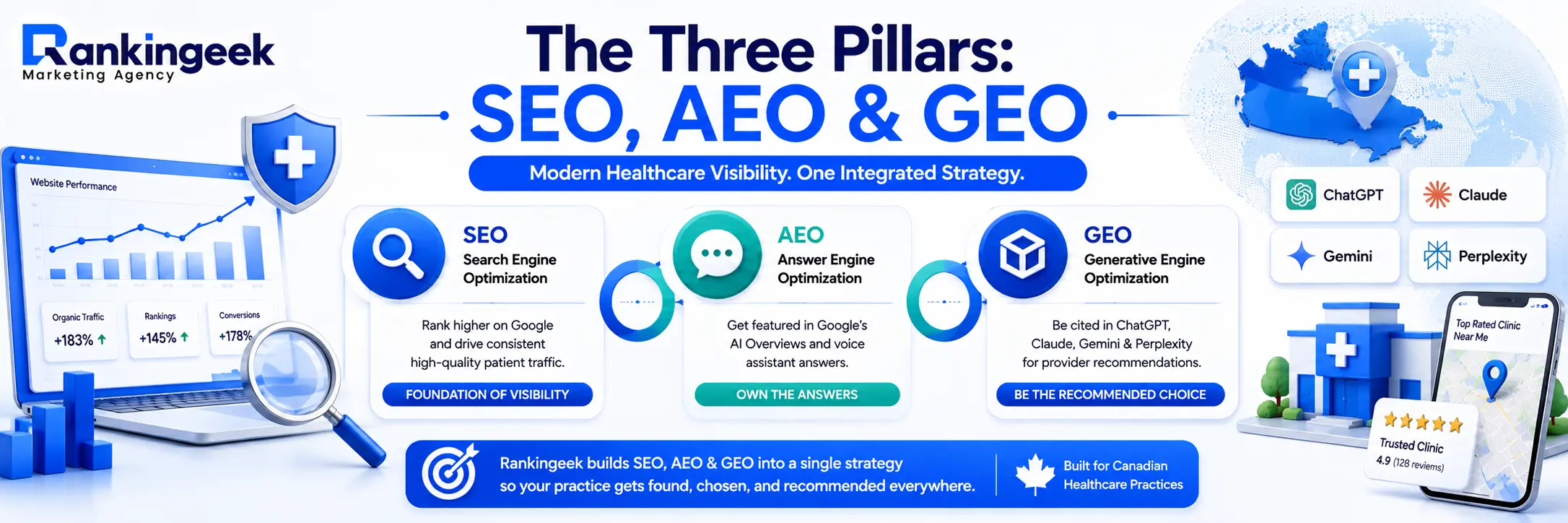
- SEO — classic Google ranking. Still the foundation, still the highest-ROI channel for most Canadian practices.
- AEO (Answer Engine Optimization) — getting your content into Google's AI Overviews and voice-assistant answers, where a direct quote from your site replaces the traditional blue links.
- GEO (Generative Engine Optimization) — being cited inside ChatGPT, Claude, Gemini, and Perplexity when patients ask for provider recommendations.
Rankingeek builds all three into a single strategy through our SEO, AEO & GEO services in Canada because doing one without the others leaves patients on the table.
What Actually Works: Our Healthcare SEO Playbook
1. E-E-A-T and YMYL — Google's Trust Bar
Google classifies medical content as YMYL (Your Money or Your Life), so the trust bar is higher than any other industry. We handle this by pairing every service and blog page with physician-reviewed content, detailed provider bios that list Canadian credentials and college registrations, and citations to sources like the Canadian Medical Association and Health Canada. Author bylines carry Person schema tied to a real medical license — Google can verify authorship at the code level, and that verification is doing more of the ranking work every quarter.
2. On-Page Basics and Medical Schema
The fundamentals still matter. Title tags under 60 characters, meta descriptions that earn the click, one clear H1 per page, and — critically — patient-language keywords instead of clinical jargon ("heart doctor Mississauga" beats "cardiologist Peel Region" for real search volume).
The bigger unlock for most clinics is medical schema. Generic schema isn't enough for healthcare in 2026. We deploy MedicalClinic for the practice, Physician for each provider, MedicalCondition and MedicalProcedure on service and condition pages, and FAQPage schema at the bottom of every substantial page. FAQPage schema is the single biggest lever for landing in Google's AI Overviews, and most Canadian healthcare sites use none of it.
3. Local SEO and Google Maps — Where Patients Actually Convert
Local SEO for clinics means optimizing your Google Business Profile, on-site local signals, and directory listings so your practice shows up in the map pack and "near me" searches for the neighborhoods you actually serve — it's the fastest lever for new patient volume, and it's where we focus first with every new client.
The local 3-pack — those three map results above the organic listings — captures roughly 44% of all clicks on "near me" healthcare searches. Google ranks it on three factors: Relevance (how well your Google Business Profile matches the query), Distance (proximity to the searcher), and Prominence (reviews, mentions, and authority signals). Prominence is where most clinics underinvest and where we spend most of our time.
A properly built Google Business Profile isn't just filled-in fields. It's the right primary category, up to nine secondary categories, every service listed with a 300-character description, service areas defined precisely (a Mississauga clinic should list Etobicoke, Oakville, and Brampton if those are realistic catchments), fresh photos monthly, and weekly Google Posts. The Q&A section matters too — seed it with the ten questions patients actually ask, or spammers will fill it for you.
Beyond Google, your NAP (Name, Address, Phone) has to be identical everywhere. On RateMDs, HealthGrades, Yellow Pages Canada, Yelp Canada, 411.ca, your provincial college directory, and Apple Maps — if your suite number is written three different ways across those sites, Google's confidence in your prominence drops and so does your ranking. Boring work, huge impact.
Reviews are the biggest single driver of prominence, but healthcare providers can't run them like a restaurant. Never offer incentives (violates both Google's terms and most provincial college rules). Ask in person after a positive appointment. Respond to every review within 48 hours without confirming or denying that the reviewer is a patient — that's a PIPEDA requirement. Take negative reviews offline politely.
Why Do Competing Clinics Keep Outranking You in Local Search?
If a clinic with weaker reviews or a smaller team keeps beating you to the map pack, it's almost never about the quality of care — it's about which practice is sending Google clearer, more consistent signals. The most common reasons we find during an audit:
- A mismatched or too-narrow Google Business Profile category, so Google doesn't fully understand what you treat
- Inconsistent NAP details across directories, which quietly erodes Google's confidence in your listing
- Fewer recent reviews, or reviews that never get a response, weakening the Prominence signal above
- Thinner service-area content, giving Google — and patients — more reason to trust a competitor's page for that specific search
- A faster-loading, more mobile-friendly competitor site, since Core Web Vitals now factor into local rankings
None of these gaps take a full SEO overhaul to close. Most clinics we onboard see movement within a single reporting cycle once we've corrected the profile, tightened the listings, and filled the content gap.
Curious which of these gaps is costing you patients?
4. Answer Engine Optimization for AI Search
Google AI Overviews now show up on more than 30% of healthcare queries in Canada. Getting picked as a source comes down to a few structural moves: answer the question in the first sentence, break articles into H2s written as actual patient questions, keep answer paragraphs under 60 words so AI can extract them cleanly, add a real FAQ block with FAQPage schema at the bottom of every service page, and cite Canadian authorities like Health Canada in your outbound links.
5. Technical SEO — the Boring Stuff That Ranks
Pages under 2.5 seconds on mobile. Full PIPEDA compliance on any form collecting patient information. HTTPS everywhere. Core Web Vitals (LCP, INP, CLS) in Google's green thresholds. None of this is glamorous, but a slow site erases the gains from every other tactic on this list.
Provincial Rules You Can't Ignore
Canadian healthcare marketing isn't one market — it's thirteen. Each provincial college has its own advertising rules. The CPSO in Ontario prohibits comparative claims ("the best cardiologist") outright. Alberta's CPSA restricts testimonials for regulated procedures. Quebec's Collège des médecins requires French-language equivalents on public-facing content. British Columbia's CPSBC bars incentivized reviews and requires every advertising claim to be accurate and substantiated, on top of the national Canadian Code of Advertising Standards. A generalist SEO agency won't know these rules and can get your license reviewed. We build every campaign around the specific province's college guidelines from day one.
Common Mistakes We Fix
- Keyword stuffing — "best doctor Canada" repeated 40 times reads like spam to both Google and patients.
- Ignoring video — short procedure explainers are massive trust-builders in 2026.
- Stock health content — generic articles that don't reflect your practice rank nowhere.
- Inconsistent NAP — even minor address variations across directories drop you out of the map pack.
- Skipping medical schema — most Canadian healthcare sites use zero. Adding it puts you ahead of 90% of competitors immediately.
- Offering incentives for reviews — a fast way to violate both Google's terms and your provincial college's rules.
Healthcare SEO Pricing in Canada
Medical SEO in Canada ranges from around $500 to $7,500 per month depending on market competitiveness, practice size, and how much of the funnel you want handled. Below are our three healthcare packages. For full details or a custom multi-location quote, see our pricing page.
Not sure which package fits your practice?
Why Clinics Choose Rankingeek Marketing Agency
We work only with healthcare. That means we understand YMYL, provincial college rules, PIPEDA, and the actual language patients use to describe their symptoms. Our local SEO for healthcare service has helped Canadian clinics move from page four to the map pack in a single quarter, and our full-service SEO program builds the technical, on-page, and content foundation that keeps them there.
Ready to Grow Your Patient Base?
Every day a competitor sits above you in the map pack is a day of lost appointments. If you're serious about fixing that, we're happy to run a free audit and show you where the fastest wins are hiding on your site.
Frequently Asked Questions
How long until I see results from healthcare SEO?
Most clinics see meaningful movement in 3 to 6 months — better GBP visibility, more "near me" impressions, first-page rankings for lower-competition terms. Competitive markets like downtown Toronto or Vancouver typically need 6 to 12 months for full page-one dominance.
How much does healthcare SEO actually cost in Canada?
Anywhere from $500 to $7,500 per month depending on the size of your practice and the competitiveness of your market. Solo clinics usually start around $800-$1,500. Mid-sized practices sit in the $1,500-$3,500 range. Multi-location groups run $3,500 and up.
What's the difference between SEO, AEO, and GEO?
SEO ranks your website on Google's traditional results. AEO gets you into AI Overviews and voice-assistant answers. GEO gets your practice cited inside ChatGPT, Claude, and Perplexity when patients ask AI tools for recommendations. All three are needed in 2026.
Do I really need medical schema markup?
If you want to rank in 2026, yes. Schema types like MedicalClinic, Physician, and FAQPage make your content machine-readable to Google and AI search engines. Almost no Canadian healthcare sites use them — adding them puts you ahead of most competitors overnight.
How important is Google Business Profile?
For most clinics, it's the single most valuable digital asset you own. GBP drives the majority of "near me" and Google Maps traffic. If you can only fix one thing first, fix this.
Is my clinic PIPEDA compliant if I do SEO?
It should be. We build every site with HTTPS, encrypted contact forms, and privacy-first tracking so no Protected Health Information leaks through analytics or ad platforms. If your current site collects patient info through an unencrypted form, that's a compliance issue we address in week one.
Can Rankingeek get my clinic into ChatGPT answers?
Yes — that's what GEO does. We structure your content, entity signals, and authority citations so AI models are more likely to name your practice when patients ask them for provider recommendations. It's the fastest-growing discovery channel in Canadian healthcare, and most competitors haven't started.
Why choose Rankingeek Marketing Agency over a general SEO agency?
General agencies don't know medical terminology, YMYL standards, or provincial college advertising rules. We do this every day, only for healthcare. That means faster results, no compliance surprises, and content that reads like a real doctor wrote it.
Does Rankingeek offer SEO for allied health and specialty clinics, not just doctors?
Yes. Our healthcare SEO services extend to physiotherapists, chiropractors, optometrists, occupational and speech therapists, dietitians, podiatrists, and mental health counsellors — any regulated or allied health provider whose patients start their search on Google. The approach is the same one we use for physicians: medical-grade content, the right schema, and local SEO built around your specific scope of practice and service area.