


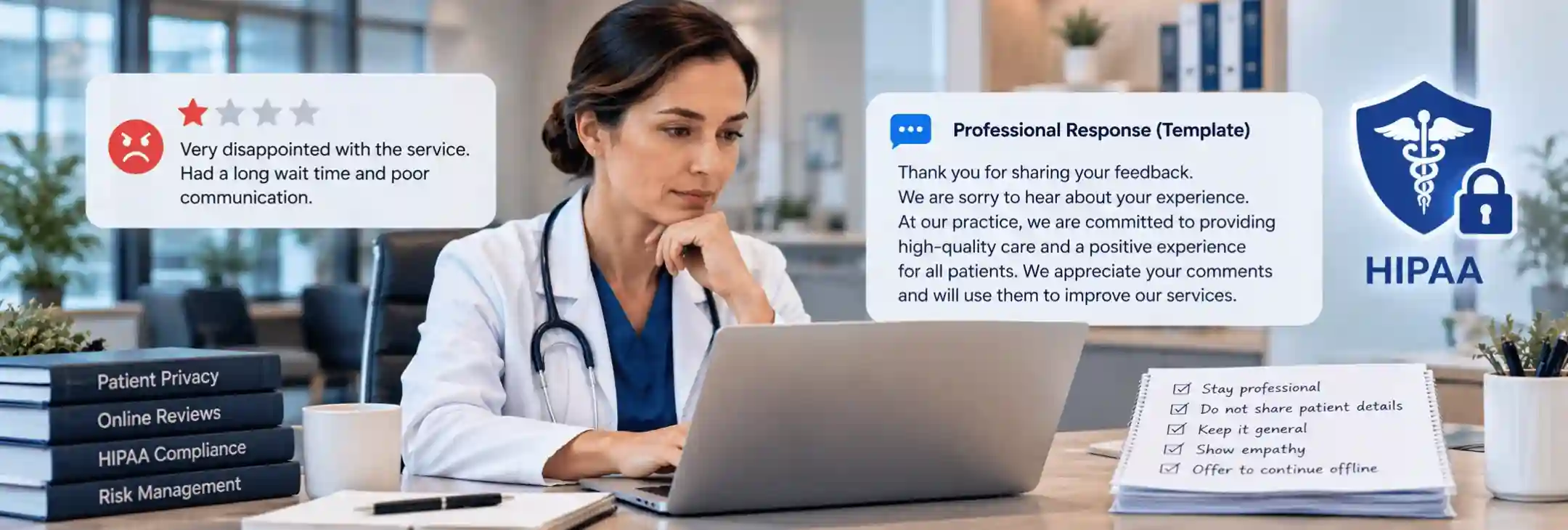

A one-star review can feel personal, especially when the details seem unfair or simply wrong. Most doctors and dentists feel the urge to explain their side right away. That instinct is where the real danger starts. A clear plan to respond to negative reviews under HIPAA protects your patients, your license and the reputation your team has spent years building in your local community.
The Quick Answer: How to Reply to Negative Reviews the HIPAA-Compliant Way
The safest reply never confirms that the reviewer is a patient and never mentions any visit, treatment or bill. A good reply stays short, general and courteous, and it invites the person to call the office privately. Federal regulators have fined several practices for revealing patient details in public review replies.
The rule protects patient privacy even when the patient shares those details first. Most negative patient reviews deserve a reply, but never a detailed one. Any team that wants to respond to negative reviews under HIPAA can build every reply around this single principle.
Why Review Replies Create HIPAA Risk for Medical and Dental Practices
Patients can post almost anything about their own care online. Providers do not have the same freedom. The HIPAA Privacy Rule requires written authorization before a practice discloses identifiable health details about anyone.
A patient's public review does not count as that authorization. Those details remain protected health information in the provider's hands, so the practice cannot confirm or expand on them.
Names, visit dates, treatment plans, insurance details and balances all qualify once they connect a person to care. A reply as simple as "we remember your visit" confirms a care relationship, and compliance experts treat that confirmation as a disclosure.
Real Penalties Practices Have Paid for Review Replies
Federal regulators have acted on this exact mistake several times. Each case below started with one unhappy patient and one defensive reply.
- A Dallas dental practice paid $10,000 in 2019 after its Yelp replies revealed a patient's last name, treatment plan, insurance and cost details.
- A North Carolina dental office received a $50,000 civil money penalty in 2022. The reviewer had posted under a pseudonym, yet the office replied with his real name and health information.
- A California dental practice paid $23,000 in late 2022. Some of its Yelp replies added full names where patients had only used a screen name.
- A New Jersey psychiatric practice paid $30,000 in 2023 after a Google reply described a patient's mental health diagnosis and treatment. Investigators found similar replies to three other patients.
The North Carolina office ignored a federal data request and a subpoena, and that silence left it with the full penalty.
Three of these practices also lacked the policies the HIPAA Privacy Rule requires, so no one on staff knew where the line sat. These cases explain why every team needs a clear way to respond to negative reviews under HIPAA before the next complaint arrives.
The fine is rarely the highest cost. Prospective patients read Google reviews for doctors closely, and they read the replies too. A hostile reply shows them how the practice treats patient privacy when it feels attacked. Strong healthcare reputation management starts with that one reply.
Also Read: How Reviews Shape Local SEO for Medical Practices in 2026
What You Must Never Say in a Reply to a Patient Review
Most HIPAA trouble in review replies comes from a handful of predictable phrases. Practice owners rarely mean any harm. They simply want the public record to look fair. The details below should never appear in a public reply.
1. Any confirmation of a care relationship, such as "you were here last Tuesday" or "we checked our records"
2. Clinical details, including a diagnosis, procedure, medication or test result
3. Visit specifics like appointment dates, the provider involved or the length of a visit
4. Billing and insurance facts, such as balances, copays or claim denials
5. The reviewer's real name when the person posted under a nickname or initials
6. Blame or sarcasm that hints at missed appointments, unpaid bills or treatment choices
Each item on this list counts as protected health information once it links a person to care. A stranger who reads the reply should learn nothing about whether the reviewer ever set foot in the practice. Real patient confidentiality depends on that discipline every single time.
Risky Replies Compared With Safer Alternatives
Small wording changes remove the risk and still keep the tone warm. The table below shows how.
Teams that respond to negative reviews under HIPAA with confidence usually keep a list like this beside the front desk computer.
A Safe 4 Step Framework for Replying to Negative Patient Reviews
A steady process keeps emotion out of the reply. It also keeps patient confidentiality intact, whether the practice is a solo dental office or a group with several locations.
Step 1. A Short Pause Before Anyone Replies
A reply that comes from frustration almost always shares too much. Many practices set a rule that no reply goes live within the first few hours. That window gives the owner time to cool down and gives the manager time to check whether the review breaks platform rules.
Step 2. A Privacy Check on Every Draft
The person who approves the draft looks for names, dates, treatments, costs and any hint of a care relationship. Good HIPAA-compliant review responses depend on what the draft leaves out. A second set of eyes, ideally the privacy officer, catches what a stressed owner misses.
Step 3. A Short, General and Courteous Reply
The strongest HIPAA-compliant review responses run between two and four sentences. They show appreciation, express concern and mention the practice's general standards. Future patients notice the tone far more than the length.
Step 4. A Private Channel for the Real Conversation
The reply ends with a phone number or email for the office manager. That shift moves the discussion to a private setting where staff can verify identity and talk through details safely. Some reviewers update their rating after a genuine conversation, which helps a Google Business Profile more than any public argument.
A written review policy ties these steps together. The policy names who monitors reviews, who approves replies and when an issue goes to a compliance officer or attorney. This framework turns the urge to argue into a repeatable way to respond to negative reviews under HIPAA.
HIPAA-Compliant Reply Templates for Common Negative Reviews
The review reply templates below give your team a safe starting point. Each one avoids confirming a care relationship and moves the conversation offline. Ready wording makes it far easier for busy staff to respond to negative reviews under HIPAA without drafting from scratch.
The text in brackets marks the details to swap in before posting. Small edits to match your practice's voice keep each reply from sounding canned.
Reply Templates for Wait Time Complaints
Wait time complaints are the most common and the easiest to answer safely. The reply speaks to scheduling in general and never touches the reviewer's visit.
Template 1 for a Brief, Warm Reply
We appreciate you taking the time to share this feedback. Our team works hard to respect every patient's time, and we never want anyone to feel forgotten. Our office manager, [Name], would welcome a call at [phone number] to talk this through.
Template 2 for a Reply That Shows Action
We hear this concern, and we take scheduling feedback seriously. Our team reviews scheduling patterns every week to find ways to reduce delays. We would value a direct conversation at [phone number].
Reply Templates for Billing Complaints
Billing reviews tempt staff to explain the numbers. Any mention of a balance, copay or insurer exposes protected health information in a public forum.
Template 1 for General Billing Concerns
We understand how frustrating billing questions can be. Our billing team is happy to look into any concern in a private conversation. You can reach our office at [phone number] or [email], and someone will respond within one business day.
Template 2 for Insurance Frustrations
Insurance rules confuse many families, and we want to answer every question clearly. Our team cannot discuss account matters in a public forum. A member of our billing staff would welcome a call at [phone number].
Reply Templates for Clinical Outcome Complaints
Clinical complaints sting the most because they touch professional pride. These replies deserve extra care, and a compliance officer or attorney should approve any reply when the review hints at legal action.
Template 1 for Dissatisfaction With Results
We are sorry to hear about this concern. Our providers care deeply about every outcome, and privacy laws prevent us from discussing individual care online. Our practice manager, [Name], would like to speak with you directly at [phone number].
Template 2 for a Serious or Emotional Complaint
We take every concern about care quality seriously. Federal privacy rules prevent us from discussing any health matter in a public setting. Our medical director would welcome the chance to listen and respond personally at [phone number].
Reply Templates for Fake or Unknown Reviewers
A review that looks fake still deserves a calm public reply. The reply should never say the person was not a patient, because that statement also reveals information about who is. The practice can report suspected fake reviews separately while the polite reply stays visible.
Template 1 for an Unfamiliar Review
We take all feedback seriously and want to understand this concern. Our team would appreciate a direct conversation to learn more. [Name] is available at [phone number] or [email].
Template 2 for a Suspected Competitor or Spam Post
We hold ourselves to high standards and welcome honest feedback from our community. Anyone with a question about our practice can reach our office directly at [phone number]. We look forward to hearing from you.
Also Read: Why Isn't My Clinic Showing Up on Google? 7 SEO Mistakes US Healthcare Practices Make
When to Flag or Report a Review on Google
Some reviews cross the line from criticism into a policy violation. Google removes reviews that break its content policies, but it does not remove a review just because a business disagrees with it. The platform also stays out of disputes between businesses and their customers. Reviews in these categories are worth reporting.
1. Spam and fake content that does not reflect a genuine experience
2. Conflict of interest, such as posts from competitors or former employees
3. Offensive or harassing language, including threats and hate speech
4. Off topic posts that have nothing to do with the practice
5. Personal information about staff members or other individuals
The owner of a verified Google Business Profile can report a review from the profile or through the Reviews Management Tool. A rejected report qualifies for one appeal. Practices that save screenshots and dates for every flagged post have a much easier time following up.
The report tool works best for obvious fake reviews and clear policy breaches, not for honest complaints. A defamatory post or a direct threat calls for an attorney rather than a public reply. Lawsuits rarely help a reputation, and they often draw more attention to the original review.
Practices with several locations find that tracking Google reviews for doctors takes real time each week. Many hand the job to a partner that offers reputation management services built around HIPAA. A practice that knows when to flag a post and when to respond to negative reviews under HIPAA spends far less energy on online battles.
Final Thoughts on “How to Respond to Negative Reviews Under HIPAA”
To respond to negative reviews under HIPAA, healthcare practices must prioritize patient privacy while maintaining a professional online reputation. Keep replies brief, courteous, and general. Train staff to follow clear response policies, move discussions offline, and report policy violations when necessary. These steps build trust and reduce compliance risks.
At Rankingeek, we help healthcare practices manage their online reputation while protecting patient privacy. Our reputation management services help monitor patient reviews, handle negative feedback professionally, and identify reviews that may violate platform policies. This allows your practice to build patient trust, maintain HIPAA-conscious communication, and strengthen its online presence.
FAQs About Responding to Negative Reviews Under HIPAA
Can I say "we have no record of you" in a reply?
That phrase carries real risk, because it suggests staff searched patient records. It also indirectly reveals who is or is not a patient, so a neutral reply that invites the author to call the office is the safer choice.
Should I respond to every negative review?
A short, courteous reply to most negative reviews shows future patients that the practice listens. Posts with threats, hate speech or obvious fake reviews are better reported than answered.
Can a negative review be removed from Google?
Google removes a review only when it breaks a content policy, such as spam, conflict of interest or offensive language. The owner can report it from the Google Business Profile dashboard. An honest but harsh review usually stays live, and a rejected report allows one appeal.
Does HIPAA still apply if the patient shared their own health details?
The HIPAA Privacy Rule still applies in full. A patient's own disclosure does not give the practice permission to confirm it or add more detail. Any practice that plans to respond to negative reviews under HIPAA treats every patient post as confidential.
Do the same rules apply on Yelp, Facebook and Healthgrades?
The same privacy obligations apply on every review platform. One consistent set of review reply templates keeps every response safe, wherever it appears.