
.png)



Australian medical practices are being targeted by SEO agencies that promise rankings, deliver nothing, and sometimes leave practices exposed to serious regulatory risk. Knowing how to spot bad SEO before you sign a contract isn't just smart budgeting; it's a compliance issue that can protect your practice from significant financial penalties.
Key Takeaways
- As of July 2026, legitimate medical SEO in Australia costs $1,500 to $5,000+ per month.
- AHPRA introduced stricter advertising guidelines effective September 2, 2025, creating new compliance traps that generalist agencies routinely miss.
- Guaranteed rankings, secret strategies, and asset-hostage tactics are the clearest signals of a bad-faith agency.
- The risk of non-compliance falls on the practice, not the agency.
Why Australian Medical Practices Are Prime Targets for Dodgy SEO Agencies
The ACCC has previously flagged SEO and digital marketing scams as a significant issue for small businesses, noting complaints about agencies over-promising and under-delivering. Small medical practices sit squarely in the crosshairs. They have real marketing budgets, limited in-house expertise, and a strong incentive to grow patient bookings fast.
The compounded risk for a medical practice is what makes this genuinely dangerous. A bad agency doesn't just waste your budget. It can produce content that violates AHPRA's advertising guidelines, turning a failed marketing strategy into a regulatory liability. That combination of wasted spend and compliance exposure is why healthcare-specific digital marketing matters more in this sector than almost any other.

What Legitimate Medical SEO Actually Costs in Australia
As of July 2026, the average cost for legitimate SEO services in Australia ranges from $1,500 to $5,000+ per month. Medical and regulated health services typically sit at the higher end of that range, because compliance overhead is real work that takes real time.
That context matters when evaluating proposals. Sub-$1,000/month offers almost never include proper keyword research, technical SEO audits, compliant content production, or meaningful reporting tied to patient enquiries. At that price point, you're likely getting automated link building or templated on-page SEO that adds no genuine value and can invite search engine penalties. Price signals capacity. An agency that can't price for compliance probably isn't doing it.
5 Red Flags That Signal a Scam SEO Agency
Learning to spot bad SEO comes down to pattern recognition. These five patterns show up repeatedly.
- Guaranteed #1 rankings:- Google's own guidelines state explicitly that no third-party SEO service can guarantee ranking performance. Any agency promising a specific position is either lying or doesn't understand how search rankings work. Walk away.
- The "secret strategy" excuse:- Legitimate agencies explain their methods. They show you what on-page SEO, off-page SEO, and technical SEO work looks like in practice. If an agency claims proprietary methods they can't describe, that's a transparency problem, not a competitive advantage. Agencies that refuse to explain their approach or share case studies are displaying a common scam warning sign.
- Asset-hostage tactics:- Some agencies retain ownership of your website, domain, or Google Business Profile to prevent you from leaving. A common variation involves unauthorised access to your Google Business Profile or Meta Business Suite, effectively holding your digital infrastructure hostage. Any contract that doesn't give you full admin credentials from day one is a structural red flag.
- AHPRA-blind content:- Generalist agencies apply e-commerce tactics to medical clients without understanding the regulatory environment. That means patient testimonials and promotional pricing for cosmetic procedures, both of which can breach AHPRA's guidelines. This isn't a minor oversight. It's a direct liability for your practice.
- Vanity metrics reporting:- Website traffic and search rankings are inputs, not outcomes. If your monthly report shows Google Analytics data but never connects it to booked appointments or qualified consult requests, the agency isn't measuring what your practice actually needs. ROI means patients in chairs, not impressions on a dashboard. You can see what outcome-focused medical practice SEO looks like in practice before committing to anything.
The AHPRA Compliance Risk Generalist Agencies Ignore
Effective September 2, 2025, AHPRA introduced stricter advertising guidelines specifically targeting higher-risk cosmetic procedures. Standard digital marketing tactics that work fine for a retail brand can directly violate these rules when applied to injectables, laser treatments, or other regulated cosmetic services.
The financial stakes are significant. According to industry reporting, as of July 2026, AHPRA penalties for breaching advertising guidelines can reach $60,000 per breach for an individual practitioner and $120,000 for a corporate entity. Those penalties don't fall on the agency. They fall on you.
Vetting SEO companies in Australia isn't just a marketing decision for a medical practice. It's a compliance decision. An agency that doesn't proactively raise AHPRA considerations in the sales conversation almost certainly won't manage them in the work either. Explore what compliance-ready healthcare marketing services actually include before you evaluate any proposal.
Also Read:- AHPRA Compliant SEO for Australian Clinics: Rank Without the Legal Risk
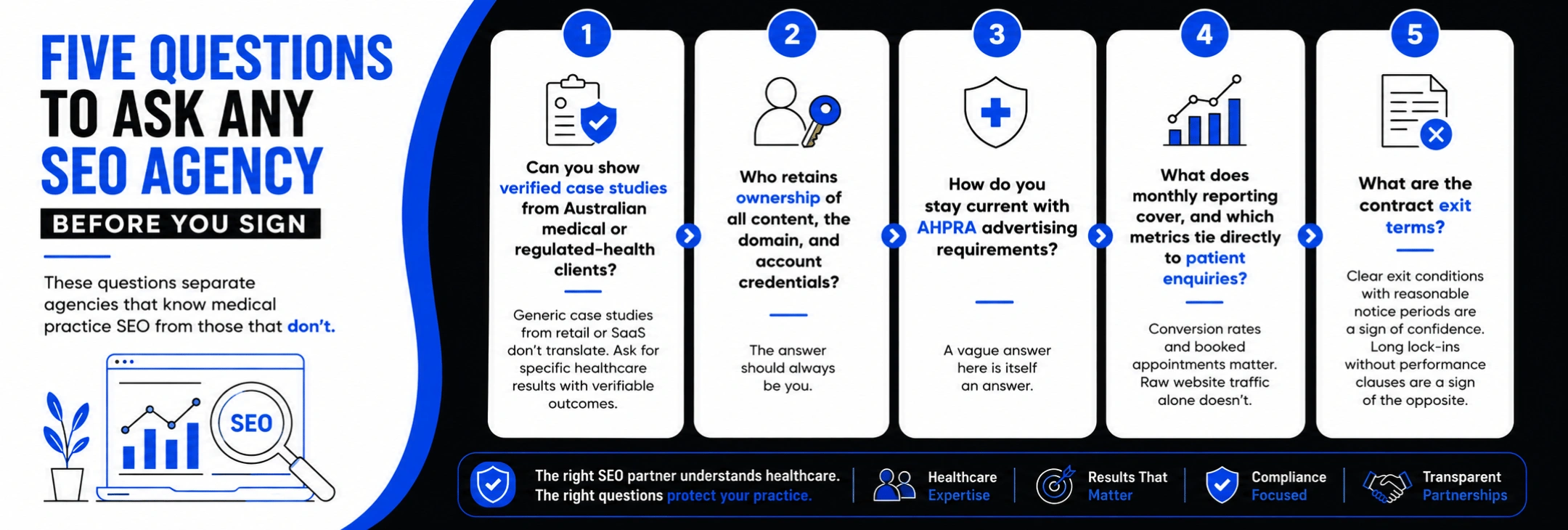
Five Questions to Ask Any SEO Agency Before You Sign
These questions separate agencies that know medical practice SEO from those that don't.
- Can you show verified case studies from Australian medical or regulated-health clients? Generic case studies from retail or SaaS don't translate. Ask for specific healthcare results with verifiable outcomes.
- Who retains ownership of all content, the domain, and account credentials? The answer should always be you.
- How do you stay current with AHPRA advertising requirements? A vague answer here is itself an answer.
- What does monthly reporting cover, and which metrics tie directly to patient enquiries? Conversion rates and booked appointments matter. Raw website traffic alone doesn't.
- What are the contract exit terms? Clear exit conditions with reasonable notice periods are a sign of confidence. Long lock-ins without performance clauses are a sign of the opposite.
Choosing a Safe SEO Partner: What a Trustworthy Agency Actually Looks Like
A trustworthy agency has a verifiable Australian presence, transparent pricing, and contract terms that don't trap you once the work begins. They don't wait for you to ask about AHPRA. They bring it up themselves, because they understand that your regulatory exposure is part of their job.
The bottom-line judgment when hiring an SEO expert in Australia is simple: does this agency reduce your compliance risk while delivering measurable patient-growth outcomes? Rankings are a means to an end. The end is qualified consult requests that convert to booked appointments.
If you want to avoid SEO scams in Australia and get a clear picture of where your current digital marketing strategy actually stands, book a free practice growth audit. It takes 24 hours to get a straight answer on what's working and what's creating risk.
Frequently Asked Questions
Can a freelance SEO consultant be a safer option than an agency for a medical practice?
Freelancers can be legitimate, but they carry higher single-point-of-failure risk if they're sick, unavailable, or exit the arrangement. Vetting requirements are identical: verify AHPRA familiarity, check healthcare-specific case studies, and confirm you retain all asset ownership from day one.
If an agency has already caused an AHPRA breach, what's the practice's immediate priority?
Address the non-compliant content as quickly as possible, since ongoing publication compounds the exposure. Keep records of what was published and when. Getting qualified legal or compliance advice before responding to any regulator contact is a sensible step.
Does in-house marketing staff eliminate the AHPRA compliance risk that generalist agencies create?
Not automatically. In-house staff face the same compliance obligations and need active training on AHPRA's current guidelines, including the September 2025 cosmetic advertising updates. Compliance risk follows the content, not the employment arrangement of whoever produced it.
Are there advertising rules that apply separately from AHPRA guidelines?
Yes. Depending on the services a practice markets, additional regulatory frameworks may apply beyond AHPRA's guidelines. Generalist agencies rarely account for this, which is another reason healthcare-specific expertise matters when choosing an SEO partner.