
.png)



Local SEO vs. national SEO isn't a technical debate. It's a capital allocation decision that determines whether your clinic fills its schedule or burns budget on traffic that never converts to booked appointments. In 2026, with AI reshaping how patients find care, picking the wrong track costs more than ever.
Key Takeaways
- Local SEO drives foot traffic for physical clinics through Google Business Profile and map pack rankings.
- National SEO builds topical authority for telehealth and multi-state health systems targeting non-geographic queries.
- As of early 2026, healthcare queries trigger Google AI Overviews 88% of the time, requiring Answer Engine Optimization alongside traditional SEO.
- Multi-location clinics need a hybrid approach to avoid keyword cannibalization while maintaining both local and national visibility.
Why Local vs. National SEO Is a Capital Decision for Clinics in 2026
Patient search behavior has shifted in ways that directly affect your patient acquisition model. As of February 2026, healthcare queries trigger Google AI Overviews 88% of the time, up from 72% in 2024. Traditional organic links are losing real estate fast.
Choosing the wrong SEO track underperforms and actively misdirects spend. A dental clinic optimizing for national brand awareness won't fill chairs. A telehealth platform ignoring topical authority won't reach patients outside its zip code. The decision starts with one question: how does your clinic actually acquire patients?
The right clinic SEO strategy aligns your marketing investment with how patients actually discover, evaluate, and book care. Instead of chasing every keyword, clinics should focus on the SEO model that matches their business goals and patient acquisition channels.
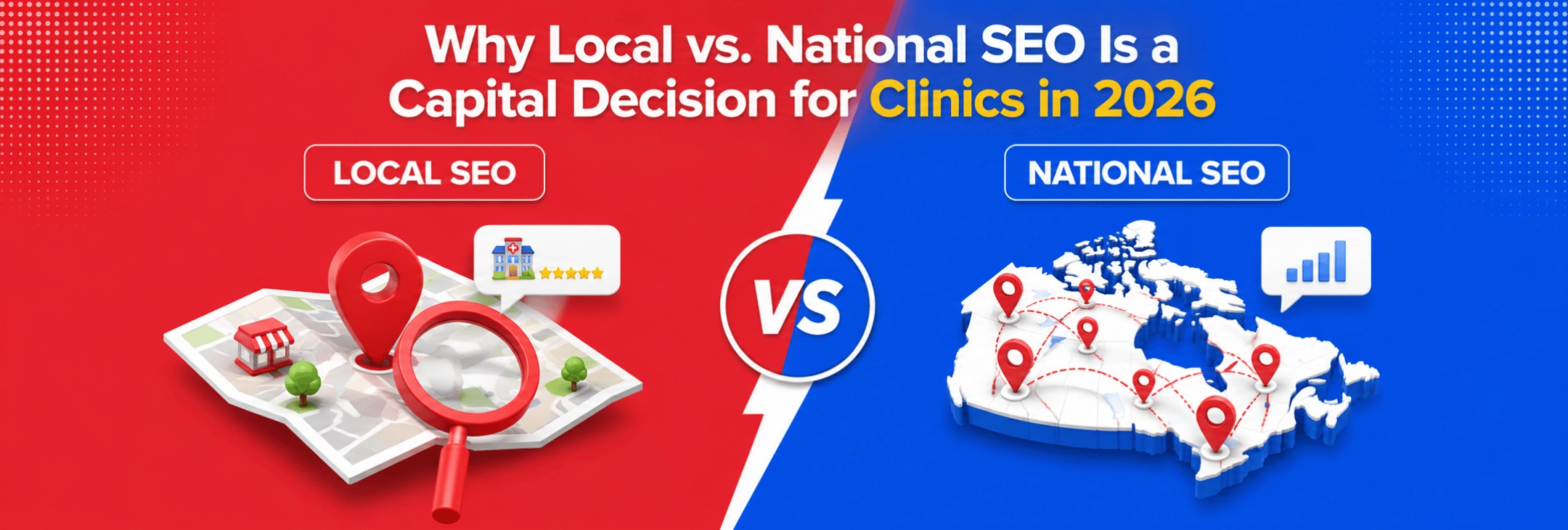
Local SEO: How Physical Clinics Win Patients in Their Backyard
Local SEO for healthcare is built around three core mechanics: Google Business Profile (GBP) optimization, the local map pack, and geo-specific keywords tied to your service area. Google ranks local results based on three pillars: relevance, distance, and prominence, per Google's own Business Profile guidelines.
Those pillars aren't abstract. A complete, accurate GBP signals all three. Complete Business Profiles are 2.7 times more likely to be considered reputable by consumers. Consistently earning positive online reviews further strengthens local trust signals, improves prominence, and can influence both search visibility and patient booking decisions. That directly affects whether a patient calls, books, or scrolls past.
For clinics dependent on foot traffic, local SEO is the primary patient acquisition engine. Geographic targeting down to the neighborhood level determines who sees you first. Physical clinics relying on regional patient traffic benefit most from this approach.
Among the biggest benefits of local SEO for doctors are higher visibility in nearby searches, stronger patient trust through local signals, and increased appointment bookings from people actively looking for care within their community.
National SEO: What Telehealth and Multi-State Health Systems Need Instead
National SEO targets broad, non-location-specific queries where geographic targeting isn't the point. A telehealth provider treating patients across multiple states needs organic traffic from searches like "online therapy for anxiety" or "virtual dermatology consult," not "dermatologist near me."
National SEO for medical clinics is most effective for organizations serving patients beyond a single geographic region, including telehealth providers, specialty networks, and multi-state healthcare systems competing across broader search markets.
The investment required is substantial. Building the domain authority and backlink profile needed to compete nationally takes time and consistent content marketing. Google's helpful content guidelines make clear that medical content must demonstrate Expertise, Experience, Authoritativeness, and Trustworthiness (E-E-A-T) to rank and to be cited by AI systems. That means clinician-authored content, credible sourcing, and website optimization that signals medical legitimacy at scale.
National SEO is the right track for telehealth providers, multi-state health systems, and nationwide healthcare services where brand awareness across a wide competitive landscape matters more than map pack placement.
Local SEO vs. National SEO: Side-by-Side for Healthcare
The table below maps the decision criteria for clinic owners choosing between the two strategies.
The sharpest divergence is scope. Local SEO can produce map pack visibility when GBP and citations are in order. National SEO requires sustained investment before search rankings and organic traffic move meaningfully.
AI Overviews and AEO: The 2026 Layer Both Strategies Must Address
Here's what changes the math for every clinic, regardless of which SEO track fits: as of February 2026, healthcare queries trigger Google AI Overviews 88% of the time. That's the majority of your patients' searches returning AI-generated answers before a single organic link appears. Answer Engine Optimization (AEO) is no longer optional.
The citation data is worth analyzing in detail. As of January 2026, YouTube is the single most cited source in health-related AI Overviews, accounting for 4.43% of all citations, outpacing traditional hospital sites. Nearly two-thirds of AI Overview citations for health queries come from sources without strong medical or evidence-based safeguards. That's both a risk and an opening.
Clinics that produce E-E-A-T-compliant content, including video, are positioned to capture AI citations that less credible sources currently hold. For a healthcare digital marketing strategy to work in 2026, it has to account for this layer. AEO sits on top of both local and national SEO, not separate from them.
Which SEO Strategy Fits Your Clinic, and How to Measure It
Match your clinic type to the right track. Single-location physical practice? Local SEO is your foundation. Knowing when to use national SEO for clinics comes down to whether your services extend beyond a local service area. Clinics offering virtual care, nationwide programs, or educational healthcare resources often benefit from building national search visibility.
Telehealth or multi-state system? National SEO builds the topical authority and online visibility you need. Multi-location? A hybrid approach using localized pages per location, combined with national domain authority, is the only model that works without triggering keyword cannibalization.
When multiple location pages compete on the same terms, search engines struggle to determine which page best serves the query. The fix is hyper-local differentiation per page, ensuring each location targets distinct neighborhood-level or city-level terms rather than competing on the same phrase.
For local campaigns, track map pack rankings and GBP actions (calls, direction requests, website clicks). For national campaigns, watch non-branded organic traffic and domain authority trends. Both tracks feed the same end metric: booked appointments.
If you're unsure which track fits your clinic's footprint and patient acquisition model, book a free practice growth audit with Rankingeek Marketing Agency. The audit identifies exactly where your search visibility gaps are and which strategy closes them fastest.
Frequently Asked Questions
Does ChatGPT also pull from clinic websites, and should that change how I create content?
Yes, as of early 2026, roughly 25% of weekly active ChatGPT users globally search health-related questions, so AI visibility extends beyond Google. E-E-A-T-compliant, clinician-authored content improves citation chances across multiple AI platforms, not just Google's AI Overviews.
Can a single-location clinic ever justify national SEO spending?
A single-location clinic can justify national SEO spending if it sells a digital product, publishes paid online courses, or earns revenue from non-local audiences. For a purely appointment-driven single location, national SEO spend rarely returns enough booked patients to justify the longer authority-building timeline.
What are the compliance risks specific to patient-facing SEO content that clinic owners should know about?
Advertising rules for medical clinics vary by jurisdiction. A qualified compliance advisor should review any patient-facing content before it publishes, regardless of which SEO track you choose.
How does keyword cannibalization actually hurt a multi-location clinic's bookings?
When multiple location pages compete on the same terms, search engines struggle to determine which page best serves the query. The fix is hyper-local differentiation per page, ensuring each location targets distinct neighborhood-level or city-level terms rather than competing on the same phrase.