
.png)



Table of Contents
- Abstract
- Methodology and data governance
- Executive summary — the three-year picture
- How the industry’s search behaviour changed
- The channel shift: organic overtakes paid
- Branded vs non-branded search — the brand-equity flywheel
- The economics: doing more with less paid spend
- Which keywords stopped working — and which took over
- The AI-assistant trend — the first measurable wave
- Period-by-period detail
- What this means for the physiotherapy industry
- Limitations
- Conclusion
Abstract
This paper examines three years of first-party digital data from a single, established physiotherapy clinic in Winnipeg, Canada, to document how patient search behaviour — and the economics of acquiring a patient online — have changed between 2024 and 2026. Rather than a marketing testimonial, it is written as a field study: every figure is drawn directly from the clinic's own Google Analytics, Search Console, and Google Ads records, and each data source is kept in its own lane to avoid the mixing errors that make most agency 'case studies' unreliable.
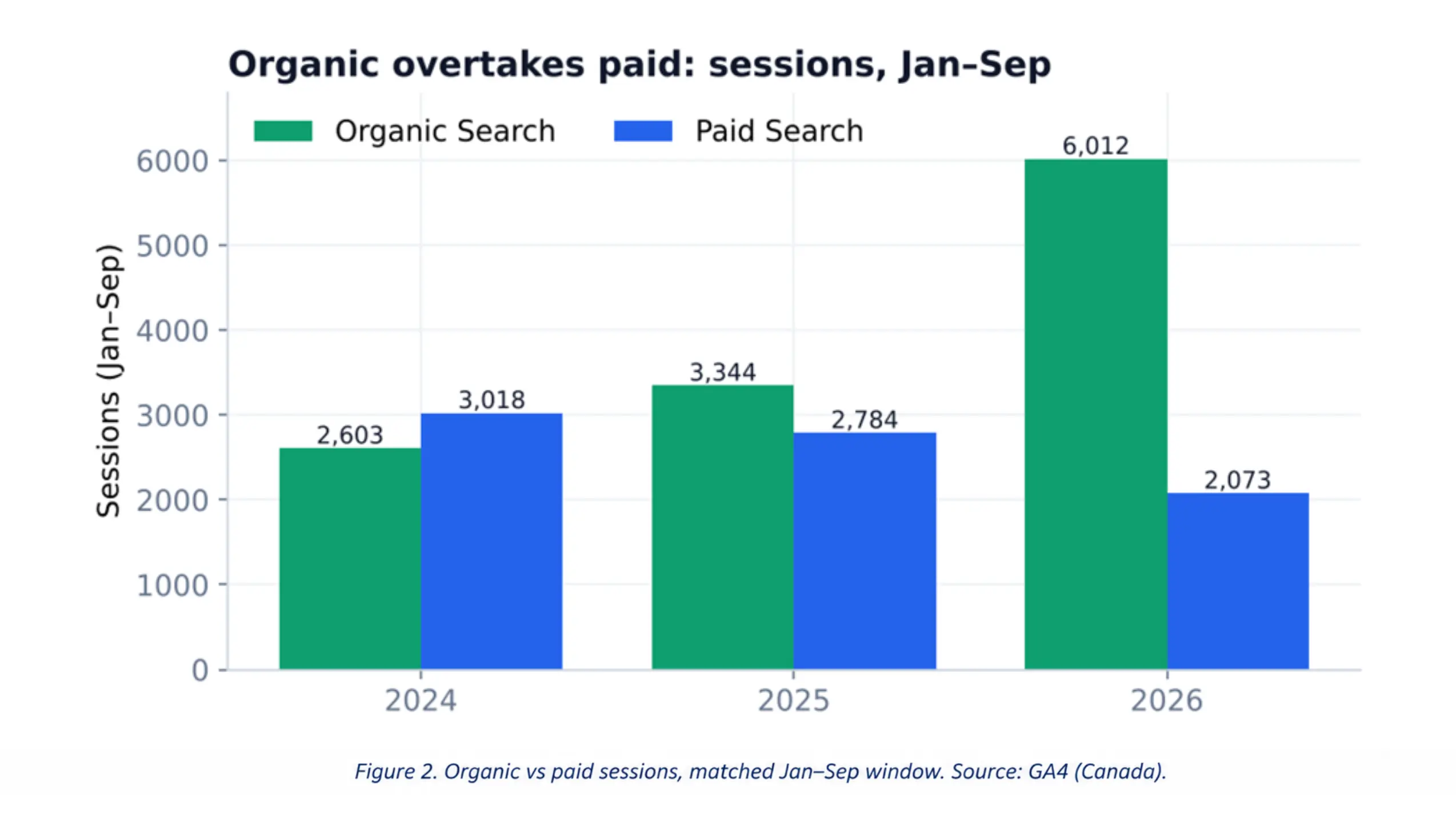
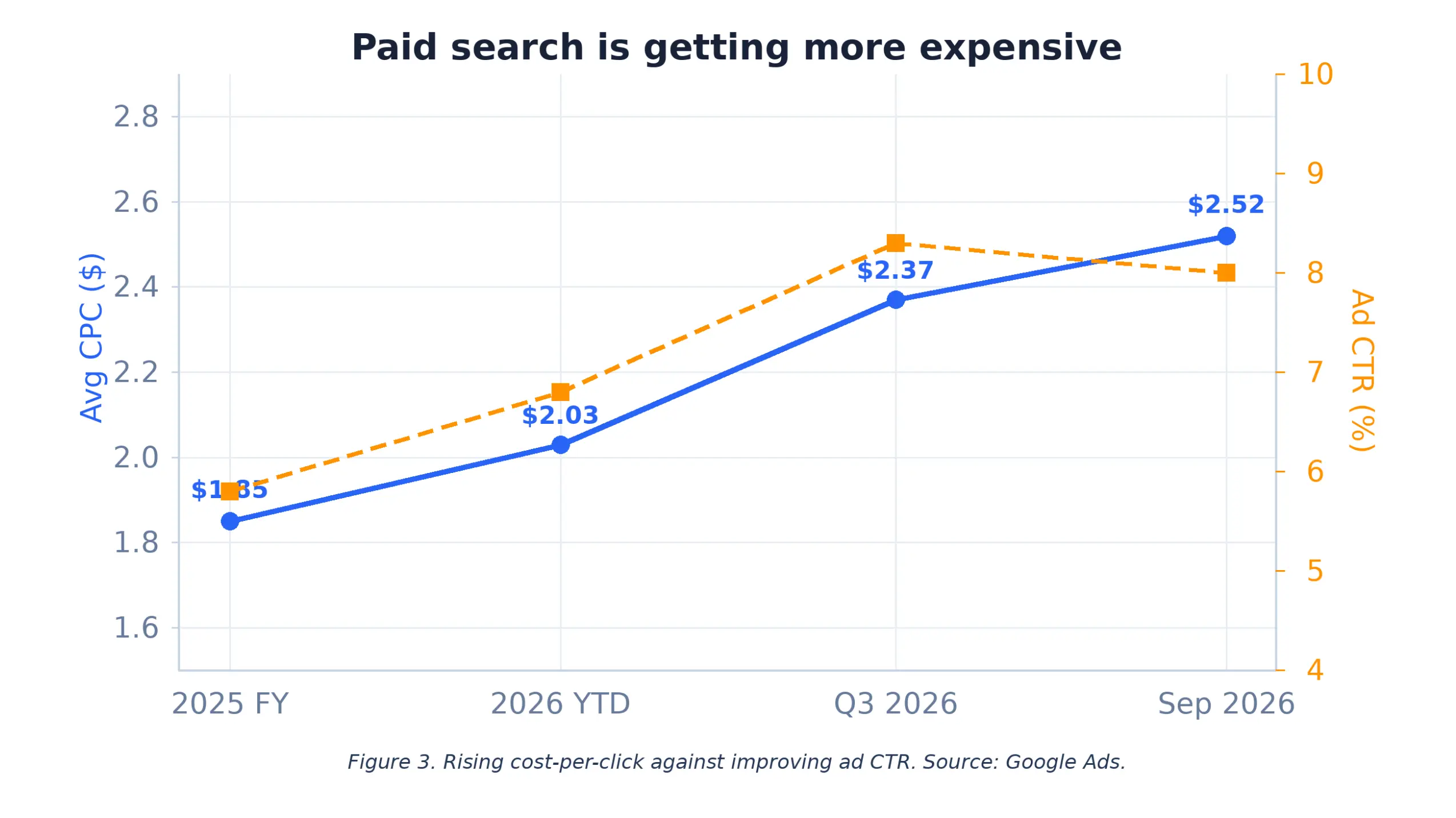
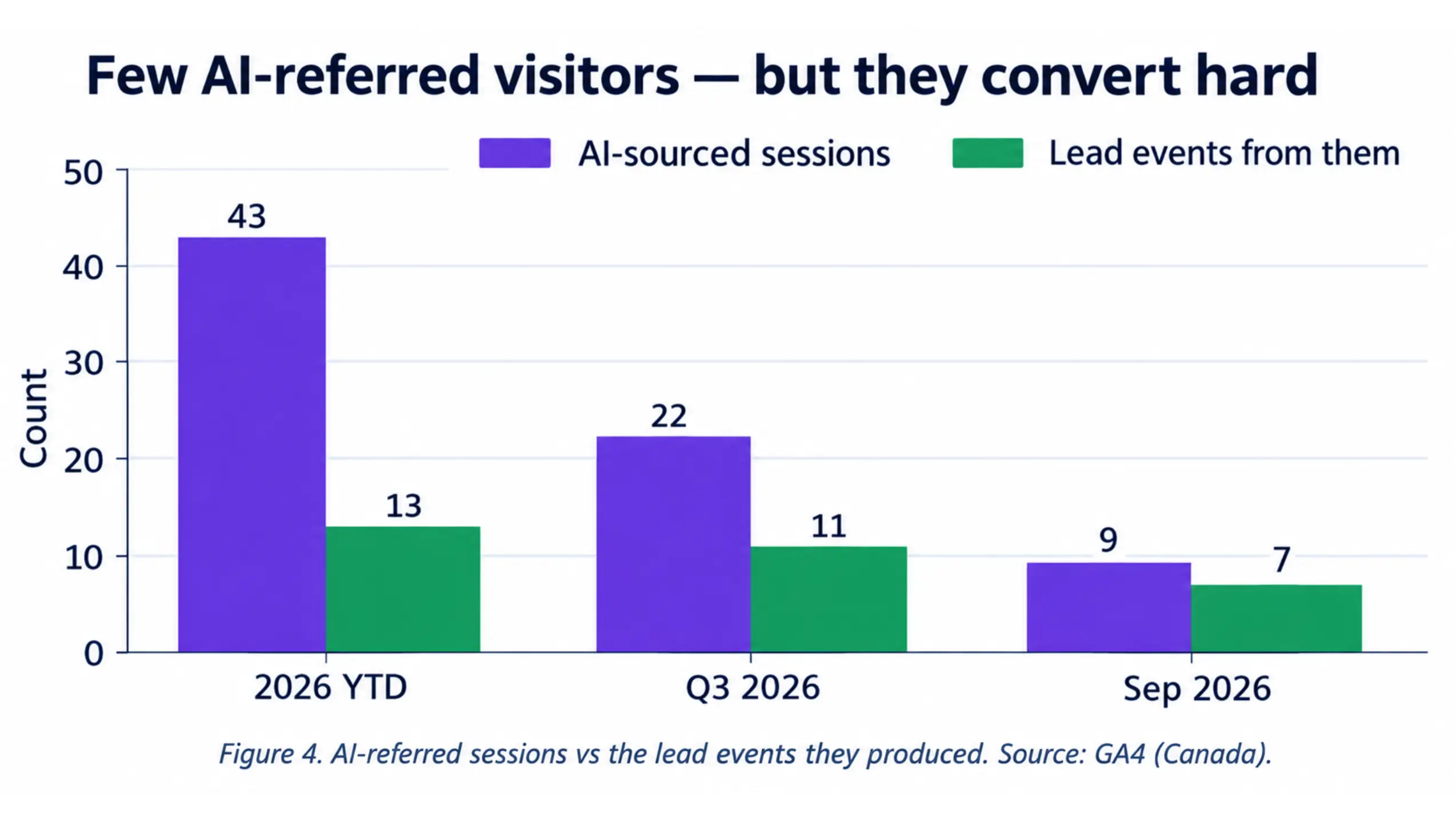
Three findings stand out. First, organic search has overtaken paid search as the clinic's primary growth engine: organic sessions in the January–September window rose from 2,603 (2024) to 6,012 (2026), a 131% increase, while paid sessions fell 31% over the same window — yet total tracked leads still nearly doubled, from 1,216 to 2,400. Second, paid search is becoming structurally more expensive: average cost-per-click rose from $1.85 to $2.52 even as ad click-through rates improved, confirming an industry-wide cost squeeze that rewards clinics with strong organic foundations. Third, and most notably, 2026 is the first year in which AI assistants (ChatGPT, Perplexity, Gemini) appear as a distinct, measurable traffic source — small in volume but converting at a strikingly high rate.
1. Methodology and data governance
Credibility in analytics comes less from the size of the numbers than from the discipline of not mixing incompatible ones. Four rules governed this study:
- Audience lens — Canada only: All Analytics and Search Console figures are filtered to Canada, the clinic's actual market, so that out-of-market and international noise never inflates the behaviour story.
- Advertising lens — kept separate: Google Ads platform metrics (cost, CPC, cost-per-lead, impressions) are reported only from the ad platform's own records, which are not country-filtered. We never equate ad-platform clicks with on-site sessions, because they are different events measured by different systems.
- Like-for-like time windows: Because 2026 is a partial year, year-over-year comparisons use a matched January–September window built from monthly data, rather than comparing a partial year against full years.
- Known data limits are stated, not hidden: Search Console history before mid-June 2025 was not retained by the platform and is therefore unavailable. Conversion (key-event) tracking for this property began in May 2024, so 2024 lead totals are conservative. Both facts are flagged wherever they touch a figure.
2. Executive summary — the three-year picture
The headline table below uses the matched January–September window so the three years are directly comparable.
.webp)
3. How the industry's search behaviour changed
Search Console shows the demand side — what patients actually type, and how often the clinic appears. Within the windows available (Search Console only retained data from mid-June 2025 onward), visibility expanded dramatically:
Patients search like patients — on mobile, during the day, in their own words
- Mobile is the front door: In 2026, mobile holds an average Google position of 6.8 against desktop's 28.0, and mobile drives roughly two-thirds of organic clicks. Physiotherapy is searched in pain, on a phone.
- Local intent dominates: The strongest non-branded terms are explicitly local — “physiotherapy winnipeg,” “pelvic floor physiotherapy winnipeg,” “hand physiotherapy winnipeg” — and even insurance-specific: patients search how Manitoba Public Insurance (MPI) and WCB cover treatment after an accident.
- Condition questions, not service names: The pages that pull the most patients are educational answers to symptoms — meniscus tears, shoulder-blade pain, knee clicking, upper-back pain, runner's knee — not generic “our services” pages.
4. The channel shift: organic overtakes paid
The clearest structural change across the three years is the crossover between organic and paid search. In 2024 the clinic bought most of its visibility; by 2026 it earns it.
5. Branded vs non-branded search — the brand-equity flywheel
One split inside the organic story deserves its own section, because it is the clearest sign of a healthy, compounding practice: the balance between branded search (patients typing the clinic’s name) and non-branded search (patients describing a condition or a location). Across the measured windows, both grew — and that combination is exactly what durable brand-building looks like.

Why rising branded search is the signal that matters
Branded search is demand the clinic owns: When a patient searches the clinic by name, they are almost always a returning patient, a word-of-mouth referral, or someone who discovered the clinic earlier and has come back ready to book. These queries sit at the very top of Google — the clinic’s own name holds an average position of roughly 1.4 with a 36% click-through rate — so this is traffic that is both high-intent and essentially free to serve.
The discovery-to-brand loop: A patient typically arrives the first time on a condition article — “meniscus tear recovery time,” “runner’s knee stretches” — or on the map listing. They have a good experience, and the next time they need care they skip the research entirely and search the clinic’s name directly. Today’s non-branded discovery becomes tomorrow’s branded demand — which is why content and brand are not separate programmes: one feeds the other.
What the shift from 64% to 50% actually means — and why it is good: Branded clicks grew in absolute terms (762 to 1,173), showing the clinic is becoming better known. At the same time the non-branded share climbed from 36% to 50%, showing the clinic is winning more brand-new patients than ever before. A practice that grew only branded search would be coasting on past reputation; one that grew only non-branded would be churning strangers who never return. Growing both at once is the flywheel: discovery builds reputation, and reputation lowers the cost of acquiring the next patient.
6. The economics: doing more with less paid spend
The advertising lens (Google Ads platform data, reported separately from the on-site figures) tells a consistent story: paid search still works, but every click costs more each period, which is precisely why a compounding organic channel matters so much.
7. Which keywords stopped working — and which took over
A recurring question from clinic owners is why ranking for the “big” industry term no longer delivers. The data answers it cleanly. Broad head terms now generate impressions but almost no clicks, because the results page for them is filled with the Maps pack, ads, and AI overviews before a single standard organic link appears.
8. The AI-assistant trend — the first measurable wave
This is the part of the dataset that did not exist two years ago. In 2024, AI tools sent this website essentially one referral all year. In 2025, a handful arrived (ChatGPT, Perplexity, Grok). In 2026, Google Analytics began classifying a distinct “AI Assistant” channel, and AI tools became a named, repeatable source of real patients.
What this data does — and does not — prove about AI
- Proven here: AI assistants now refer real, high-intent human patients who convert, and the trend is accelerating month over month.
- Not measurable here (stated honestly): the volume of AI crawlers (GPTBot, ClaudeBot, PerplexityBot and others) reading the site. Analytics and Search Console only record humans; crawler activity lives in server logs. Any claim that “AI bots are crawling us” cannot be made from this dataset — and shouldn't be, by anyone.
- The next frontier: clinics and agencies that begin analysing server logs now will be the first to quantify how AI systems read and cite local businesses — the logical successor to the SEO reporting of the last decade.
9. Period-by-period detail
For completeness, each reporting period is summarised on its own terms. Leads are tracked key events; sessions and leads are Canada-filtered Analytics; ad figures are platform data.
2024 — the paid-led baseline
9,161 sessions and 2,301 tracked leads for the year, with paid search the largest single channel (4,008 sessions). Conversion tracking only began in May 2024, so the true lead figure is higher than recorded. This is the “before”: a clinic dependent on bought visibility.
2025 — the crossover year
9,530 sessions and 2,173 recorded leads. Organic search overtook paid in sessions for the first time (4,813 vs 3,553), and organic lead volume rose even as paid lead volume slipped. A content and technical rebuild during this period — migrating legacy pages to clean, topic-focused URLs — laid the groundwork for the 2026 acceleration.
2026 year-to-date — organic compounds
Through 12 October: 8,895 sessions and 2,467 tracked leads, already surpassing each previous full year on leads. Organic now accounts for roughly 69% of all sessions and delivered 1,161 leads; paid delivered 1,061 from far fewer sessions, confirming paid's role has narrowed to high-intent, bottom-of-funnel capture.
Q3 2026 (Jul–Sep) — the steady state
2,643 sessions and 963 leads in the quarter, 69.0% engagement. Organic contributed 1,741 sessions and 499 leads; Winnipeg alone accounted for 351 of those organic leads, underscoring how local the demand is.
September 2026 — a representative month
929 sessions and 372 tracked leads, 69.3% engagement — the highest of any period measured. Organic delivered 668 sessions and 241 leads; the homepage and condition-education articles carried the month.
10. What this means for the physiotherapy industry
- Own your organic foundation before the ad auction forces you to: CPCs rose 36% across these periods. Clinics without an organic engine will watch their cost-per-patient climb with the auction; clinics with one can let paid do only what it does best.
- Write for conditions and your city, not for the industry's biggest keyword: Head terms are now impression-rich and click-poor. Specific symptom answers and local phrasing are what bring patients.
- Treat mobile as the primary experience: Rankings, clicks, and conversions are mobile-first; desktop is the minority.
- Start watching AI now: AI-referred patients are few but convert exceptionally well, and the trend is only accelerating. Being early to understand it is a durable advantage.
11. Limitations
- Search Console data before mid-June 2025 is unavailable (platform retention), so the longest search-demand trends begin in H2 2025.
- Conversion tracking began in May 2024; full-year 2024 lead totals are therefore conservative, and year-over-year lead comparisons use matched Jan–Sep windows.
- 2026 figures run to 12 October and are labelled year-to-date wherever used.
- Google Ads platform metrics are not country-filtered and are reported only as advertising-platform data, never blended with on-site Analytics.
- This study measures human visitors, including those referred by AI assistants; it does not measure AI crawler/bot activity, which requires server-log analysis.
12. Conclusion
Across three years, a single Winnipeg physiotherapy clinic's data tells a story that generalises to the whole local-service sector. Patients moved to mobile, to condition-specific questions, and increasingly to AI assistants for recommendations. The economics of paid search tightened. And the clinics that will win are the ones that built an organic, content-led foundation — earning visibility for the exact questions patients ask, in the city they ask them from — rather than renting it by the click.