
.png)

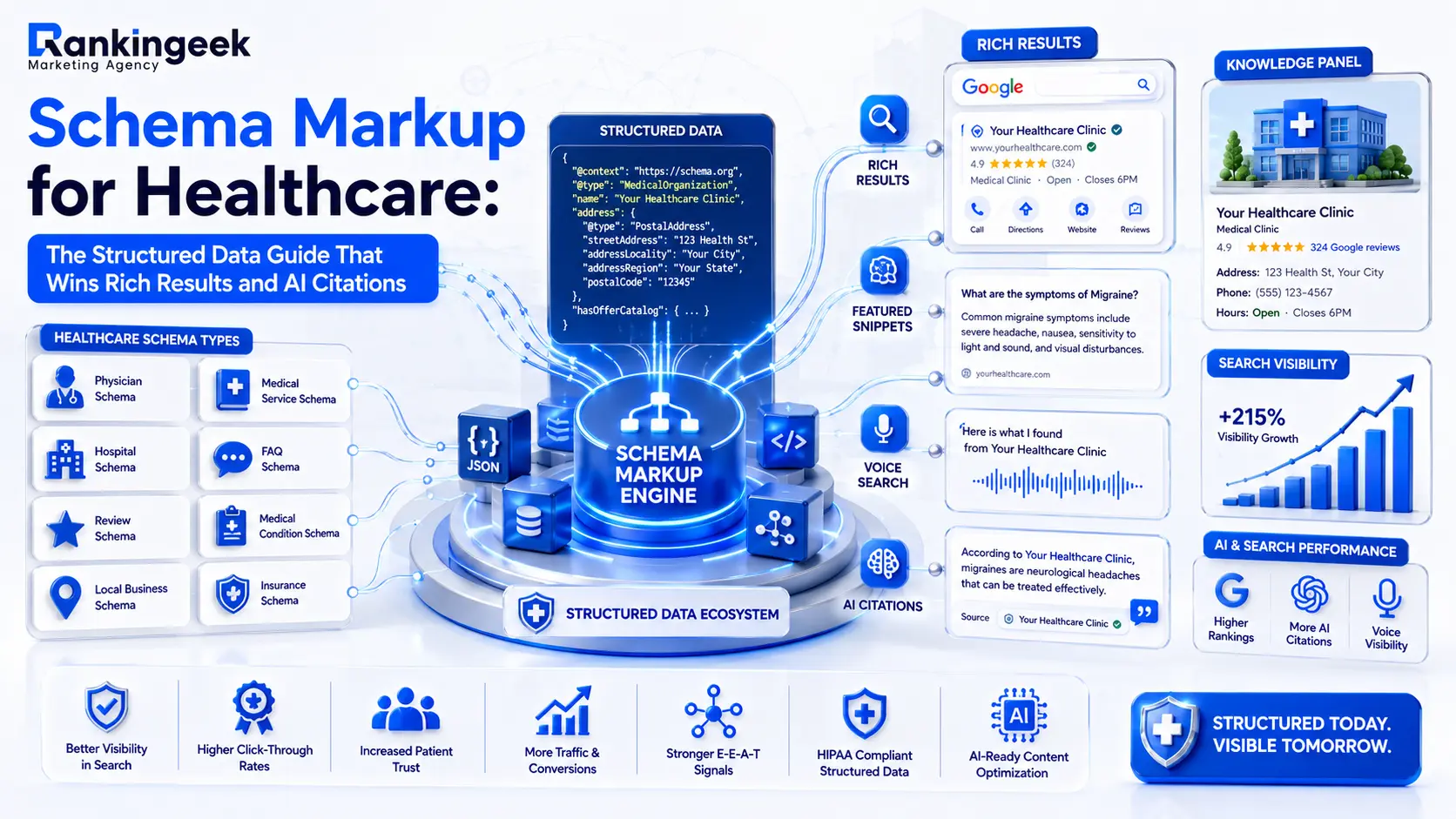

When a patient types "knee pain specialist near me" into Google, they do not just see a list of blue links anymore. They see star ratings, appointment hours, accepted insurance panels, and doctor credentials — all appearing directly in the search results before a single click. That is not magic. That is healthcare schema markup SEO working exactly the way it was built to work.
Structured data has quietly become one of the most consequential technical layers in healthcare SEO. As Google's AI Overviews pull answers from verified, machine-readable content and as LLMs increasingly cite structured sources, healthcare providers who skip schema markup are leaving serious visibility on the table. This guide covers every essential schema type, how to implement healthcare JSON-LD correctly, and why getting this right now gives your practice a lasting edge in both traditional SERPs and AI-generated answers.
What Is Healthcare Schema Markup and Why Does It Matter in 2025?
Schema markup is a shared vocabulary, maintained at Schema.org, that lets you label your webpage content in a way search engines and AI systems can actually read and interpret. Instead of hoping Google figures out that a page is about a cardiologist who sees patients on Tuesdays, you tell it directly using structured data tags embedded in your HTML or placed in a separate JSON-LD script block.
For healthcare websites, this matters on two separate but related fronts.
Rich Results in Traditional Search
Google surfaces rich results — enhanced SERP features like review stars, event details, FAQ dropdowns, and breadcrumb trails — only when the underlying page has valid structured data. A clinic using clinic structured data SEO properly can appear in the local pack with reviews, hours, and a "Book Appointment" action link. A competitor without schema gets a plain blue link. The click-through difference can be significant.
AI Overview and LLM Citations
This is the emerging dimension. AI Overviews, introduced by Google as part of its Search Generative Experience, pull structured, trustworthy content to form instant answers. Pages that use MedicalWebPage, MedicalCondition, and other healthcare-specific schema types signal to these systems that your content is authoritative, verifiable, and structured — exactly what AI needs to cite a source confidently. If you want Rankingeek's healthcare digital marketing services clients to appear in AI-generated answers, schema is not optional. It is the entry ticket.
The Core Healthcare Schema Types You Need to Know
Schema.org has a dedicated health and medical ontology that goes far beyond generic business markup. Here are the types that matter most for providers, clinics, and medical websites.
MedicalWebPage Schema
MedicalWebPage is a subtype of WebPage designed specifically for pages containing health-related content. It lets you declare the medical specialty a page covers, link it to a certifying authority, and label the audience (patients, caregivers, clinicians). Adding this to a condition or treatment page helps Google understand that your content is medically relevant — not just topically adjacent.
MedicalCondition Schema
MedicalCondition markup allows you to formally describe a health condition covered on a page: its name, symptoms, possible complications, risk factors, and associated treatment types. For a practice that ranks for symptom-based queries — "signs of Type 2 diabetes" or "chronic lower back pain causes" — this is the schema type that converts a blog post into a potential AI-cited resource.
Physician Schema Markup
Physician schema markup is built on the Physician type (a subtype of MedicalBusiness). It lets you define a doctor's name, credentials, specialty, hospital affiliations, languages spoken, and accepted insurance. When implemented correctly, this data can appear in knowledge panels and helps patients find the right provider faster — which is exactly the friction you want to remove.
Hospital and Clinic Schema
Schema for hospital and clinic pages typically uses the Hospital or MedicalClinic types. These extend the standard LocalBusiness schema with medical-specific properties including medical specialties, available services, and emergency capabilities. Combined with GeoCoordinates, OpeningHoursSpecification, and ContactPoint, this structured layer is the backbone of any effective local SEO for healthcare strategy.
Medical FAQ Schema
Medical FAQ schema uses the standard FAQPage type, but in healthcare contexts it carries extra weight. When implemented on a conditions page or a patient education section, FAQ schema can generate expanded SERP listings with dropdown answers — doubling your visual real estate without spending a single dollar on ads. It is also one of the more reliable ways to get cited in AI Overviews, since these systems look for clearly labelled question-and-answer structures.
Healthcare Schema Markup: Quick Reference by Schema Type
How to Implement Healthcare JSON-LD Correctly
Healthcare JSON-LD is the preferred implementation format recommended by Google. Unlike microdata, which requires wrapping HTML elements in schema attributes, JSON-LD is placed in a <script> block in the page's <head> or <body> without touching the visible content. This makes it easier to maintain, test, and update — a big advantage when managing schema across a large hospital or multi-location practice network.
Schema Markup and AI Overviews: The New Ranking Reality
Since Google began rolling out AI Overviews more broadly, the relationship between structured data and AI citations has become a genuine strategic priority. These AI-generated answers favour content that is clearly attributed, factually specific, and machine-readable — exactly what schema enables.
A page using MedicalCondition schema with correctly labelled symptoms, risk factors, and treatment pathways is far more likely to be cited as a source in an AI Overview than an identical article with no structured data. The same logic applies to physician pages using proper physician schema markup — they surface in AI responses to "who is a cardiologist near [city]" queries because Google's systems can verify the data is structured and authoritative.
For multi-location practices working with a professional healthcare digital marketing agency, implementing consistent JSON-LD across all location and provider pages is one of the highest-ROI technical SEO tasks available right now.
Common Healthcare Schema Mistakes That Kill Rich Results
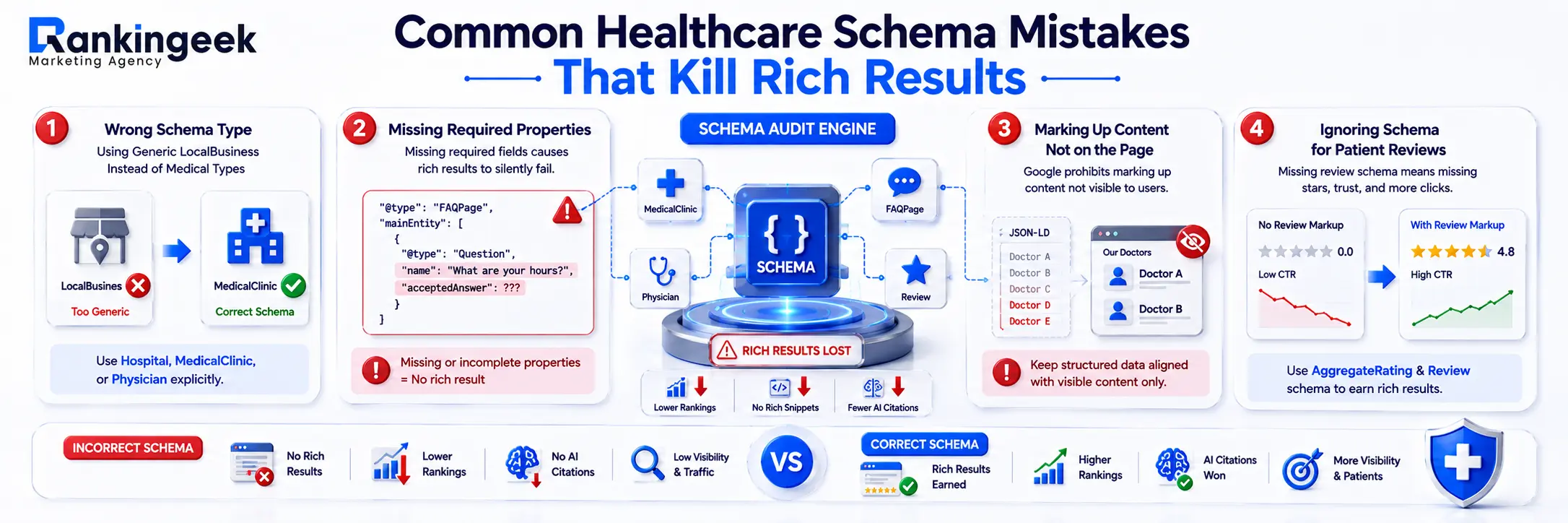
Using Generic LocalBusiness Instead of Medical Types
Marking up a hospital page with plain LocalBusiness schema misses the entire medical-specific vocabulary. Google cannot infer that your page should be treated as medical content — you have to declare it. Use Hospital, MedicalClinic, or Physician explicitly.
Missing Required Properties
Each schema type has required and recommended properties. FAQPage requires mainEntity with a list of Question types, each containing an acceptedAnswer. Missing any required property causes the rich result to silently fail — no error in Search Console, just no rich result in the SERP.
Marking Up Content Not on the Page
Google's guidelines explicitly prohibit marking up content that is not visible to users. If your JSON-LD lists five doctors but only two have profile pages, that is a policy violation. Keep your structured data strictly aligned with the visible page content.
Ignoring Schema for Patient Reviews
Patient reviews structured with AggregateRating and Review schema are one of the clearest drivers of SERP click-through rates in healthcare. Combined with solid reputation management for healthcare, properly marked-up reviews can generate visible star ratings that meaningfully increase organic traffic without any ad spend.
Building a Full Healthcare Schema Strategy: Key Priorities
Effective healthcare structured data is not a one-page task — it is a site-wide architecture decision. Here is how to approach it systematically.
Start with the Homepage and Service Pages
The homepage should carry MedicalClinic or Hospital schema with your core NAP (name, address, phone), specialties, and geo coordinates. Each service page should then carry the relevant MedicalProcedure or MedicalTherapy type linked back to the parent organisation.
Build Physician Schema for Every Provider
Every doctor profile page deserves its own Physician JSON-LD block. This is non-negotiable for competitive multi-specialty groups. Link each physician to the parent organisation using the worksFor property and include their specialty, accepted insurance, and whether they are accepting new patients.
Add FAQPage Schema to All Condition and Treatment Pages
Patient education pages — the ones covering conditions, treatments, and procedures — are the ideal home for medical FAQ schema. Identify the two to four most common patient questions for each page and mark them up in a visible Q&A section with proper FAQPage structured data. This is a direct path to both expanded SERP appearances and AI Overview citations.
Integrate Schema with Your Local SEO Stack
Schema does not work in isolation. It amplifies everything else in your local SEO toolkit. Practices investing in local SEO for medical professionals should ensure their Google Business Profile, website schema, and citation data are perfectly consistent. NAP discrepancies between these sources undermine the trust signals that schema is trying to build.
Frequently Asked Questions: Healthcare Schema Markup
Q1. What is the difference between MedicalWebPage and a standard WebPage schema?
A standard WebPage tells Google a page exists and has a topic. MedicalWebPage goes further — it signals the page is health-related, identifies the target audience (such as patients or medical professionals), and links the content to a medical specialty. This distinction matters for E-E-A-T and for appearing in health-related rich results and AI citations.
Q2. Does schema markup directly improve Google rankings?
Schema markup is not a direct ranking factor in the traditional sense, but it influences ranking indirectly. Rich results increase click-through rates, better CTRs signal engagement to Google, and structured data increases the probability of appearing in AI Overviews — all of which compound over time into measurable visibility gains.
Q3. How often should healthcare schema be updated?
Schema should be reviewed whenever content changes — new doctors join, services are added or removed, hours change, or insurance panels are updated. Set a quarterly schema audit as a standard workflow task, and trigger an immediate update any time a major content change goes live on the site.
Q4. Is JSON-LD the only way to add healthcare schema?
No — microdata and RDFa are also valid. However, Google officially recommends JSON-LD for all structured data because it can be added without touching the visible HTML, making it easier to implement and maintain. For healthcare sites managing dozens of provider and condition pages, JSON-LD is the practical standard.
Q5. Can schema markup help with voice search for healthcare queries?
Yes. Voice assistants frequently pull answers from structured, machine-readable data. A clinic using proper schema for hours, address, and services is far more likely to be read aloud in response to queries like "Is [clinic name] open on Saturday?" or "What does Dr. Mitchell specialise in?" This makes schema a core pillar of any voice search strategy in the healthcare space.
Q6. What tools should I use to test and monitor healthcare schema?
Use Google's Rich Results Test for pre-publish validation, Google Search Console's "Enhancements" report for post-publish monitoring, and Schema Markup Validator (validator.schema.org) for detailed property-level checks. For enterprise-scale healthcare sites, Screaming Frog with its custom extraction feature is excellent for auditing schema consistency across hundreds of pages.