
.png)



SEO agency scams cost medical practices far more than wasted marketing budget. They trigger Google penalties, expose patient data, and drain the appointment pipeline that keeps a practice viable. Here's what to watch for before you sign anything.
Key Takeaways
- No legitimate agency can guarantee a #1 Google ranking, and promises that do are a documented red flag.
- Google's June 2026 Spam Update upgraded its AI-based SpamBrain system to aggressively target scaled AI content, parasite SEO, and spammy links.
- Non-specialized agencies routinely miss HIPAA compliance risks that carry real civil money penalties.
- Only 30% of penalized websites recover their search rankings within a year after a Google penalty for black-hat SEO tactics.
Why Medical Practices Are Prime Targets for SEO Scams
Doctors and practice managers are busy running clinical operations. That knowledge gap around search engine optimization is exactly what SEO fraud operators exploit. A dermatologist or physio owner rarely has time to audit link schemes or verify content quality standards.
The stakes are higher in healthcare than in most industries. Bad SEO doesn't just cost clicks. It can trigger Google penalties, expose a practice to HIPAA violations, and destroy the local SEO visibility that drives booked appointments. As of June 2026, Google rolled out its Spam Update, upgrading its AI-based SpamBrain system to aggressively target scaled AI content, parasite SEO, and spammy links. For medical sites, black hat SEO is no longer just risky; it's a fast track to de-indexing.
Red Flags That Signal a Scam SEO Agency
Spotting medical marketing red flags early saves months of damage. Watch for these patterns before you commit to any contract.
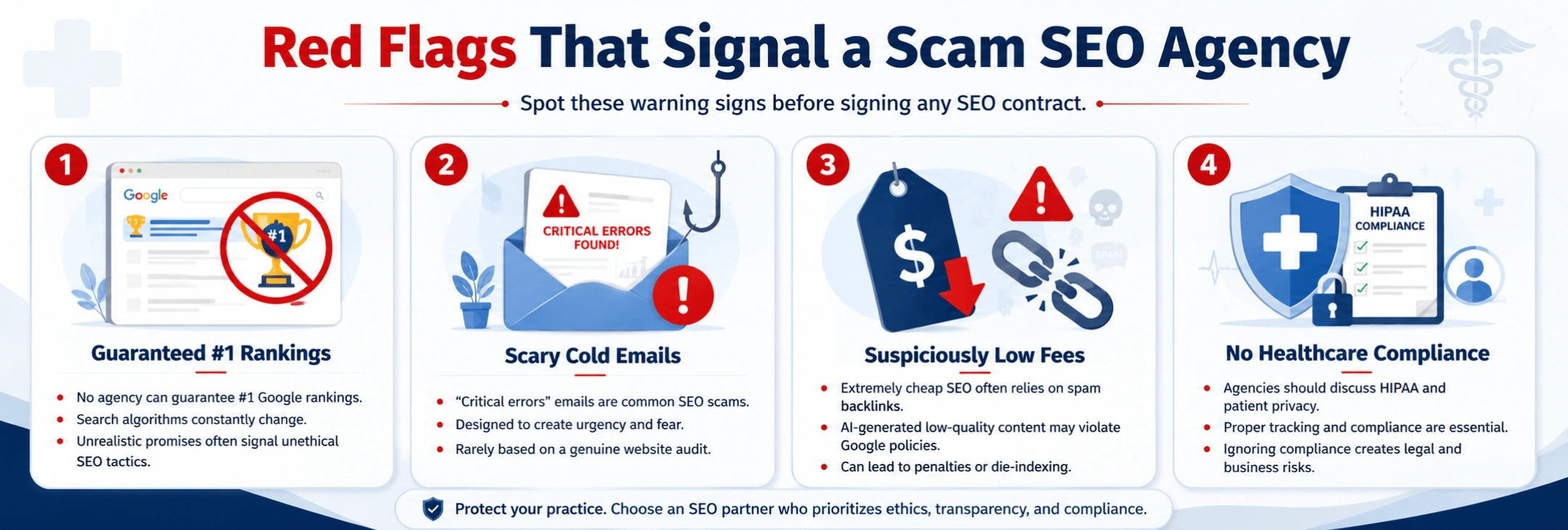
- Guaranteed #1 rankings. No legitimate SEO company can guarantee a #1 ranking on Google. Search algorithms constantly change, and Google's own documentation explicitly warns against agencies making such guarantees. Any agency promising a guaranteed top position is either lying or planning to use unethical SEO tactics that will eventually backfire.
- Unsolicited cold emails claiming your site has "critical errors." Unsolicited cold emails promising "#1 rankings" or claiming a website has "critical errors" are common red flags of SEO scams preying on business owners' lack of technical knowledge. These emails are designed to trigger anxiety in practice owners who can't independently verify the claim. They're rarely based on a real SEO audit.
- Suspiciously low monthly retainers. Cheap SEO agencies often use black hat tactics like buying spammy backlinks or mass-producing AI-generated content. Both violate Google's spam policies. Both can result in manual actions or complete de-indexing.
- No mention of healthcare compliance. Any agency pitching medical marketing without raising HIPAA, patient data handling, or compliant tracking setups doesn't understand the environment. That's not a minor gap. It's a liability. You can review what a compliance-aware healthcare marketing service actually looks like before comparing proposals.
The Hidden Costs Cheap SEO Leaves Behind
The real price of cheap SEO shows up months after you've signed. There are three costs that practices consistently underestimate.
- The ownership trap. A common hidden cost of cheap SEO is the ownership trap, where the agency builds a site or landing page on their own domain. The medical practice loses all digital assets and leads if they stop paying. It's a contract trap that's surprisingly common in low-cost healthcare SEO packages.
- Toxic backlink and AI-spam cleanup. Recovering from a Google manual action requires identifying and disavowing every spammy link the agency built. That process is slow, expensive, and often requires a specialist. The hidden fees here can exceed what the cheap retainer saved.
- The recovery rate is brutal. Only 30% of penalized websites recover their search rankings within a year after being hit by a Google penalty for black-hat SEO tactics. For a practice that depends on local SEO to fill its appointment calendar, that's a year of reduced patient acquisition with no guarantee of return. Real case studies from healthcare-focused campaigns show what recovery-free growth looks like by comparison.
Two Compliance Risks That Can Sink Your Practice
Most SEO fraud discussions focus on Google penalties. But for medical practices, the regulatory exposure is just as serious.
- The FTC Consumer Reviews Rule. Effective October 2024, this rule strictly prohibits buying reviews, creating fake testimonials, or suppressing negative reviews. As of late 2025 and into early 2026, the FTC was actively issuing warning letters and threatening civil penalties of up to $53,088 per violation. If your agency buys reviews on your behalf, your practice is exposed to those penalties directly. The rule targets the business benefiting from the deceptive reviews, so the liability lands on the practice, not just the agency.
- HHS OCR guidance on tracking pixels. Under updated HHS OCR guidance, the unauthorized use of online tracking technologies, including analytics or advertising pixels on healthcare websites, can result in HIPAA violations and civil money penalties. Non-specialized agencies often install these tools without a second thought. A reputable healthcare SEO partner will understand this guidance and configure tracking correctly before touching your site. Practices that want to understand compliant infrastructure from the start can explore HIPAA-aware web development as a baseline.
What a Trustworthy Medical SEO Partner Actually Looks Like
Choosing a reputable SEO agency in healthcare requires attention to a few non-negotiable behaviors.
Reporting transparency matters more than ranking screenshots. Reputable SEO agencies provide transparent reporting on metrics that matter, such as organic traffic and conversions, rather than focusing solely on vanity ranking metrics. Booked appointments and qualified consult requests are the numbers that keep a practice running.
They can show healthcare-specific case studies. General SEO results don't transfer cleanly to a regulated clinical environment. Ask to see work done for practices in your specialty, or at least in healthcare broadly.
They guarantee you own everything. Domains, Google Business Profile access, ad accounts, CRM data. All of it. From day one. No ownership trap, no contract leverage. And they understand HIPAA compliance. If an agency can't speak to tracking pixel risks or HHS OCR guidance, that conversation ends there.

Scam Agency vs. Legitimate Partner: Side-by-Side
Before signing any agreement, run a prospective agency through these five criteria. The contrast is usually obvious.
A free practice growth audit is a low-risk way to get an independent read on where your current SEO stands before committing to any agency relationship. If there are hidden Google penalties or compliance gaps already present, it's better to know now.
Frequently Asked Questions
Can a medical practice handle SEO in-house instead of hiring an agency?
Yes, building an in-house marketing team is a legitimate option alongside hiring a specialized or general agency with healthcare case studies. In-house teams offer tighter compliance control, but require hiring staff who understand both SEO and healthcare regulatory requirements simultaneously.
Is the Google March 2026 Spam Update different from the June 2026 SpamBrain update?
They're separate events. The March 2026 Spam Update was completed in under 20 hours, making it the fastest officially documented Spam Update rollout on record. The June 2026 SpamBrain update followed, specifically targeting scaled AI content and parasite SEO with upgraded AI-based detection.
Does the FTC Consumer Reviews Rule apply to the practice itself, or only the SEO agency?
It applies to both. If your agency buys reviews on your behalf, your practice is exposed to penalties, not just the agency. The rule targets the business benefiting from the deceptive reviews, so the liability lands on the practice directly.
What's the third-party option if neither a specialized agency nor a cheap generalist feels right?
Legitimate routes for medical practices seeking SEO include hiring specialized healthcare marketing agencies, partnering with reputable general SEO agencies with proven healthcare case studies, or building an in-house marketing team. A general agency with documented healthcare case studies is a recognized middle path, though you'd want independent legal counsel to cover any compliance obligations they may not handle natively.