
.png)

.webp)

A Canadian healthcare SEO agency is failing if your rankings, patient inquiries, and return on investment continue declining while compliance risks increase. This guide explains four warning signs your agency may be hurting your practice instead of helping it, and what to do next to protect your visibility, reputation, and future patient growth.
Key Takeaways
- Google's 2026 core updates shifted roughly 80% of top-three search results, hitting clinics with low-quality content hardest.
- Non-compliant SEO tactics can put a physician's license at direct risk under CPSO and Health Canada rules.
- Four specific red flags signal a failing agency before the damage becomes irreversible.
- Three clear exit routes exist, with compliance-aware partners offering the most practical path for most private practices.
How Google's 2026 Updates Changed Healthcare Rankings Overnight
The March and May 2026 Google core updates hit harder than most agencies warned their clients. As of May 2026, roughly 80% of top-three search results shifted positions within an 11-day window. About 25% of pages that had been ranking in the top ten dropped out of the top 100 entirely. Sites carrying low-quality, mass-produced content took the worst of it.
The May 2026 phase targeted content quality signals specifically. Google's E-E-A-T framework now separates expert-written content grounded in real-world experience from mass-produced AI-generated text. For a dermatology or physiotherapy clinic, that distinction is the difference between page one and page four.
Agencies still running pre-2026 playbooks- thin blog posts, keyword stuffing, templated metadata- aren't just underperforming. They're actively creating ranking drops for their healthcare clients. As of mid-2026, Google's algorithm has reduced unhelpful content in search results by 45%, and practices tied to that content are paying the price in lost patient acquisition.

Four Red Flags That Signal a Failing Healthcare SEO Agency
Spotting poor SEO agency performance early saves clinics from compliance exposure and months of wasted spend. Here are the four patterns that matter most.
Red Flag 1: Ignoring Canadian Medical Advertising Rules
The College of Physicians and Surgeons of Ontario prohibits medical advertising that includes testimonials, comparative statements, or guaranteed outcomes. An agency using any of these tactics in your on-page SEO or off-page content isn't cutting corners. It's putting your license at direct risk.
Health Canada's regulatory framework goes further. Direct-to-consumer advertising for prescription drugs, including SEO metadata and keyword targeting, can't make direct or indirect therapeutic claims. If your agency has optimized a page around a specific drug's outcome promise, that's a compliance violation sitting in your search results right now.
Red Flag 2: Vanity Metrics and Zero-Volume Keywords
As of May 2026, a common tactic among failing agencies is reporting top keyword rankings for obscure terms that no patient ever actually searches. The report looks impressive. The booked appointments don't follow.
The check is simple: pull your own Search Console data and look at actual search impressions for the terms they're ranking. If the volume is near zero, the ranking is meaningless. Real SEO performance shows up in consult requests and calls, not arbitrary keyword positions.
Red Flag 3: Data Hostage Tactics
Agencies that won't grant full administrative access to your Google Analytics and Search Console accounts are using what the industry calls "data hostage" tactics. Your reporting history, conversion data, and technical SEO audit trail belong to you. Withholding them is a transparency red flag, not standard practice.
Leaving an agency without admin access means losing the historical data that informs every future decision. That's a deliberate lock-in, not an oversight. Evaluating SEO agency effectiveness starts with confirming you own your own accounts.
Red Flag 4: Guaranteed Rankings and "Secret" Methods
Google explicitly warns against any agency that guarantees specific rankings. The algorithm uses hundreds of constantly changing factors no agency controls. When an agency promises a guaranteed number-one position, it signals one of two things: they don't understand how Google works, or they're using black-hat techniques that will eventually trigger a penalty.
"Proprietary methods" that can't be explained in plain language usually mean the same thing. Vague answers about methodology aren't just frustrating. They're a sign the work won't survive the next core update.
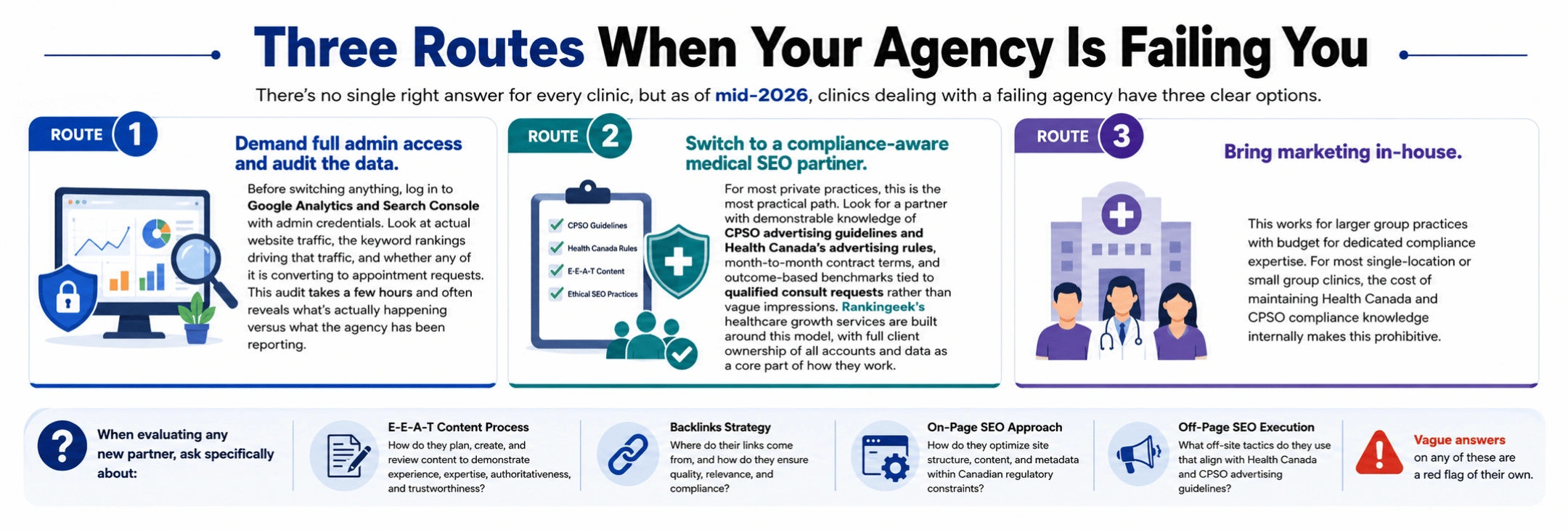
Three Routes When Your Agency Is Failing You
There's no single right answer for every clinic, but as of mid-2026, clinics dealing with a failing agency have three clear options.
Route 1: Demand full admin access and audit the data
Before switching anything, log in to Google Analytics and Search Console with admin credentials. Look at actual website traffic, the keyword rankings driving that traffic, and whether any of it is converting to appointment requests. This audit takes a few hours and often reveals what's actually happening versus what the agency has been reporting.
Route 2: Switch to a compliance-aware medical SEO partner
For most private practices, this is the most practical path. Look for a partner with demonstrable knowledge of CPSO advertising guidelines and Health Canada's advertising rules, month-to-month contract terms, and outcome-based benchmarks tied to qualified consult requests rather than vague impressions. Rankingeek's healthcare growth services are built around this model, with full client ownership of all accounts and data as a core part of how they work.
Route 3: Bring marketing in-house
This works for larger group practices with budget for dedicated compliance expertise. For most single-location or small group clinics, the cost of maintaining Health Canada and CPSO compliance knowledge internally makes this prohibitive.
When evaluating any new partner, ask specifically about their E-E-A-T content process, their backlinks strategy, and how they handle on-page SEO versus off-page SEO under Canadian regulatory constraints. Vague answers on any of these are a red flag of their own.
What a Trustworthy Medical SEO Partner Actually Looks Like
The right partner reports on booked appointments and qualified consult requests, not just keyword positions. That distinction matters because ranking drops hurt clinics through empty chairs, not through abstract digital marketing metrics.
Content should be expert-reviewed, satisfying both Google's E-E-A-T signals and CPSO advertising rules at the same time. Those two requirements aren't in conflict. A specialist who understands both handles them together.
Contracts should reflect confidence in the work. Month-to-month terms, action-based benchmarks, and full client retention of all data and accounts are the baseline. If a partner won't offer those terms, ask why.
If you're not sure what your current agency is actually delivering, a free practice growth audit can surface what the reports have been hiding, including which keywords are driving real patient volume and where signs of Canadian SEO compliance gaps may be putting your practice at risk.
Frequently Asked Questions
Does switching SEO agencies risk losing my Google rankings during the transition?
Securing full admin access to your Search Console and Analytics before switching is the most important protective step you can take. It preserves your historical data, which helps any new partner understand past performance and avoid repeating mistakes from the start.
Are CPSO advertising rules the same across all Canadian provinces, or do they vary?
The CPSO sets advertising standards for physicians in Ontario. For practices operating in other provinces, the relevant provincial licensing body governs advertising conduct. Always verify the specific rules with your own licensing body before approving any SEO content or metadata.
Can a general digital marketing agency learn healthcare compliance, or does specialization actually matter?
Specialization matters practically, not just in principle. CPSO and Health Canada compliance requires ongoing familiarity with regulatory updates that general agencies rarely track. A compliance gap in metadata or on-page content can sit undetected for months, accumulating regulatory risk while rankings quietly decline.
How do I know if my current SEO content already contains Health Canada violations?
Search your own site for pages targeting prescription drug names and check whether the copy makes outcome or efficacy claims. Any language promising a drug's results in metadata, headers, or body copy likely violates Health Canada's therapeutic claims rules and warrants a compliance review.