
.png)

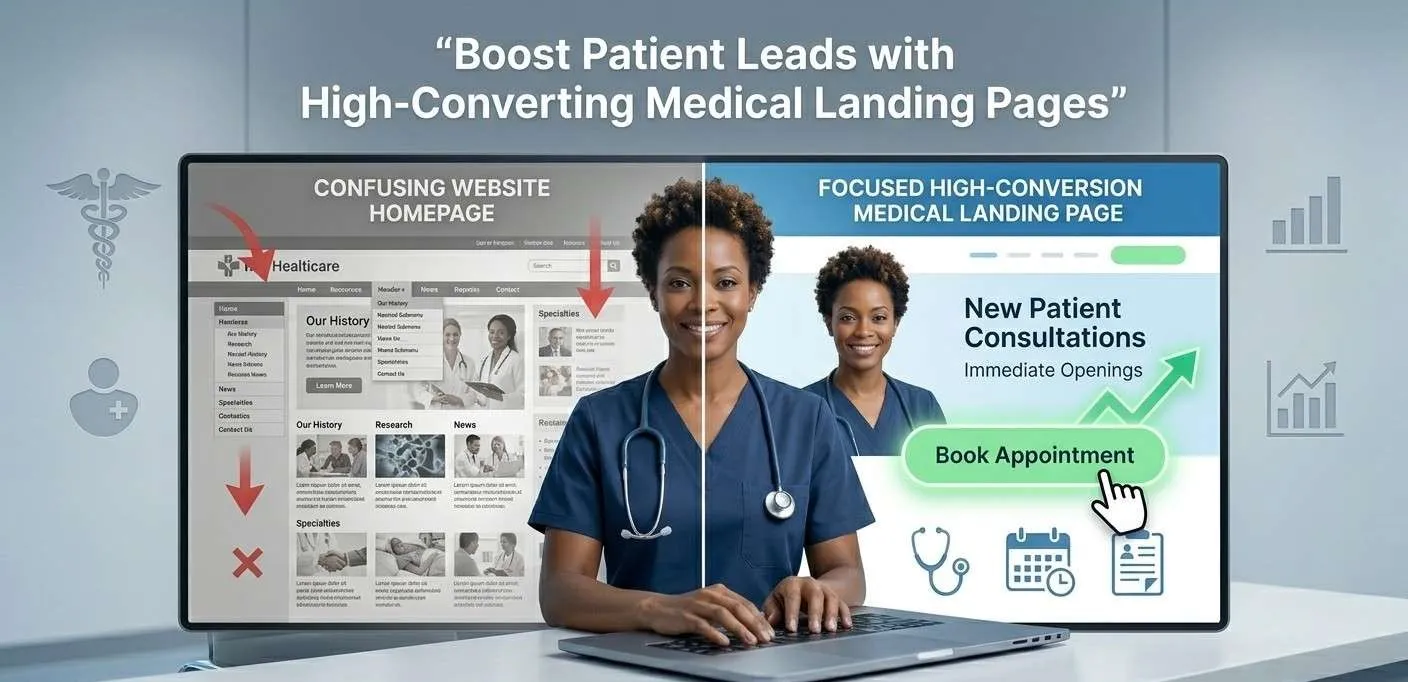

Sending paid ad traffic, especially from Google or Meta, directly to a generic homepage is a common mistake, often halving potential patient leads. Dedicated, conversion medical landing pages are designed to convert ad clicks into actionable patient leads. This focused approach ensures optimal return on investment for healthcare advertising agency efforts and maximizes patient conversion rate optimization.
Key Takeaways
Directing ad traffic to a homepage squanders significant budget; it overwhelms visitors with choice, dilutes your message, and hinders patient conversion rate efforts. Dedicated high-conversion medical pages provide a focused, message match experience with clear Call-to-action for patients. This can significantly improve lead generation. Implementing healthcare landing page best practices delivers higher ROI for medical lead generation strategy by reducing bounce rates and efficiently capturing qualified prospects.
Understanding the Homepage vs. Landing Page for Doctors Dilemma
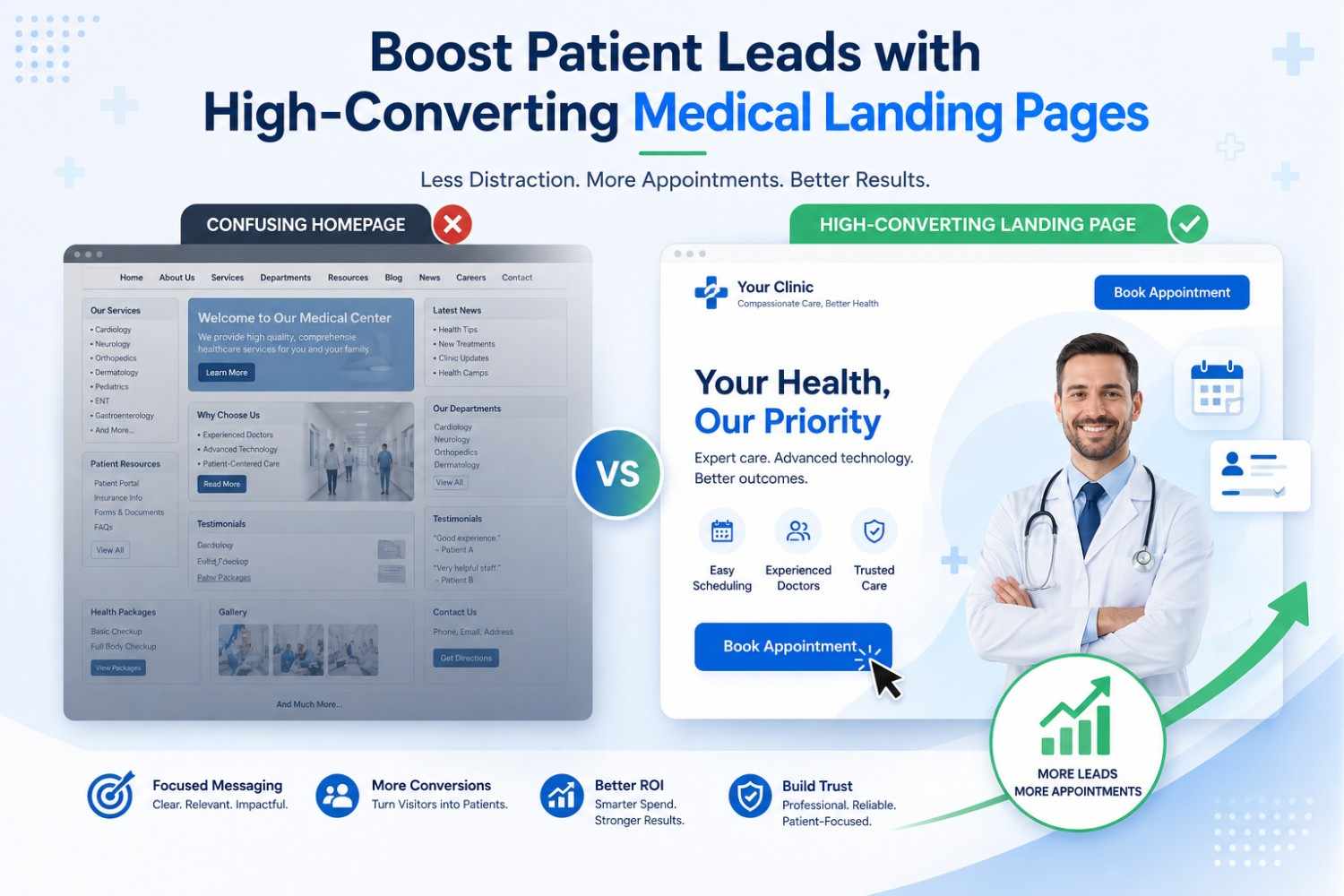
Many private practice owners and clinic marketing managers mistakenly believe their comprehensive homepage can effectively serve as a destination for paid ad campaigns. This common oversight, however, introduces the "Paradox of Choice," which is a significant barrier to patient conversion. A homepage typically features a broad navigation menu, multiple service offerings, and general information. While valuable for organic visitors exploring a practice, this broad content becomes a significant distraction for someone arriving from a targeted ad. This abundance of options leads to "analysis paralysis," causing visitors to hesitate, feel overwhelmed, and ultimately bounce without taking action. Practices lose valuable leads and ad spend this way.
A high-conversion medical landing page, conversely, eliminates distractions and guides the visitor toward a single, specific action. When a potential patient clicks a Google Ad for "orthodontic consultations," they expect a page immediately addressing that specific need. A dedicated landing page honors, maintaining the psychological "scent" from the ad's promise to the page's headline. This consistency builds trust and reinforces the visitor's intent. It dramatically increases the likelihood they will complete the desired (CTA) for patients), whether booking an appointment, requesting a call, or downloading an information guide. The landing page's focus remains hyper-specific. It directly addresses the ad's promise and the patient's immediate need, thereby optimizing the conversion funnel healthcare. This targeted approach defines effective medical lead strategy and forms a cornerstone of successful healthcare digital marketing agency campaigns.
Crafting High-Conversion Medical Landing Pages with Message Match
Effective landing pages for Google Ads healthcare campaigns fundamentally rely on message principles. When a patient clicks an ad promising a "Free Dental Consultation for New Patients," the landing page must immediately echo that exact promise in its headline and primary content. This consistency creates a seamless "psychological scent" from the ad to the page, reassuring visitors they have landed in the right place. Without this crucial alignment, visitors experience a disconnect. This leads to confusion, increases bounce rates, and undermines your medical lead generation.
To achieve superior patient conversion optimization, landing page content must be concise, relevant, and compelling. The value proposition for patients should immediately appear evident. This means highlighting specific benefits a patient receives, directly addressing their pain points or desires, rather than presenting generic practice information. For instance, a plastic surgeon advertising a specific procedure should focus the page on outcomes, relevant patient testimonials, and a clear path to booking a consultation for that specific service. Bullet points, concise paragraphs, and clear headings ensure readability, especially since healthcare seekers often decide whether to remain on a page in under three seconds. The above-the-fold content for doctors section, therefore, represents valuable real estate, demanding immediate engagement. This area must feature a compelling headline, a sub-headline reinforcing the value, and an unmistakable primary Call for patients. Integrating social proof in healthcare, such as patient reviews or trust badges from reputable organizations, immediately builds credibility and encourages trust. This proves critical for specialists like fertility specialists or orthodontists, where the decision-making process often becomes prolonged and emotionally charged. A proficient healthcare digital marketing understands that the narrative must flow logically, guiding the user toward the conversion goal with minimal cognitive load.
Optimizing Patient Conversion Rate Optimization Through Design and UX
A strategically designed high-conversion medical landing page extends beyond compelling copy; it prioritizes user experience (UX) in medical websites to minimize friction and maximize conversions. Ensuring mobile-responsive medical pages is a critical element. A significant percentage of healthcare searches now occur on mobile devices. Therefore, a page that loads quickly and renders perfectly on any screen size is non-negotiable. Slow loading times or awkward mobile layouts instantly deter potential patients, particularly those searching on the go for urgent care or immediate appointments. This responsiveness maintains engagement and ensures accessibility for a wider range of patient demographics.
Furthermore, the page's visual hierarchy must intuitively guide the user's eye toward the primary Call-to-action for patients). The CTA should appear prominently displayed, contrasting with the page's color scheme, and use action-oriented language (e.g., "Book Your Appointment Now," "Schedule a Free Consultation"). Strategically placing this CTA, often multiple times throughout the page including above-the-fold content for doctors, reinforces the desired action. Beyond the CTA, page design must effectively incorporate trust signals healthcare. This includes professional branding, clear contact information, practitioner photos, and potentially accreditation logos. For practices managing sensitive patient data, implementing secure, HIPAA-compliant landing pages with encrypted forms for lead capture is not merely best practice, but also a forthcoming regulatory necessity with HIPAA Standards. Practices must ensure form optimization healthcare prioritizes both user-friendliness (minimal fields, clear labels) and robust data security, protecting both patient and practice. An effective healthcare marketing agency implements rigorous A/B testing for healthcare marketing on different layouts, button colors, and headline variations. This continuously refines clinical landing page design and improves conversion rates for local SEO for healthcare and paid ad campaigns.
Implementing Healthcare Landing Page Best Practices for Trust and Compliance
Trust forms the bedrock of patient acquisition in healthcare. For high-conversion medical landing pages, establishing immediate credibility is paramount. This begins with transparent and authentic social proof in healthcare. Patient testimonials, genuine reviews, and clear doctor bios featuring qualifications and experience reassure potential patients. Displaying relevant certifications, affiliations with professional organizations, and awards significantly boost trust signals healthcare. For example, an orthodontist might highlight their American Board of Orthodontics certification, while a fertility specialist could showcase success rates or compassionate patient stories, always ensuring anonymity and privacy where necessary.
Crucially, modern landing pages must strictly adhere to current HIPAA compliance requirements for data privacy and security. Any lead capture forms on a medical landing page must be secure and encrypted to protect patient information. This means avoiding standard, non-compliant web forms; instead, practices must utilize specialized, secure solutions. Failure to comply can result in severe penalties and erode patient trust. A reputable healthcare digital marketing agency or medical advertising agency ensures robust compliance for all data collection methods, offering practice owners peace of mind. Moreover, the page should clearly state its privacy policy and terms of service, often linked in the footer to demonstrate commitment to patient data protection. Beyond compliance, a clear value proposition for patients must immediately articulate itself, answering the core question: "What's in it for me?" This value should be specific, such as "Reduced Wait Times," "Experienced Specialists," or "Personalized Treatment Plans." This directly addresses patient concerns and reinforces the practice's unique selling points, effectively driving patient conversion.
Strategies for Landing Page for Google Ads Healthcare Success
Achieving exceptional results with landing page for Google Ads healthcare campaigns demands more than just a well-designed page; it requires strategic integration with your broader medical lead. The journey starts with granular audience targeting within Google Ads, ensuring ad groups focus focused” or “dedicated on patient needs and search queries. Each ad group should then lead to a unique clinical landing page design, meticulously crafted to match the ad's specific offer and keywords. For instance, an ad targeting "knee pain specialist Phoenix" should direct users to a page specifically addressing knee pain treatments, not a generic orthopedic services page. This precision in message match principles proves crucial for maximizing ad spend and improving quality scores, ultimately reducing the cost-per-lead.
Pro-Tips for Maximizing Your Healthcare Landing Page Conversions: Implement A/B testing for healthcare marketing consistently: Test different headlines, (CTA) for patients button colors, form lengths, and above-the-fold content for doctors layouts. Even minor tweaks significantly impact patient *. Prioritize Mobile-responsive medical pages: Ensure your page loads quickly and flawlessly on all devices. Rigorously test across various smartphones and tablets to confirm an optimal user experience (UX) in medical websites)*. Focus on the Value proposition for patients*: Clearly articulate the specific benefit a patient receives. Do not simply list services; explain how those services solve a patient's problem or improve their life. Leverage compelling Social proof in healthcare: Integrate authentic patient testimonials, before-and-after photos (with consent), and awards. This builds immediate trust signals healthcare*. Optimize Form optimization healthcare: Keep lead forms concise, asking only for essential information. Implement clear error messages and secure, HIPAA-compliant landing pages* for data capture.
- Create a sense of urgency (ethically): Limited-time offers for consultations or promotions can encourage immediate action, but always maintain professional and ethical standards.
Continuously monitor and refine your conversion funnel healthcare*: Use analytics to identify drop-off points in the patient journey mapping. Make data-driven improvements.
- Integrate with your CRM: Ensure captured leads immediately route to your patient management system for timely follow-up, preventing lost opportunities.
Effective healthcare digital marketing agency and medical advertising agency strategies recognize that a landing page functions not as a static brochure but as a dynamic conversion engine. By meticulously applying healthcare landing page best practices and integrating them with precise ad targeting and continuous optimization, practices transform their digital advertising from an expense into a powerful, predictable medical lead generation strategy. This significantly boosts patient bookings and overall ROI.
FAQ
Q. What is the primary difference between a homepage and a landing page for doctors?
A. A homepage offers broad information and multiple navigation options, designed for general exploration. A landing page for doctors, conversely, focuses hyper-specifically on a single goal, typically lead generation, with minimal navigation and a clear, specific Call-to-action (CTA) for patients). This focus dramatically improves patient conversion rate optimization by eliminating distractions.
Q. Why is sending ad traffic to a homepage detrimental to lead generation?
A. Sending ad traffic to a homepage introduces the "Paradox of Choice," overwhelming visitors with too many options and leading to "analysis paralysis." It dilutes message principles, causing a disconnect between the ad's promise and the page's content, which results in higher bounce rates and lower lead conversion. This costs practices money.
Q. How do 2026 HIPAA Standards affect medical landing pages?
A. 2026 HIPAA necessitate that all lead capture forms on HIPAA-compliant landing pages be secure and encrypted to protect patient data. Medical practices must ensure their forms meet these stringent requirements to avoid compliance issues and maintain patient trust. This prioritizes data security as a core best practice. What is the "3-Second Rule" and why is it important for above-the-fold content for doctors?
A. The "3-Second Rule" highlights that healthcare seekers decide whether to stay on a page in under three seconds. This makes the above-the-fold content for doctors critically important; it must immediately convey a compelling value proposition for patients, establish trust signals healthcare, and present a clear Call-to-action (CTA) for patients) to capture attention and encourage further engagement.
Q. What are some key healthcare landing page best practices to improve patient conversion?
Key best practices include ensuring strict message match principles between ads and page content, prioritizing mobile-responsive medical pages, incorporating strong social proof in healthcare, using secure HIPAA-compliant landing pages for forms, and employing clear (CTA). Consistent A/B testing for healthcare marketing is also vital for continuous improvement.