


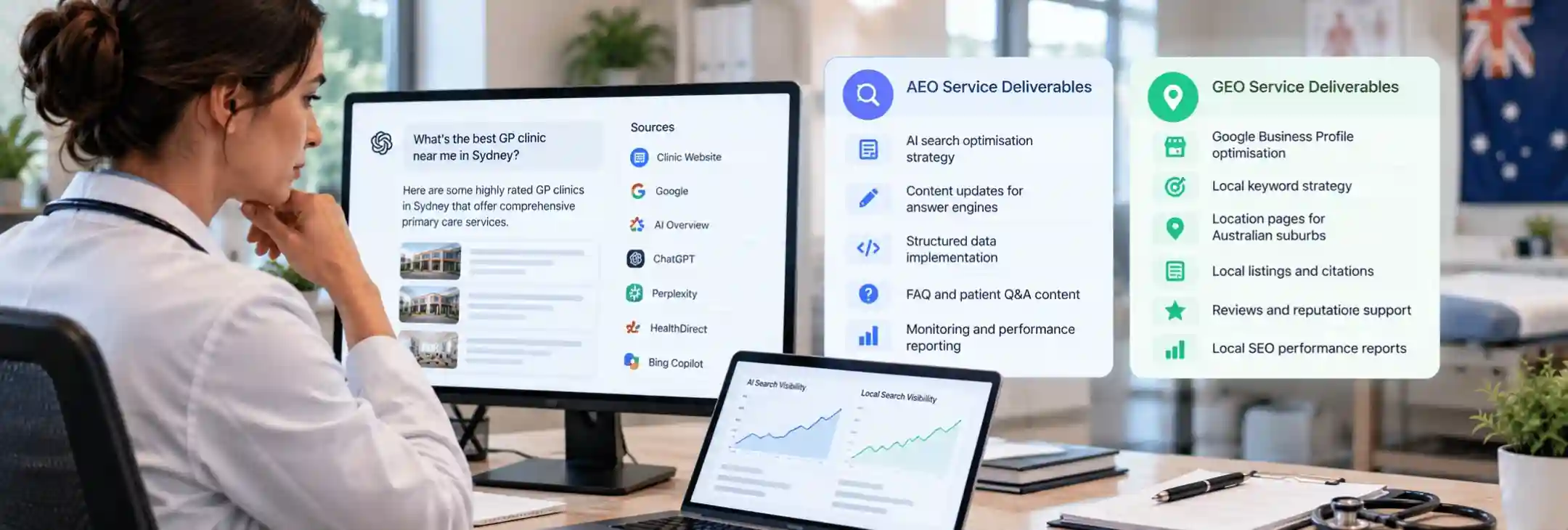

Most Australian practice owners now hear a similar pitch from agencies about AI search. The trouble is that few proposals explain what the work actually involves. This guide breaks down real GEO service deliverables month by month, from the first audit to ongoing reports. You will see what a fair agency should hand over, what it cannot promise and where AEO fits into the plan.
What AEO and GEO Work Includes for an Australian Clinic
A real AEO and GEO service starts with an AI visibility audit. The agency then restructures key pages so they answer patient questions directly. The work also strengthens your structured data. Your entity signals get the same attention, so AI tools can tell exactly who you are and where you practise.
The next stage builds trusted mentions on other respected websites. A monthly report then shows how often AI tools name your clinic. The best GEO service deliverables build on your existing SEO and never replace it.
Why GEO Means Different Things at Different Agencies
Agencies use the term GEO in very different ways right now. Some treat a tracking dashboard as the whole set of GEO service deliverables. Others rewrite three blogs, add an FAQ and call the job done.
The phrase itself comes from a 2024 research paper on generative engine optimisation. That study tested nine ways to change web content and measured how often AI answers used each source. The strongest methods lifted source visibility by up to 40 percent.
Statistics, expert quotes and clear references to credible sources performed best. Keyword stuffing, the old SEO habit, did little to help. The researchers also found that results changed from one subject area to another, which matters a lot for health content.
Answer engine optimisation focuses on short, direct answers that search tools can lift straight from your page. GEO aims at the longer responses inside ChatGPT, Gemini, Perplexity and Copilot.
A clinic needs both, because patients ask quick questions as well as complex ones. Clear AEO service deliverables belong next to the GEO work in any proposal you receive. Strong AI search visibility comes from the two working together.
Also Read: The Difference Between AEO, GEO and SEO for Healthcare Clinics in 2026
Month 1 Starts With an AI Visibility Audit and Baseline
The first month exists to measure where your clinic stands today. Later GEO service deliverables mean little without a clear starting point. The audit starts with a set of real patient questions, usually 30 to 50 of them.
These prompts cover symptoms, treatments, costs, suburbs and practitioner choice. A Parramatta physio clinic might test "best physio for a running injury near Parramatta" across ChatGPT, Gemini, Perplexity, Copilot and Google AI Mode. The baseline report records four things for every question:
1. Whether your clinic appears at all
2. Which page or profile the AI tool cites
3. Which competitors it names in your place
4. How accurately it describes your services and locations
The audit also checks your technical basics. Official search guidance confirms that AI Overviews have no extra technical requirements beyond normal indexing. Search engines still need to index a page and allow it a snippet before any AI feature can use it.
Strong healthcare SEO therefore remains the foundation of this work. A competitor gap list closes out the month. It shows which rival clinics AI tools trust and the likely reasons behind that trust.
GEO Service Deliverables Month by Month
The table below shows how a typical six month program runs for an Australian clinic.
Months 2 and 3 Bring Content and Technical Changes
This phase turns the audit findings into real changes on your website and profiles. Most of the visible GEO service deliverables happen here.
Answer First Page Structure
AI tools favour pages that answer a question in the first one or two sentences. Long welcome paragraphs and vague promises give them nothing useful to quote. Each priority section now opens with a direct answer to one of your patient questions. The detail, evidence and booking link follow after that answer. Facts, local statistics and practitioner expertise give AI tools a reason to cite the page.
Australian clinics face one extra rule here. The national advertising rules for health services ban testimonials about symptoms, treatment or outcomes. Your pages therefore lean on facts and qualifications instead of patient success stories.
Example of a Physio Service Page
The old page opened with a line about passionate and caring physios. The new version answers a real question in its first sentence. It reads "Our Parramatta clinic offers sports injury assessments on weekdays and Saturdays, and most first sessions last 45 minutes."
Example of a GP Clinic FAQ Block
A Brisbane GP clinic adds short answers about bulk billing, telehealth bookings and new patient availability. Each answer stays under 50 words and links to the right booking page. This format suits answer engine optimisation because search tools can lift each answer cleanly.
Schema and Structured Data That Match the Page
Schema markup tells search engines what each part of a page means. The work usually covers the clinic, each practitioner, opening hours, locations and FAQ content. Search engine rules on markup insist on one point above all. Your structured data must reflect what visitors can actually see on the page.
Some agencies sell a special AI text file as a core deliverable. Search guidance for AI Overviews says plainly that site owners do not need new AI files or special markup. A proposal built around that file deserves a closer look.
Example of Clinic and Practitioner Markup
A dental practice with four dentists marks up the practice once and gives each dentist their own profile markup. Each profile lists qualifications, languages and registration details, so AI tools can see who works where.
Entity Consistency Across the Web
AI systems treat your clinic as an entity with a name, address, practitioners and services. Inconsistent details across the web weaken those entity signals and lower AI confidence in your clinic.
This work covers your Google Business Profile, HealthEngine, HotDoc, the national health services directory, association listings and local directories. Your clinic name, address, phone number, hours and practitioner list need to match everywhere.
Example of a Dental Group With Old Addresses Online
A dental group that moved premises in 2022 might still show its old address on five directories. AI tools then pull mixed details and may leave the clinic out of answers altogether. Search crawlers can take days or even months to pick up the corrected listings, so this cleanup starts early.
Month 4 Onwards Brings Trusted Mentions, Monitoring and Reports
AI tools lean heavily on what other websites say about you. A clinic that only talks about itself rarely earns their trust. The off-site side of GEO service deliverables looks different from general link building. The work includes practitioner commentary in local news, association profiles, guest articles for health publications and community sponsorships. Each mention adds weight to your entity signals over time.
Reviews need extra care in Australia. Clinics carry responsibility for reviews on websites they control, and reviews that praise clinical results count as testimonials. Comments about friendly staff, clear communication or easy parking remain fine.
The agency repeats the prompt tests every month alongside this work. A useful monthly report covers a few clear numbers.
1. How many tracked questions now mention your clinic
2. Your citation share against local competitors
3. Which pages AI tools cite most often
4. Traffic that arrives from AI tools and AI features
5. Calls, form fills and bookings linked to that traffic
Search Console counts clicks from AI features inside its standard Web report. A good agency pairs that data with analytics and booking records, so the report ties AI visibility to real appointments.
Also Read: Why AI Tools Like ChatGPT Aren't Recommending Your Australian Practice
Realistic Timelines and Results for Australian Practices
Most clinics see first movement around 60 to 90 days after priority pages and markup go live. That movement usually shows up as new featured snippets, early citations or a mention in a few tracked answers.
Steady AI search visibility across several platforms tends to take four to six months. Competitive specialities such as cosmetic dentistry in Sydney or Melbourne can take longer. Early citation share gains often come from smaller suburb-level questions first.
No agency can guarantee that ChatGPT or Google will name your clinic. Search engines themselves do not guarantee indexing or display, even for sites that follow every rule. A proposal that promises a set number of AI citations deserves a hard second look. Honest GEO service deliverables come with ranges, not promises.
Final Thoughts on AEO and GEO Service Deliverables for Australian Clinics
AEO and GEO service deliverables help Australian clinics improve their visibility across traditional search engines and AI-powered platforms. This includes AI visibility audits, optimised content, structured data and accurate business listings.
Rankingeek offers AEO and GEO services with realistic timelines. Our team works as an extension of healthcare SEO rather than a separate product. We also check every page against Australian advertising and health privacy rules before it goes live. Clinics that need wider local support can also see our healthcare SEO services across Australia.
Frequently Asked Questions About AEO and GEO for Clinics
Is GEO different from SEO?
GEO and SEO overlap, but they chase different results. SEO aims for rankings and clicks, while generative engine optimisation aims for mentions inside AI answers.
How long does AEO and GEO take to show results?
Most clinics see early movement within 60 to 90 days of priority changes going live. Stable results across several AI platforms usually take four to six months.
Can an agency guarantee my clinic appears in ChatGPT?
No honest agency can make that promise. AI tools decide which sources to name, and search engines do not guarantee that any page will appear. A good agency improves your odds and reports progress openly.
Does AEO need different work from GEO?
AEO focuses on short answers for snippets, voice search and AI Overviews. GEO targets longer conversational answers in tools like ChatGPT and Perplexity. One plan usually covers both because the groundwork overlaps.
What should a monthly AEO and GEO report include?
A useful report shows how many tracked questions mention your clinic and which pages AI tools cite. It also links AI referral traffic to calls and bookings. Clear GEO service deliverables always come with this level of reporting.