
.png)



Local SEO for clinics Canada isn't a nice-to-have anymore. Over 87% of Canadian patients read online reviews before choosing a provider, and more than 70% start their entire search on Google. If your clinic doesn't appear in local results with strong ratings and a complete profile, those patients aren't calling you. They're booking with someone else.
Key Takeaways
- Over 87% of Canadian patients check online reviews before selecting a clinic, and most won't consider any practice with fewer than four stars.
- Google Business Profile optimization, location-specific content, and review volume are the three highest-impact local SEO levers for Canadian clinics.
- Meaningful patient acquisition typically takes six to twelve months, but early GBP wins can appear within the first few months.
- PHIPA and PIPEDA compliance must be baked into your SEO strategy from day one, not bolted on later.
Why 87% of Canadian Patients Won't Choose Your Clinic Without Local SEO
Patient search behavior has shifted decisively. Over 70% of patients now turn to search engines when looking for a healthcare provider. That figure isn't surprising when you consider how people find a family doctor in Calgary, a physiotherapist in Mississauga, or an emergency dentist in Vancouver. They search. They compare. Then they decide.
The review barrier is real and unforgiving. Over 77% of patients begin their search for a new provider online, and more than 60% won't consider a clinic with fewer than four stars on Google. That's not a soft preference. It's a hard filter that removes under-rated practices from consideration entirely before a patient ever reads a single word about your services.
Traditional marketing doesn't reach patients at that moment of intent. A flyer doesn't appear when someone searches "walk-in clinic near me" at 9pm on a Tuesday. A newspaper ad doesn't surface in the Google local pack. Your online presence either shows up when patients are actively looking, or it doesn't. There's no middle ground.
The Three Pillars of Local SEO That Drive Patient Appointments
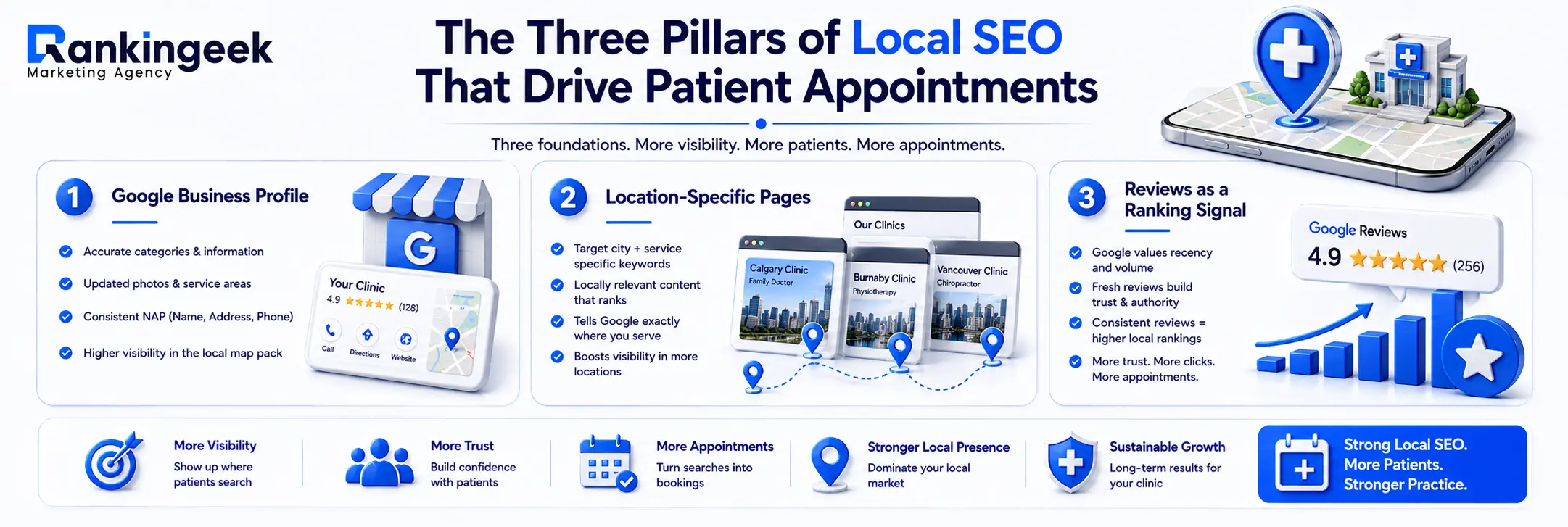
Your local search for clinics strategy should rest on three foundations. Skip any one of them and you're leaving appointment bookings on the table.
Google Business Profile. Many Canadian clinics still haven't fully optimized their Google My Business listings. That's a significant missed opportunity: because GBP is where patients find your hours, phone number, address, and reviews at a glance. Accurate categories, updated photos, correct service areas, and consistent NAP (name, address, phone) data all influence where you appear in the local map pack.
Location-specific website pages. A generic "services" page doesn't rank for "family doctor in Calgary" or "physiotherapist in Burnaby." Building dedicated location pages with locally relevant content, specific to cities across Ontario, British Columbia, Alberta, or Quebec, tells Google exactly which patients you serve and where. This is how geotargeting works in practice for a medical practice.
Reviews as a ranking signal. Google's local ranking algorithm weighs reviews for trust and authority, factoring in recency and volume alongside the star rating, not just the average score. A clinic that earned twenty reviews two years ago is losing ground to a competitor that's collecting five new ones every month. Recency matters as much as quantity.
Building Trust Through Reviews: The Fastest Path to Patient Growth
Positive reviews don't just build credibility with patients. They directly influence how Google ranks your clinic in local results. That connection between review volume and visibility should reshape how your front desk team thinks about patient interactions.
The most reliable approach to reviews management is automation. Sending personalized review requests via text or email immediately after a positive appointment removes friction and keeps your request volume consistent. Manual follow-up works occasionally. Automated follow-up works every time.
Simplify the submission process as much as possible. Direct Google review links, placed in follow-up emails or on your website, reduce the number of steps between intent and completion. QR codes posted in exam rooms and at the front desk work particularly well for patients who prefer to act in the moment, while they're still in a positive headspace about their visit.
Staff training matters too. A brief, genuine ask from a receptionist or nurse after a good appointment, timed well, increases completion rates meaningfully. The patient experience itself is the foundation. Happy patients leave reviews. Frustrated ones don't, or worse, they leave the wrong kind. Responding to every review, positive or critical, also signals to Google and future patients that your clinic is attentive and engaged.
Navigating Canadian Healthcare Compliance While Ranking
Healthcare SEO in Canada carries legal obligations that don't apply to most other industries. PHIPA (Personal Health Information Protection Act) in Ontario and PIPEDA (Personal Information Protection and Electronic Documents Act) at the federal level govern how patient data can be collected and used. Any marketing strategy that involves contact forms, booking tools, or email follow-ups must be built with these frameworks in mind from the start.
Google classifies medical websites as YMYL (Your Money or Your Life) content, which means the platform applies stricter quality signals and a higher bar for ranking than it does for, say, a restaurant or a clothing retailer. E-E-A-T, which stands for Experience, Expertise, Authoritativeness, and Trustworthiness, is the framework Google uses to evaluate medical content. Clinics that publish credential-backed content, display professional affiliations, and cite qualified authors rank more reliably than those that don't.
For clinics in Quebec, bilingual website optimization isn't optional. French-language content reaches a significant patient population that searches primarily in French, and ignoring that audience means ceding it to competitors who don't.
Local SEO Cost Breakdown for Canadian Clinics
Pricing for Canadian clinic SEO services scales with clinic size, market competitiveness, and scope of work. Here's how the numbers typically break down, based on research from w3era.com.
Solo practitioners and small clinics generally invest between $500 and $1,500 per month for foundational local visibility. This typically covers GBP management, basic citation building, and review growth support, a practical starting point for practices just entering the local search landscape.
Mid-sized clinics operating in more competitive markets, or those adding content development and local page creation, typically spend between $1,500 and $3,500 monthly. As your service area expands and the keyword targets multiply, the work required scales with it.
Multi-location groups or practices in dense urban markets like Toronto or Vancouver can expect to invest $3,500 to $7,000 or more per month. At this level, each individual location needs its own optimization, and the local search environment is often saturated with well-established competitors.
Hourly rates for experienced specialists run between $100 and $200 per hour, usually for audits or strategy sessions rather than ongoing campaign management. What drives pricing most is the combination of agency expertise, market competitiveness, and the breadth of services included.
Realistic Timelines: When Local SEO Delivers Patient Results
Patience is required. But progress isn't invisible. The timeline breaks down into distinct phases.
Months one through three are about foundations. GBP optimization and citation cleanup lay the groundwork for map pack movement, with improving impressions and better technical health becoming visible relatively early. Don't expect the phone to start ringing from SEO alone yet.
Months three through six is when the search ranking movement becomes visible. Reviews accumulate, local listings gain consistency, and content begins earning authority. Early patient inquiries from organic search start appearing, particularly for less competitive terms.
Months six through twelve is where consistent patient acquisition and measurable conversion rates become the story. For most clinics, full return on investment lands somewhere in this window.
New practices with a fresh domain face a longer road. Achieving competitive keyword rankings can take twelve to eighteen months in established markets. That's not a flaw in the strategy. It's the reality of how Google evaluates domain authority and trust over time.
Choosing a Healthcare SEO Partner That Understands Canadian Clinics
A generalist agency that also does healthcare SEO is not the same as a team that specializes in it. Medical practices operate under compliance requirements, patient privacy laws, and E-E-A-T standards that most generalist agencies haven't internalized. When PHIPA or PIPEDA compliance is treated as an afterthought, the risk isn't just lower rankings. It's regulatory exposure.
Watch for specific red flags. Agencies that promise first-page rankings within thirty days are either misleading you or planning tactics that could harm your site long-term. Any agency that doesn't ask about your privacy obligations in the first conversation probably doesn't understand the regulatory environment well enough to operate in it.
The right partner provides transparent reporting tied to real metrics: map pack position, patient inquiry volume, review growth, and organic traffic trends. They tailor strategy to your clinic's size and market, not a templated playbook. If you want to see what that looks like in practice, the healthcare growth case studies at Rankingeek include examples from physiotherapy, dental, mental health, and skin clinics across Canada.
Your Next Step: Audit Your Current Local SEO Visibility
Start with your Google Business Profile. Is every field complete? Are your hours accurate? How many reviews do you have, and when was the last one posted? These are the questions that determine whether patients see you or scroll past you.
Then benchmark against competitors in your city. Search for your specialty and location the way a patient would. If you're not in the top three map results, you're not getting the majority of that traffic. A quick free clinic growth audit can show you exactly where the gaps are.
Review automation delivers the highest return on investment of any single local SEO tactic. Set it up first. Everything else builds on the trust and authority that a strong review profile creates. For local SEO for clinics Canada, this is the fastest path from invisible to in-demand.
Frequently Asked Questions
How much does local SEO cost for a clinic in Canada?
Most Canadian clinics spend between $500 and $5,500 per month depending on their size and market. Solo practitioners typically invest $500 to $1,000 monthly for basic local visibility, while mid-sized clinics usually fall in the $1,500 to $3,000 range. Larger multi-location groups or practices in competitive cities like Toronto and Vancouver can reach $3,500 to $7,000 or more.
What is the best way to get more patient reviews for my clinic?
Automating review requests via text or email immediately after a positive appointment is the most consistent approach, as it removes the reliance on staff memory and manual follow-up. Simplifying the process with direct Google review links and QR codes placed in exam rooms and at the front desk significantly increases completion rates. One often-overlooked tactic: respond to every review, positive or critical. It signals attentiveness to future patients and reinforces to Google that your clinic is active and engaged.
How long does it take to see results from local SEO for a medical practice?
Early improvements in GBP visibility and technical health can appear within the first few months, but meaningful organic patient inquiries typically take six to twelve months to develop consistently. New practices with a fresh domain may need twelve to eighteen months to achieve competitive keyword rankings. To use that waiting period productively, focus on building review volume and publishing location-specific content, both compound in value over time and accelerate results once domain authority begins to establish itself.