
.png)

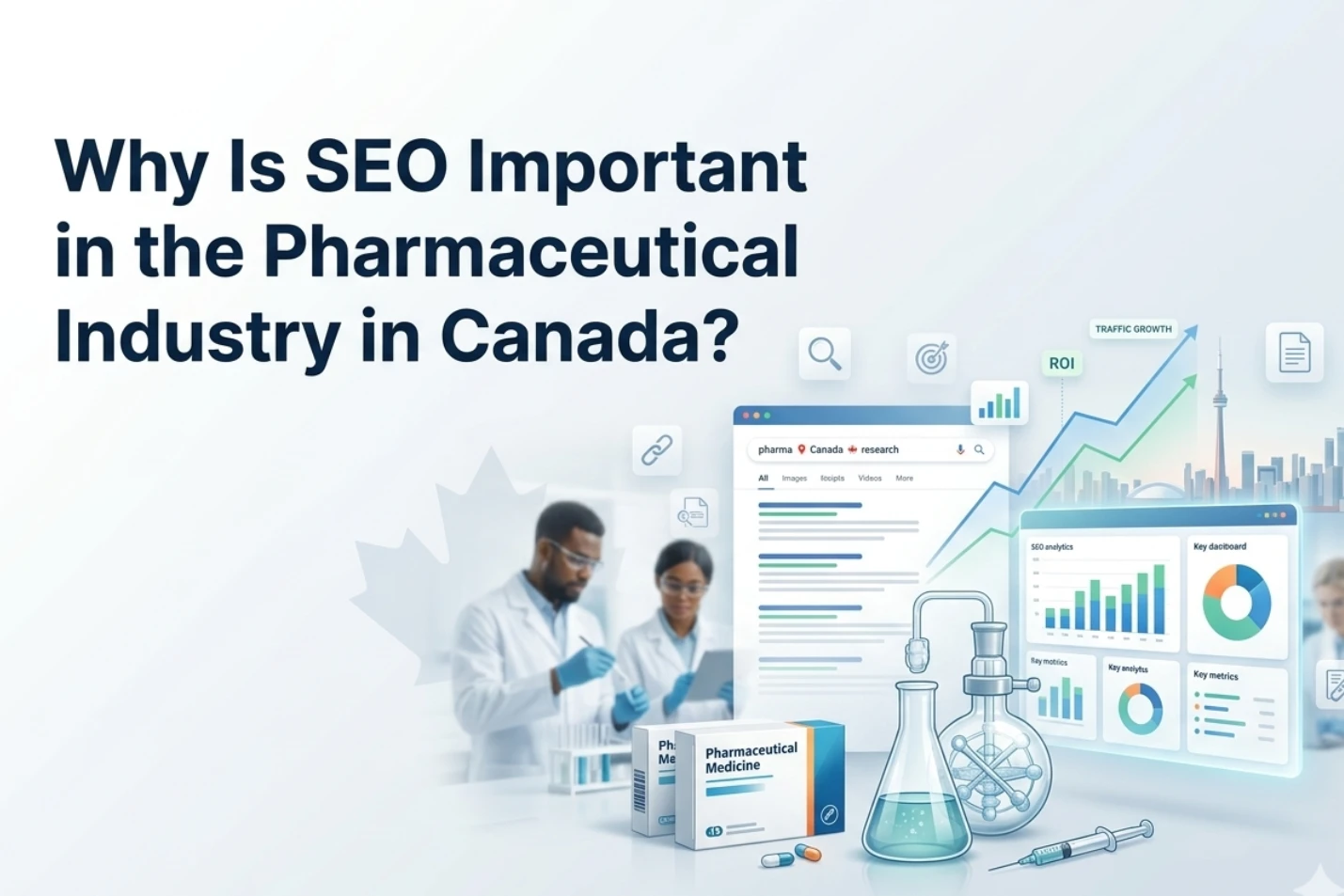

In the rapidly evolving landscape of 2026, the way Canadians access health information has fundamentally shifted. Gone are the days when a pharmaceutical brand could rely solely on sales representatives or traditional broadcast media to reach its audience. Today, the journey starts with a search query.
Whether it is a patient in Vancouver searching for "symptoms of chronic migraines" or a specialist in Toronto looking for the latest clinical trial data, search engines are the primary gatekeepers of information. However, for pharmaceutical companies operating in Canada, the digital space is not a "wild west." It is a highly regulated environment where SEO for Pharma Industry success is measured not just by rankings, but by trust, authority, and strict adherence to Health Canada and PAAB (Pharmaceutical Advertising Advisory Board) standards.
If your brand is not visible at the exact moment a Healthcare Professional (HCP) or patient seeks answers, you are effectively invisible in the Canadian market. This guide explores why a robust digital presence is no longer optional and how to navigate the complexities of healthcare digital marketing in the Great White North.
What is SEO for the Pharma Industry?
SEO for Pharma Industry refers to the strategic process of optimizing a pharmaceutical company’s digital assets—websites, resource hubs, and patient portals—to rank higher in organic search results. Unlike standard retail SEO, pharma SEO is bifurcated:
- HCP-Targeted SEO: Optimizing for technical, clinical, and data-driven keywords used by doctors and pharmacists.
- Patient-Targeted SEO: Focusing on disease state awareness, symptom-based searches, and educational content that empowers patients without crossing into prohibited direct-to-consumer (DTC) prescription drug advertising.
In Canada, this also heavily involves Local SEO in Pharma, ensuring that medical clinics and pharmacies carrying specific treatments are discoverable by patients in their immediate vicinity.
Why SEO Matters in the Canadian Healthcare Industry
The Canadian market presents unique challenges and opportunities that make SEO a critical pillar of any commercial strategy.
1. The Rise of "Answer Engine Optimization" (AEO)
In 2026, search has moved beyond a list of links. Google’s AI Overviews and conversational AI tools now provide direct answers to health queries. To remain relevant, pharma brands must structure their content so that AI engines recognize them as the "authoritative source." Without a dedicated SEO strategy, your clinical data won't feed into these AI responses, leaving the floor open to competitors or potentially inaccurate third-party sources.
2. Navigating Direct-to-Consumer (DTC) Restrictions
Canada has some of the world's strictest regulations regarding the promotion of prescription drugs to the public. You cannot "sell" a drug on a landing page. However, you can provide high-quality, non-promotional information about a disease state. SEO allows you to capture "top-of-funnel" traffic by ranking for symptom and condition keywords, establishing your brand as a leader in patient education before a prescription is even discussed.
3. Building E-E-A-T (Experience, Expertise, Authoritativeness, Trustworthiness)
Google prioritizes "Your Money or Your Life" (YMYL) content—which includes all pharmaceutical information. In Canada, establishing E-E-A-T is vital. This means having content reviewed by Canadian-licensed medical professionals and citing authoritative sources like Health Canada or the Canadian Medical Association (CMA). Proper SEO signals these trust factors to search engines.
Key Strategies for Success in Canada
To win in the Canadian market, healthcare marketers must move beyond basic keyword stuffing and embrace a holistic, "privacy-first" approach.
Local SEO in Pharma
For many pharmaceutical companies, the goal is to drive patients to a specialist or a pharmacy. Local SEO in Pharma involves:
- Optimizing "Find a Doctor" tools to be crawlable by search engines.
- Ensuring local clinic partners have accurate Google Business Profiles.
- Targeting geo-specific keywords like "dermatologists in Winnipeg" or "rheumatology clinics Montreal."
Symptom-Based Content Clusters
Patients rarely start their journey by searching for a brand name. They search for what hurts. Developing content around "symptom-to-solution" pathways is a major trend for 2026.
- Example: Instead of just a product page, create a comprehensive guide on "Managing Seasonal Allergy Fatigue in Ontario."
Technical SEO & Accessibility
Canadian websites must be inclusive. This means adhering to AODA (Accessibility for Ontarians with Disabilities Act) standards and ensuring fast load times on mobile devices, especially in rural areas where high-speed internet may be inconsistent.
Regulatory Considerations: PIPEDA and Beyond
In Canada, digital marketing and data privacy are inseparable. Pharmaceutical companies must ensure their SEO and data collection practices comply with PIPEDA (Personal Information Protection and Electronic Documents Act).
- Privacy-First Tracking: As third-party cookies disappear, pharma brands must rely on first-party data. Your SEO strategy should focus on "ethical engagement"—getting users to opt-in to newsletters or resource hubs voluntarily.
- PAAB Compliance: Every piece of "indexed" content that could be seen as promotional must be pre-cleared by the Pharmaceutical Advertising Advisory Board. SEO writers must work hand-in-hand with legal teams to ensure that meta tags and headers do not inadvertently make unauthorized therapeutic claims.
Benefits for Healthcare Businesses
Investing in a specialized SEO strategy offers long-term ROI that paid media cannot match:
- Reduced Patient Acquisition Cost: Organic traffic provides a steady stream of leads without the "pay-to-play" cost of PPC.
- Higher Credibility with HCPs: Doctors are skeptical of ads. They trust organic search results that lead to high-quality clinical evidence and peer-reviewed summaries.
- Future-Proofing: As AI-driven search becomes the norm, brands that have optimized for topical authority will dominate the "Answer Economy."
FAQs
1. Is SEO for pharma different in Canada vs. the USA?
Yes. Canada has much stricter rules regarding Direct-to-Consumer (DTC) advertising. US-based strategies often focus on brand names, while Canadian SEO must focus on disease state awareness and educational value to remain compliant.
2. How does PIPEDA affect my SEO strategy?
PIPEDA requires that any data collected through your website (like through a "Find a Doctor" tool) is handled with explicit consent. Your SEO strategy should avoid hyper-targeting based on sensitive health data unless clear, PIPEDA-compliant consent is obtained.
3. What are the best keywords for the pharma industry?
The best keywords are "high-intent" but "low-risk." Focus on symptom-based queries (e.g., "why is my skin red and itchy") or professional queries for HCPs (e.g., "latest clinical guidelines for Type 2 Diabetes").
4. Can a pharma brand use Local SEO?
Absolutely. By optimizing for Local SEO in Pharma, brands can help patients find the nearest infusion clinics, specialized pharmacies, or healthcare providers who are familiar with their specific therapeutic areas.
5. Does Google treat healthcare websites differently?
Yes. Google applies the E-E-A-T framework more strictly to healthcare sites. Your content must be accurate, authoritative, and ideally authored or reviewed by a medical professional to rank well.
Ready to Elevate Your Pharma Brand's Presence?
The Canadian pharmaceutical landscape is more competitive than ever. In an era of AI-driven search and strict PAAB regulations, your digital strategy needs to be as precise as your clinical data. Don't let your life-changing treatments get lost in the noise of the internet.
At Rankingeek, we specialize in SEO for Pharma Industry and healthcare digital marketing tailored specifically for the unique regulatory environment in Canada. We help you bridge the gap between complex science and patient accessibility.
Contact us today to schedule a complimentary SEO audit of your current healthcare website. Let’s identify your untapped growth opportunities and ensure your brand is the first authority Canadians find when they search for health solutions.