
.png)



Many local SEO agencies serving healthcare clinics operate with strategies 24 months behind the current tech curve, jeopardizing online visibility and lead generation. Google's rapid AI evolution demands modern approaches like entity SEO, generative AI, and predictive analytics for sustained local search optimization, moving far beyond outdated backlink tactics and manual methods.
Key Takeaways
Outdated local SEO agencies for healthcare often lag, failing to integrate AI and modern strategies. Healthcare businesses must adopt AI in local SEO,embrace new approaches like entity and generative AI, and use SEO automation tools for superior local search optimization. This proactive shift ensures enduring relevance and sustained patient acquisition as local search trends rapidly evolve towards 2026.
The landscape of local search optimization has undergone a seismic shift, fundamentally altering how healthcare businesses connect with patients online. While many healthcare clinic owners and hospital marketing managers still rely on a traditional healthcare digital marketing agency, a significant number of these providers operate with strategies dangerously out of sync with current technological advancements, particularly in AI. This lag directly impacts healthcare lead generation, patient acquisition, and the overall digital footprint for multi-location healthcare brands, dentists, dermatologists, cosmetic clinics,chiropractors, and private practitioners alike.
The core problem lies in a pervasive reliance on antiquated tactics. These include an overemphasis on volume-based backlink acquisition and static keyword research, which were once cornerstones of SEO but are now largely outmoded. Google's continuous algorithmic evolution,now heavily influenced by Generative AI in SEO and machine learning, prioritizes sophisticated signals like entity SEO, topical authority,and E-E-A-T principles.Agencies failing to integrate these concepts inadvertently handicap their healthcare clients, leaving them vulnerable to competitors leveraging truly modern SEO strategies. Understanding this technological gap and implementing proactive solutions becomes critical for any healthcare business aiming for robust online growth and sustained patient engagement.
Embracing AI in Local SEO for Proactive Healthcare Lead Generation
The most significant chasm between outdated and modern local SEO agencies is their adoption, or lack thereof, of AI. While many agencies still rely on manual data analysis and reactive adjustments, forward-thinking medical SEO agency teams integrate AI in local SEO at every stage of their strategy. This isn't about replacing human expertise, but augmenting it to achieve levels of precision and foresight previously impossible. For healthcare businesses, this means moving beyond basic keyword stuffing to truly understanding patient intent and anticipating future search behaviors.
The shift to an AI-driven search experience by Google means search results are no longer just about matching keywords. They are about understanding context, user intent, and delivering the most relevant, authoritative, and trustworthy information. For example, a patient searching for "best dermatologist near me" expects results based not just on location, but on reputation signals, specific services offered, patient reviews, and medical expertise: all factors AI can weigh with incredible accuracy. Agencies stuck in the past fail to leverage AI for advanced competitive analysis, predictive analytics for SEO, and hyper-personalized content strategies. They miss opportunities to optimize for complex queries and voice search, which are increasingly powered by AI and influence local rankings. A truly modern healthcare marketing experts team utilizes AI to analyze vast datasets, identify emerging local search trends, and predict shifts in patient demand, enabling proactive adjustments to local search optimization campaigns. This capability is vital for healthcare online marketing, as it ensures marketing efforts always align with how patients are actually searching and making decisions about their care.
The Shift to Generative AI in SEO and Predictive Analytics
The advent of Generative AI in SEO marks a significant departure from traditional content creation and keyword analysis. Outdated agencies often produce generic, keyword-stuffed content that fails to resonate with patients or meet Google’s sophisticated quality standards. In contrast, modern healthcare SEO services leverage generative AI to craft highly specific, E-E-A-T-focused content that addresses nuanced patient queries and builds topical authority. For instance, instead of just a page on "diabetes treatment," AI can help generate content covering specific sub types, management strategies, and related health issues,positioning a clinic as a comprehensive resource. This kind of depth is crucial for complex medical topics and significantly improves both user engagement and search engine rankings.
Furthermore, predictive analytics for SEO is revolutionizing how agencies plan and execute campaigns.Traditional methods are often reactive, responding to algorithm updates or changes in search volume after they occur. With predictive analytics, modern agencies can forecast future local SEO trends 2026, anticipate changes in patient demand, and identify untapped opportunities before competitors. Fora multi-location healthcare brand, this allows strategic resource allocation,predicts which new services might gain traction in specific geographic areas,or even identifies potential reputation management issues before they escalate.This proactive approach ensures that digital marketing for clinics is always one step ahead, securing valuable market share, and optimizing healthcare lead generation efforts. Agencies that ignore these AI-driven capabilities will continue to see their clients fall behind in an increasingly competitive digital healthcare landscape.
Optimizing for Google's AI-Driven Search Experience
Google's search experience is no longer a simple keyword matching system; it is an intricate, AI-driven search experience that understands context, intent, and relationships between entities. Outdated agencies often miss the subtle signals Google's AI prioritizes, such as nuanced linguistic patterns, the trustworthiness of a medical practice, and the comprehensive nature of its online presence. Merely having a website with basic information no longer suffices for a healthcare provider. Google's AI evaluates the entire digital footprint, including reviews, mentions across authoritative health sites, and the quality of schema markup implementation.
Effective optimization for this AI-driven environment requires a deep understanding of how Google processes information and connects related entities. Modern healthcare marketing experts focus on creating a cohesive digital identity, ensuring all online mentions of a clinic, doctor, or service are consistent and contribute to a clear entity profile. For example, a plastic surgery clinic needs its Google Business Profile, website, social media, and third-party listings to accurately and consistently portray its services, doctors, and locations. This consistency helps Google's AI understand the clinic's identity, offerings, and patient base, boosting its chances of appearing for highly specific, intent-driven searches. This comprehensive approach to local search optimization is essential for any healthcare branding agency aiming to stand out in a crowded market, thus generating high-quality leads. Agencies stuck in the old paradigm of simply chasing backlinks and generic keywords will find their clients increasingly invisible to Google’s intelligent algorithms.
Prioritizing Entity SEO and E-E-A-T Principles for Clinical Authority
One of the most profound shifts inSEO, largely driven by AI, is the move from keyword-centric optimization to entity-centric optimization. Outdated local SEO agencies often remain fixated on traditional keyword density and exact match phrases, failing to grasp Google's sophisticated understanding of concepts, relationships, and "entities". For healthcare businesses,this neglect is detrimental. Entity SEO focuses on establishing your clinic, doctors, and services as authoritative, well-defined entities in Google's knowledge graph. This means clearly defining what your practice specializes in, who your expert practitioners are, and how your services relate to specific medical conditions.
Crucially, E-E-A-T principles(Experience, Expertise, Authoritativeness, Trustworthiness) are no longer justbest practices; they are fundamental ranking factors, particularly in the YMYL(Your Money Your Life) sector like healthcare. An outdated agency might focus on generic content that only superficially touches on medical topics. In contrast,a cutting-edge medical SEO agency prioritizes showcasing the genuine experience of doctors, the verifiable expertise of staff, the authoritative nature of clinical research, and the overall trustworthiness of the brand through clear credentials, patient testimonials, and secure online practices.This ensures that when a potential patient searches for a complex medical condition or a specific treatment, Google's AI recognizes your practice as are liable and credible source of information and care. For example, a reputable ophthalmology clinic's SEO strategy should highlight its lead surgeon's publications, conference presentations, and years of specialized experience,reinforcing their E-E-A-T signals.
Building Topical Authority through High-Quality Content for Local Search Optimization
In the era of AI in local SEO,simply having a blog post for every relevant keyword is no longer enough;healthcare businesses must build topical authority. Outdated agencies might recommend a scattershot approach to content, churning out numerous shallow articles that barely scratch the surface of a topic. This contrasts sharply with modern healthcare SEO services that strategically develop comprehensive content clusters around core medical entities and related topics. For example, instead of just individual pages for"back pain relief" and "sciatica treatment," a chiropractic clinic with topical authority would develop an entire hub covering spinal health, including detailed articles on anatomy, various conditions, treatment modalities, preventative care, and related patient resources. Each piece of content would link logically, demonstrating a holistic understanding of the subject. This approach, critical for local search optimization, not only improves search rankings but also significantly enhances the user experience by positioning the clinic as a trusted educational provider. The goal is to answer every possible patient question about a health condition or treatment,establishing the clinic as an undisputed authority in its local market.
Enhancing Trust with Schema Markup Implementation and GBP Optimization
For healthcare entities, trust and clarity are paramount, and this is where technical SEO elements like Schema markup implementation and Google Business Profile optimization become crucial. Many legacy agencies overlook the intricacies of structured data or treat Google Business Profile (GBP) as a static listing, rather than adynamic reputation management and SEO tool. This oversight prevents clinics from fully leveraging the power of SERP feature optimization and presenting their information in the richest possible way. Modern local SEO for healthcare recognizes that detailed schema markup, such as `Medical Organization`, `Physician`, `Service`, and`Review` schema, directly feeds Google’s AI with explicit information about your services, doctors, and patient feedback. This helps your clinic appear in rich snippets, local packs, and other prominent SERP features, enhancing visibility and credibility.
Furthermore, Google Business Profile optimization goes far beyond merely claiming your listing. It involves actively managing reviews, promptly responding to patient feedback,regularly posting updates about services, events, and hours, and ensuring all information is meticulously accurate and consistent across the web. This proactive management of reputation signals and GBP details is a critical component of local search optimization, directly influencing how Google’s algorithms perceive the trustworthiness and activity of your practice.For a multi-location healthcare brand, consistent and optimized GBP listings across all locations are non-negotiable for effective healthcare online marketing. Agencies that fail to deeply engage with schema and GBP management are leaving significant ranking and conversion opportunities on the table for their clients.
Implementing Modern SEO Strategies with Advanced Automation Tools
The sheer volume of data and the rapid pace of algorithmic change make manual SEO processes untenable for competitive healthcare digital marketing. Agencies clinging to manual keyword tracking,rudimentary reporting, and laborious content updates operate at a severe disadvantage. Truly modern SEO strategies are characterized by the intelligent application of SEO automation tools and machine learning SEO tools to streamline operations, gain deeper insights, and respond with agility to the dynamic nature of search.
For a busy healthcare digital marketing agency, automation frees up human capital from repetitive tasks,allowing experts to focus on strategic thinking, creative content development,and complex problem-solving. This includes automated rank tracking across thousands of local keywords, sentiment analysis of patient reviews, automated reporting SEO, and even AI-powered content topic generation. Instead of spending hours compiling data, an agency can use automated dashboards that provide real-time performance metrics, identifying opportunities and threats instantly. For example, machine learning tools analyze changes in competitor rankings and website structure, predicting optimal strategies for your clinic. This enables a proactive rather than reactive approach. This level of efficiency and insight is crucial for delivering effective healthcare SEO services at scale, particularly for multi-location healthcare brands that require consistent performance monitoring across numerous clinics. Agencies that fail to leverage these tools are not only inefficient but also incapable of providing the data-driven insights necessary for competitive advantage in healthcare online marketing.
Leveraging SEO Automation Tools for Efficiency and Scale
The effective deployment of SEO automation tools is a hallmark of a modern, efficient healthcare digital marketing agency. Outdated agencies often rely on time-consuming manual checks for broken links, duplicate content, or basic ranking reports, which not only consume valuable resources but also introduce human error. In contrast,advanced automation allows for continuous monitoring of hundreds, if not thousands, of technical SEO parameters, ensuring a clean and optimized website foundation. For instance, an automated crawling tool can identify issues like missing meta descriptions, slow loading pages, or canonicalization problems across an entire hospital website instantly—problems that would take weeks to manually audit.
Beyond technical SEO, automation extends to sophisticated tasks such as competitor analysis, backlink profile monitoring, and even initial content drafting through Generative AI in SEO. Automated reporting SEO provides clients with transparent, real-time insights into campaign performance, moving beyond static monthly PDFs. This empowers clinic owners and hospital marketing managers with immediate access to crucial data on patient acquisition, keyword visibility, and local pack performance.For healthcare lead generation, automation can identify seasonal trends or geographic variations in patient demand more rapidly than human analysts,allowing for timely campaign adjustments. By reducing the manual workload, healthcare marketing experts can dedicate more time to strategic thinking, innovative content creation, and personalized client consultations, ensuring their healthcare online marketing efforts are both effective and scalable.
Understanding Local Algorithm Updates and Their Impact
Google's algorithms are constantly evolving, with frequent local algorithm updates directly impacting how healthcare businesses appear in local search results. Outdated agencies often react slowly to these changes, or worse, ignore them until clients see significant visibility drops. This reactive approach is detrimental. Even minor updates can drastically alter ranking factors or how specific SERP feature optimization elements are displayed. For a modern medical SEO agency,staying ahead means continuous monitoring of these updates, understanding their implications, and proactively adjusting client strategies.
For example, a Google update emphasizing review freshness and sentiment might require a clinic to double down on its reputation management strategy, encouraging more recent reviews and improving response times. An update focusing on mobile-first indexing or page experience metrics would necessitate a thorough audit of site speed and mobile usability. Modern healthcare marketing experts utilize machine learning SEO tools to analyze patterns in algorithm changes, identify commonalities, and predict future shifts, allowing them to adapt modern SEO strategies before competitors. This proactive understanding of local SEO trends 2026 ensures that a clinic's local search optimization efforts are resilient and consistently aligned with Google's latest directives,protecting their online visibility and patient flow. Without this forward-thinking approach, healthcare businesses risk being left behind with every new algorithm tweak.
Adapting to Voice Search Optimization and Hyperlocal Trends
The rise of smart speakers and mobile assistants has fundamentally changed how patients interact with search engines,ushering in an era where voice search optimization is no longer a nichetactic but a necessity. Many traditional local SEO agencies are ill-equipped to handle the nuances of conversational queries, focusing instead on text-based keywords. For healthcare clinics, this represents a significant missed opportunity, as patients increasingly use voice commands like, "Okay Google, find an urgent care clinic near me that's open now," or "Siri, what are the symptoms of strep throat and where can I get tested?" These queries are longer, more conversational, and often include hyper-local intent.
Modern healthcare SEO services understand that optimizing for voice search requires a shift to natural language processing and answering direct questions. This involves creating content that directly addresses common patient questions in a clear, concise manner, often in an FAQ format, and ensuring Schema markup implementation clearly defines these questions and answers. Furthermore, the future of local SEO trends 2026 points towards even greater hyperlocal relevance and personalized results, with Google's AIl everaging a user's real-time location and past search history to deliver highly tailored recommendations. This means a dermatology clinic needs its content and Google Business Profile to be optimized not just for"dermatologist in [city]," but for very specific queries like"laser hair removal near [specific neighborhood]" or "pediatric dermatologist for eczema in [zip code]." Agencies that fail to adapt to these conversational and hyper local nuances will see their clients miss out on a growing segment of potential patients, highlighting the critical need for a forward-thinking healthcare digital marketing agency.
The Future of Local SEO Trends 2026 and User Intent
Looking ahead, local SEO trends 2026 indicate a continued acceleration of AI's role in understanding deeply complex user intent optimization local.Outdated agencies might still be optimizing for generic "dentist near me" queries, while the reality is that patients perform far more specific searches. They might be looking for a "pediatric dentist that accepts[specific insurance]," a "dermatologist specializing in cysticacne," or a "physical therapist for sports injuries with evening appointments." These queries demand a sophisticated understanding of a user's needs, beyond simple geographical proximity.
Effective local search optimization for these future trends requires a nuanced approach to content creation and technical SEO. This means meticulously mapping out every potential patient journey,identifying their pain points, and creating highly targeted content that provides direct answers and clear calls to action. For example, a chiropractic clinic should not just have a service page for "back pain," but also dedicated content on "non-surgical solutions for herniated disc,""posture correction exercises," and "chiropractic care during pregnancy," each optimized for specific intent. Furthermore, machine learning SEO tools analyze user behavior data, revealing emerging patterns in intent that manual analysis would miss. This deep dive into user intent optimization local is crucial for healthcare lead generation, ensuring a clinic’s online presence directly addresses the precise needs of its target audience, driving higher quality traffic and conversion rates.
Optimizing for SERP Feature Optimization beyond Organic Listings
The search engine results page (SERP)is no longer a simple list of ten blue links. It is a complex ecosystem of rich snippets, local packs, knowledge panels, "People Also Ask" boxes,carousels, and more, collectively known as SERP feature optimization. Many traditional SEO agencies still primarily focus on achieving a #1 organic ranking, overlooking the immense visibility and conversion potential offered by these diverse SERP features. For healthcare businesses, appearing in these features can often be more impactful than a top organic listing, driving immediate visibility and trust.
For example, a clinic appearing in a"local pack" for "urgent care near me" gains immediate geographical prominence and direct access to maps, reviews, and contact information. Answering a "People Also Ask" question directly on your site can position your clinic as an expert, leading to higher click-through rates. Achieving SERP feature optimization requires a strategic approach, including robust Schema markup implementation to clearly define your services, doctors, and patient reviews, ensuring your content directly answers common questions, and meticulously optimizing your Google Business Profile optimization. A modern healthcare marketing experts team will not only aim for organic rankings but will also actively pursue these featured snippets and knowledge panel placements, understanding they offer prime real estate and significantly enhance a clinic's online authority and healthcare lead generation capabilities.
Integrating Healthcare Online Marketing for Holistic Growth with Modern SEO Strategies
A common failing of outdated local SEO agencies is their siloed approach, treating SEO as a standalone discipline distinct from other healthcare online marketing efforts. This fragmented strategy is ineffective in today's integrated digital landscape. For sustained growth and maximum impact, healthcare brands need integrated SEO + paid ads strategies that work in concert, amplifying each other’s strengths. An effective healthcare digital marketing agency understands that SEO builds long-term organic authority and visibility, while Google Ads for healthcare provides immediate, targeted patient acquisition and fills gaps where organic rankings might be slower to develop. This integration is a cornerstone of modern SEO strategies, ensuring that every marketing channel works towards a unified goal.
For example, a new clinic or a specialty service might use Google Ads to quickly gain visibility for highly competitive keywords while the SEO strategy works to build foundational organic rankings and topical authority. Conversely, SEO insights into top-performing keywords and patient intent can inform and optimize Google Ads campaigns, making them more cost-effective and conversion-driven. This integration extends beyond just SEO and PPC; it encompasses content marketing,social media engagement, email marketing, and comprehensive health care branding agency initiatives. The goal is to create a seamless patient journey across all digital touch points, from initial search to appointment booking. Agencies that fail to offer this integrated approach leave significant growth opportunities untapped and provide a disjointed experience for both their clients and potential patients. A holistic strategy ensures that every dollar spent on digital marketing for clinics contributes to a cohesive,high-impact effort.
The Synergy of Google Ads for Healthcare and Local Search Optimization
The outdated notion that Google Ads for healthcare and SEO compete represents a significant hurdle for many agencies and their clients. In reality, these are powerful complementary forces. When integrated, they create a formidable healthcare online marketing strategy. SEO builds organic visibility, trust, and long-term authority, which can take time, especially for highly competitive medical keywords. Google Ads, conversely, provides instant visibility at the top of the search results page, allowing clinics to capture immediate patient demand. This dual approach is vital for comprehensive local search optimization.
A modern healthcare marketing experts team leverages the synergy between these two channels. For instance, data from top-performing Google Ads keywords can inform and validate which organic keywords to prioritize for SEO, ensuring content creation and local search optimization efforts align with proven conversion drivers. Conversely, achieving top organic rankings for certain high-volume keywords can reduce reliance on paid ads for those terms, freeing up budget for other strategic initiatives or for targeting less competitive, niche areas. This integrated approach is particularly beneficial for healthcare lead generation, allowing clinics to dominate the search results for critical services, simultaneously building brand awareness and driving direct patient in quiries. Without a unified strategy, clinics risk sub optimal performance,missing out on patients who might click on either paid or organic listings.
Developing an Integrated Healthcare Branding Agency Approach for Robust Local Search Optimization
Effective healthcare online marketing goes beyond simply ranking for keywords; it is about building a recognizable, trusted, and authoritative brand. This requires an integrated approach typically provided by a specialized healthcare branding agency,which many local SEO agencies fail to offer. An outdated agency might focus solely on technical SEO elements, neglecting the broader brand narrative,visual identity, and consistent messaging that resonates with potential patients. In the healthcare sector, where trust and reputation are paramount,branding is inextricably linked to SEO success and plays a crucial role in local search optimization.
A truly integrated approach ensures every piece of content, every social media post, and every local listing reinforces the clinic's core values, mission, and unique selling propositions.This contributes directly to E-E-A-T principles and strengthens entity SEO, making it easier for Google's AI to understand and trust the brand.For example, a modern medical SEO agency would work hand-in-hand with a branding team to ensure website design, content tone, patient testimonials, and even the clinic's physical appearance align with the desired brand image. This consistency builds patient confidence and loyalty, which in turn influences positive reviews and online engagement – powerful signals for local search algorithms. By combining sophisticated local search optimization with robust branding, healthcare businesses can not only attract more patients but also cultivate a loyal patient base and establish themselves as leaders in their respective specialties, leveraging digital marketing for clinics to its fullest potential.
Traditional vs. Modern Healthcare SEO Agency Focus
Pro-Tips for Healthcare Clinic Owners
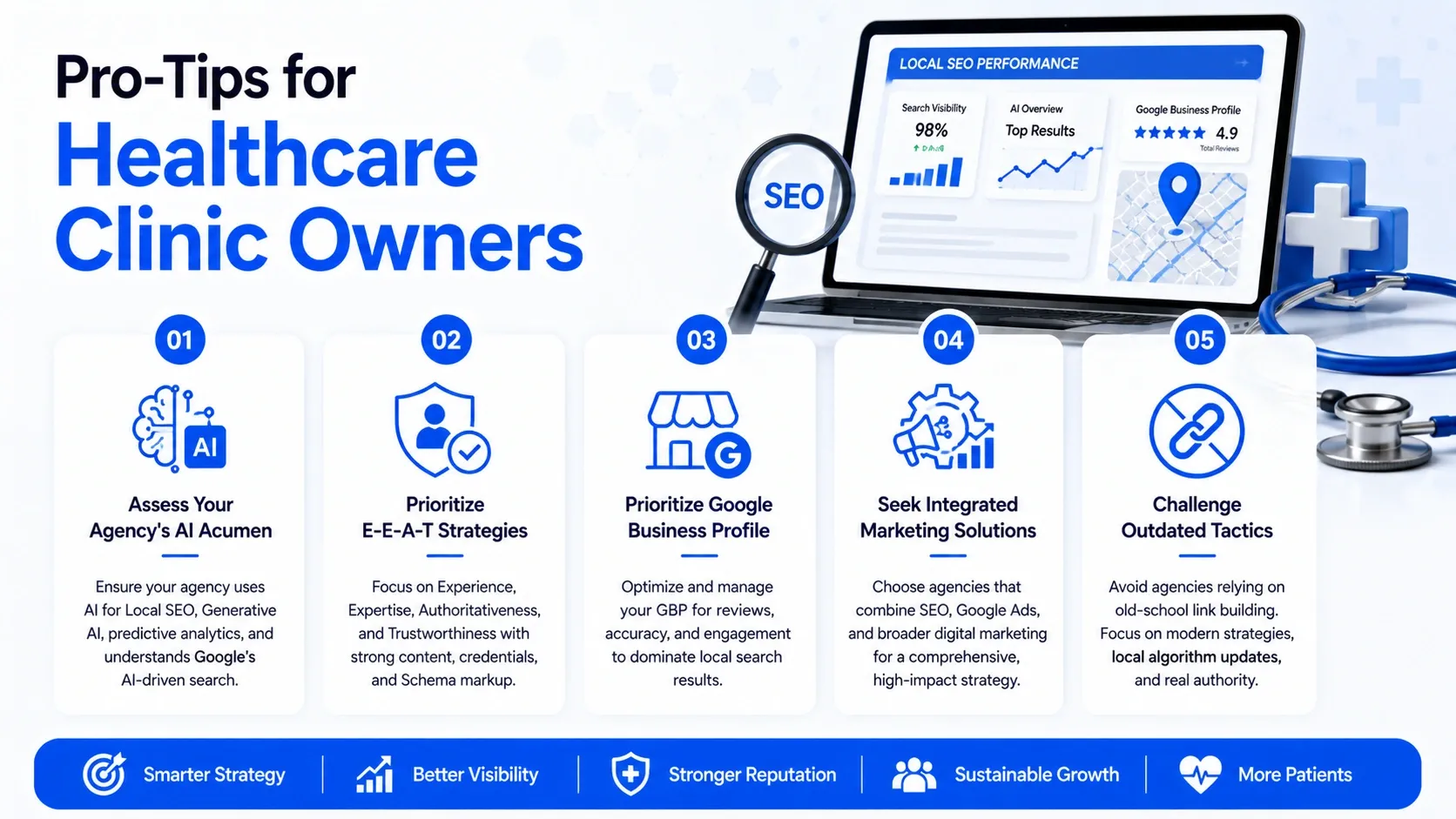
- Assess Your Agency's AI Acumen: Ask your current or prospective healthcare digital marketing agency how they integrate AI in local SEO, specifically inquiring about their use of Generative AI in SEO, Predictive analytics for SEO, and machine learning SEO tools. Ensure they understand Google's AI-driven search experience.
- Prioritize E-E-A-T Focused Strategies: Insist on a clear strategy for demonstrating your clinic’s Experience, Expertise, Authoritativeness, and Trustworthiness through content, credentials, and robust Schema markup implementation. Your agency should prioritize Entity SEO and building topical authority*.
- Prioritize Google Business Profile Optimization: Your GBP is your digital front door. Ensure your agency actively manages and optimizes it for reviews, accurate information, and engagement, leveraging it for superior local search optimization.
- Seek Integrated Marketing Solutions: Don't settle for siloed SEO. Look for healthcare marketing experts that offer an integrated approach, combining healthcare SEO services with Google Ads for healthcare and broader healthcare online marketing strategies for maximum impact.
- Challenge Outdated Tactics: Be skeptical of agencies still heavily emphasizing antiquated backlink tactics without a clear, modern strategy for local algorithm updates and local SEO trends 2026. Focus should be on genuine value and authority.
Also Read: A healthcare provider’s guide to appearing in "AI Overviews" and "Smart Summaries."
FAQ
Q1: How has AI fundamentally changed local SEO strategies for healthcare?
A1: AI has transformed local SEO by shifting focus from keywords to understanding user intent, entities, and context. Modern strategies leverage Generative AI in SEO for content, Predictive analytics for SEO for trend forecasting, and machine learning SEO tools for sophisticated analysis. This allows for hyper-personalized, E-E-A-T-focused optimization, moving beyond outdated backlink tactics and reactive methods.
Q2: Why are E-E-A-T principles so critical for healthcare SEO now?
A2: E-E-A-T principles(Experience, Expertise, Authoritativeness, and Trustworthiness) are crucial because Google's AI heavily prioritizes them, especially in the "Your Money Your Life" healthcare sector. Demonstrating E-E-A-T through high-quality, expert-backed content, verifiable credentials, and strong online reputation signals builds trust, which directly influences rankings and patient confidence.
Q3: What is Entity SEO and why is it important for a medical SEO agency?
A3: Entity SEO focuses on establishing a healthcare provider, doctor,or service as a well-defined, authoritative concept in Google's knowledge graph. It is vital because Google's AI understands relationships between entities, not just keywords. A modern medical SEO agency ensures consistent, rich information across all digital touchpoints to build topical authority and improve visibility for complex, intent-driven searches.
Q4: How do SEO automation tools benefit digital marketing for clinics?
A4: SEO automation tools benefit digital marketing for clinics by streamlining repetitive tasks like rank tracking, technical audits, and reporting. This frees up healthcare marketing experts to focus on strategy, content creation, and analysis. Automation provides real-time data, identifies opportunities faster, and ensures campaigns are consistently optimized for efficiency and scale, improving healthcare lead generation.
Q5: Why do healthcare brands need integrated SEO and paid ads strategies?
A5: Healthcare brands need integrated SEO + paid ads strategies because they are complementary. SEO builds long-term organic authority and trust, while Google Ads for healthcare delivers immediate, targeted patient leads. Combining them allows clinics to dominate search results, use paid ad data to refine organic strategies, and ensure comprehensive healthcare online marketing coverage, optimizing patient acquisition and ROI.