
.png)



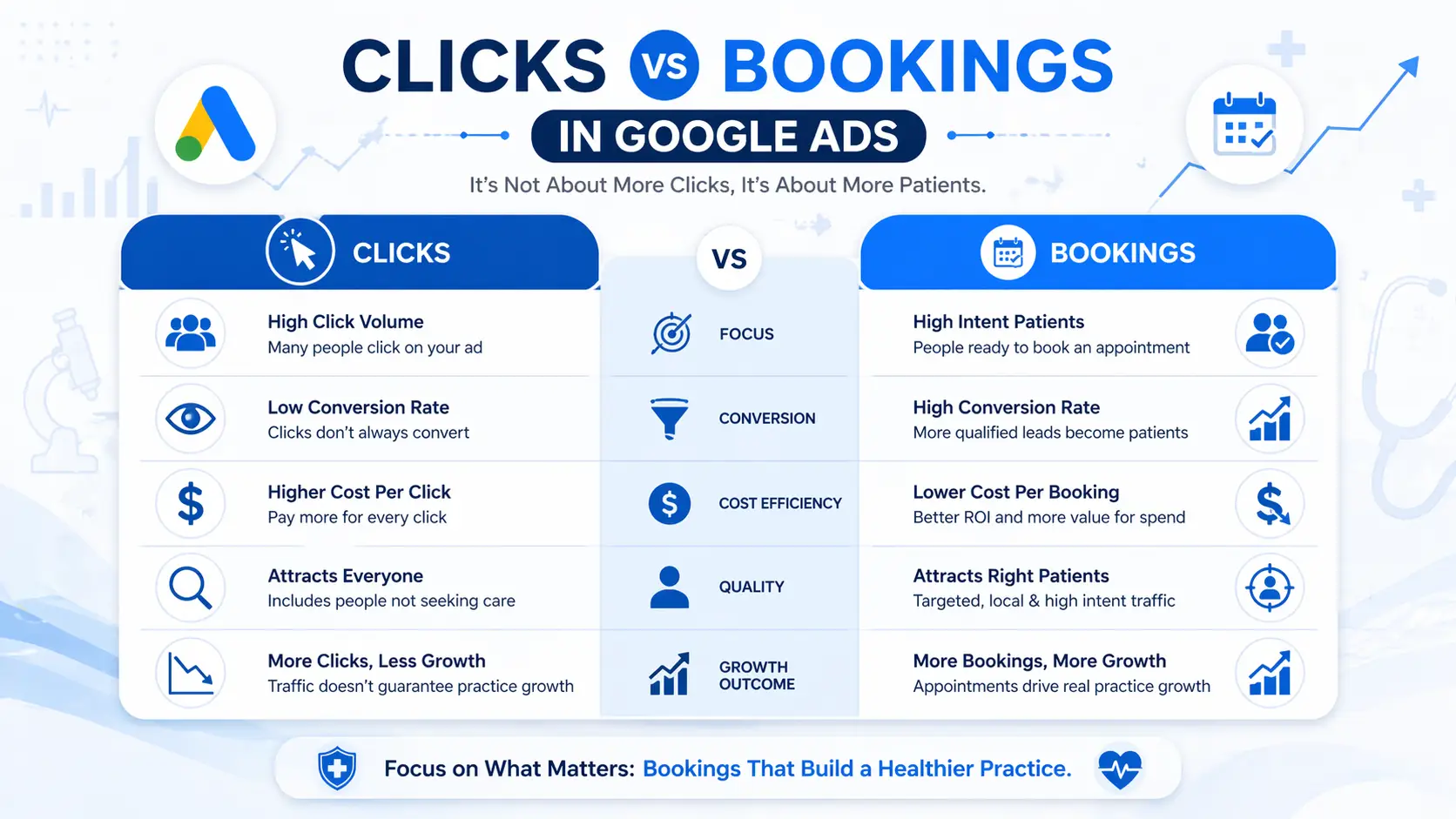
Many private practice owners find their Google Ads drain significant budgets without delivering a proportionate increase in patient intake. The fundamental flaw often lies in mistaking high click volumes for actual patient appointments. This creates a critical disconnect between merely "buying clicks" and strategically "buying bookings." Recognizing this distinction is paramount for sustainable growth and a healthy Healthcare Google Ads ROI.
Healthcare practices burn ad budget chasing clicks, not bookings. As AI Overviews increase costs, prioritizing Conversion Rate Optimization for Clinics becomes urgent. Implement Lead Scoring and focus on High-intent Medical Keywords to shift from a high Patient Acquisition Cost to profitable patient intake.
The Deceptive Lure of "Buying Clicks" in Healthcare Google Ads ROI
Seeing thousands of clicks on your Google Ads dashboard can be a potent, yet ultimately misleading, indicator of success. For many high-volume specialists, including dentists, orthopedists, and LASIK providers, this high click volume often masks a deep inefficiency: a poor Healthcare Google Ads ROI. The distinction between simply attracting attention and securing a new patient appointment defines whether your ad budget acts as an investment or a liability. Without a clear strategy for converting clicks into scheduled visits, your practice effectively pours money into an an unoptimized funnel. Clinic CFOs and practice owners must look beyond the Cost Per Click (CPC); instead, they should scrutinize the Cost Per Acquisition (CPA) for a true measure of ad performance. Agencies sometimes present high click volumes as a proxy for success. Yet, as one expert insight reveals, "1,000 clicks mean nothing if they result in 0 appointments," highlighting how "agencies use high click volume to hide poor conversion strategy" (Expert Insights). This "Vanity Metric" trap requires exposure and thorough understanding.
Unmasking the "Vanity Metric" Trap in Your Patient Acquisition Cost
The "vanity metric" trap proves particularly insidious for Google Ads for doctors. While a high number of clicks might initially appear impressive, this metric becomes deceptive if those clicks fail to translate into tangible patient bookings. Healthcare Marketing Managers frequently explain why "low-quality leads" result from seemingly robust ad campaigns. The reality often involves a significant portion of clicks coming from individuals merely browsing, conducting research without immediate booking intent, or even accidental engagements. These "browsers" inflate click data. They drive up Patient Acquisition Cost 2026 without contributing to revenue. The true measure of success instead lies in the Click-to-booking ratio. A low ratio indicates a fundamental problem: perhaps with your targeting, ad messaging, landing page experience, or internal booking process. Focusing Medical PPC management on conversion over sheer volume is essential to avoid this trap. Private practice owners must understand and act on this distinction, especially as competitive pressure intensifies across all specialties.
The Rising Cost of Empty Clicks: 2026 Ad Reality
Online search and advertising constantly change, making the cost of "empty clicks" increasingly detrimental. As we approach 2026, Google’s AI Overviews will occupy more prominent space within search results (Expert Insights). This shift inherently pushes traditional paid ads further down the page or compresses their visibility. It will lead to a rise in the cost of "Top of Page" ads (Expert Insights). For multi-location practice groups, an unoptimized ad strategy then becomes an even greater financial drain across various markets. Your practice pays premium prices for clicks that do not convert, so the financial burden will escalate. This severely impacts your Return on Ad Spend (ROAS) medical. Factors like slow loading landing pages, unclear calls to action, or complex booking processes create "conversion friction," which becomes a "fatal mistake" in this hyper-competitive environment (Expert Insights). This necessitates an urgent re-evaluation of your entire healthcare conversion funnel. Every single step, from the initial ad impression to the final booking confirmation, must be streamlined. This minimizes drop-offs and maximizes the value of each paid click. The urgency to optimize for bookings, not just clicks, has never been greater.
Optimizing for Bookings, Not Just Traffic: Conversion Rate Optimization for Clinics
Shifting focus from mere traffic generation to genuine patient bookings requires a robust approach: Conversion Rate Optimization for Clinics. This strategy extends beyond simply tweaking ad copy. It is a holistic examination of every touchpoint a potential patient has with your practice online. For private practice owners and clinic CFOs, this means understanding that a click represents only the start of the patient journey, not its ultimate destination. Effective optimization ensures that when a high-intent medical keyword brings a prospective patient to your site, they are guided seamlessly towards scheduling an appointment. This involves refining every element, from your ad creative to your landing page design, and critically, your internal follow-up processes. By meticulously analyzing user behavior, identifying specific friction points, and implementing data-driven changes, clinics can significantly improve their Click-to-booking ratio and, consequently, their Healthcare Google Ads ROI.
From Click-Through to Patient Through: Optimizing the Healthcare Conversion Funnel
Optimizing the healthcare conversion funnel involves understanding the distinct stages a potential patient navigates and optimizing each one. It begins with the initial ad impression, progresses through the click-through, lands on your dedicated page, and ideally culminates in a booking. Each stage presents opportunities for significant drop-off. For instance, a generic ad might attract numerous clicks, but a highly targeted ad using High-intent medical keywords is far more likely to attract individuals actually ready to book. Once a potential patient clicks, the quality of your medical landing page best practices becomes paramount. Is the page relevant to the specific ad? Is the call to action clear and prominently displayed? Does it load quickly, and is it mobile-responsive? Furthermore, the booking process itself must offer zero friction. Integrating patient booking software integration directly into your landing page, or clearly presenting multiple booking options like online scheduling or a prominent phone number with call tracking for clinics, significantly enhances conversion chances. Multi-location practice groups can standardize these optimized funnels across all their locations, ensuring consistent performance and maximizing medical lead generation strategies.
High-Intent Medical Keywords: Your Gateway to Qualified Leads
Selecting High-intent medical keywords is arguably the single most critical factor in attracting "bookers" rather than "browsers." These are precisely the search terms individuals use when actively seeking a specific medical service, often driven by an urgent need or a clear decision in mind. For example, phrases such as "LASIK eye surgery cost near me" or "dentist accepting new patients [city name]" clearly signify high intent. Contrast this with "what is LASIK" or "types of dental procedures," which are lower-intent queries attracting informational seekers. By focusing your ad spend exclusively on these precise, conversion-oriented keywords, you ensure your ads appear to the most qualified audience. This drastically improves your Click-to-booking ratio. Effective Medical PPC management demands rigorous keyword research, continuous monitoring of search terms, and the strategic implementation of long-tail keywords that capture specific patient needs. This highly targeted approach minimizes wasted ad spend on irrelevant clicks and directly contributes to a healthier Cost-per-acquisition (CPA) healthcare. Healthcare Marketing Managers should regularly review search query reports to identify these crucial keywords and adjust bidding strategies accordingly.
Read More: How to Get More Patients from Google : The Ultimate Healthcare Marketing Guide
Implementing a Robust Medical PPC Management Strategy
Effective Medical PPC management extends far beyond simply setting a budget and allowing ads to run. It represents a dynamic, data-driven process, essential for securing a positive Healthcare Google Ads ROI. Practices experiencing high ad spend with low patient intake require a robust strategy involving constant monitoring, adjustment, and optimization across various campaign elements. This is not a one-and-done task; rather, it demands ongoing vigilance to adapt to market changes, competitor actions, and evolving patient search behaviors. A comprehensive strategy integrates advanced bidding techniques, leverages local search opportunities, and consistently refines ad creatives and landing pages to ensure maximum efficiency. Clinic CFOs will particularly appreciate the focus on improving Cost-per-acquisition (CPA) healthcare through disciplined management, transforming ad spend from a mere cost center into a reliable patient acquisition channel.
Beyond Basic Bidding: Strategic Ad Spend Optimization for Healthcare
Strategic Ad spend optimization healthcare goes well beyond basic "set it and forget it" bidding. It involves sophisticated techniques designed to extract the most value from every dollar invested. This includes utilizing Google Ads' smart bidding strategies, such as "Target CPA" or "Maximize Conversions," once sufficient conversion data has accumulated. These automated strategies, however, still demand careful oversight and manual adjustments based on continuous performance analysis. For high-volume specialists, understanding the peak times for bookings and adjusting bids accordingly can yield significant competitive advantages. Consider, for example, increasing bids during proven high-conversion hours. Geographic targeting, audience segmentation, and device bid adjustments also play a crucial role. If your data shows that mobile users convert at a much higher rate for urgent care bookings, increasing mobile bids might be warranted to capture that demand. Multi-location practice groups particularly benefit from A/B testing different ad creatives and landing pages to identify the highest-performing combinations. They can then apply these valuable learnings across all their markets. This iterative process of testing, measuring, and optimizing is fundamental to achieving a superior Return on Ad Spend (ROAS) medical.
The Power of Local: Integrating Google Local Service Ads for Healthcare
For private practices and multi-location groups, leveraging Google Local Service Ads for healthcare is a critical component of a comprehensive Medical PPC management strategy. Unlike traditional Google Search Ads, LSA features verified professionals and directly displays a "Google Guaranteed" badge, instantly building trust with potential patients. These ads consistently appear at the very top of search results, often positioned above both paid search and organic listings, providing exceptional visibility. LSAs operate on a pay-per-lead model; you only pay when a qualified lead contacts your practice directly, rather than paying per click. This structure makes them highly attractive for improving Patient acquisition cost 2026, as the cost directly ties to a tangible lead. Integrating LSA into your overall strategy for Google Ads for doctors can significantly boost local patient acquisition, particularly for services where local proximity is a key decision factor, such as emergency dental care or physical therapy. Ensuring your Google Business Profile is fully optimized for local SEO for healthcare remains a prerequisite for both LSA eligibility and optimal performance.
Distinguishing "Browsers" from "Bookers": A Healthcare Lead Scoring Framework
The ultimate goal of Google Ads for doctors is to attract patients ready to book, not just those passively browsing for information. To achieve this precision, practices need a systematic way to distinguish between "browsers" and "bookers." Here, a Lead Scoring framework specifically for healthcare proves invaluable. Expert insights highlight the necessity of such a framework to help doctors "distinguish between 'browsers' and 'bookers'" (Expert Insights). This framework assigns scores to leads based on various indicators of intent and engagement. It allows Healthcare Marketing Managers to prioritize follow-up efforts and truly understand the quality of their medical lead generation strategies. For instance, a lead filling out a detailed appointment request form, demonstrating multiple website interactions, and using specific high-intent medical keywords would receive a significantly higher score. Conversely, someone who merely clicks an ad and quickly bounces receives a lower score. Implementing this framework allows for a more efficient allocation of resources and improved Return on Ad Spend (ROAS) medical.
Elevating Lead Quality with Strategic Negative Keywords
A powerful, yet often underutilized, tool for elevating lead quality and optimizing Patient acquisition cost 2026 is a robust Negative keywords strategy medical. Negative keywords prevent your ads from showing for irrelevant search queries. This directly reduces wasted ad spend on "browsers" and accidental clicks. For instance, a LASIK clinic might add "free," "at home remedies," or "careers" as negative keywords. This avoids attracting job seekers or individuals seeking free information instead of a surgical consultation. Similarly, a dental practice could add "DIY," "toothache cure home," or "school project" to avoid non-patient searches. Regularly reviewing your search term reports is critical for identifying new negative keyword opportunities. This proactive approach ensures your ad budget directly targets searches indicating genuine intent to book, significantly improving the Click-to-booking ratio and the overall effectiveness of your Medical PPC management.
Essential Tools: Call Tracking for Clinics and Patient Booking Software Integration
Accurately measuring conversions and understanding lead quality demands that clinics implement essential tools: Call tracking for clinics and seamless Patient booking software integration. Call tracking delivers invaluable data. It allows practices to attribute phone calls directly to specific ad campaigns, keywords, and even individual ad variations. This granular data reveals precisely which aspects of your Google Ads for doctors generate high-quality phone leads, enabling data-driven optimization. For example, if a specific ad for "emergency dental" generates a high volume of calls, understanding its Cost-per-acquisition (CPA) healthcare through call tracking becomes crucial. Likewise, frictionless patient booking software integration directly on your medical landing page best practices is paramount. A clunky, multi-step booking process inevitably creates "conversion friction" (Expert Insights), leading to abandoned appointments. Private practice owners and multi-location practice groups should invest in systems offering intuitive, real-time scheduling, ideally pre-populating patient information to minimize manual input. These tools are critical for closing the loop on your healthcare conversion funnel and accurately measuring your Healthcare Google Ads ROI.
Achieving Sustainable Patient Acquisition Cost 2026 and Beyond
Achieving a sustainable Patient acquisition cost 2026 requires a forward-thinking, integrated approach to digital marketing. It moves beyond immediate campaign metrics to focus on long-term growth, patient retention, and brand building. For clinic CFOs, this means ensuring every dollar spent on healthcare advertising agency services or internal marketing efforts contributes positively to the bottom line, rather than merely generating activity. Sustainable acquisition is not just about reducing costs. It involves optimizing the value of each acquired patient, fostering loyalty, and generating positive word-of-mouth referrals. This holistic perspective ensures your Healthcare Google Ads ROI continues to improve year over year, making your practice more resilient in an increasingly competitive market.
The Indispensable Role of a Healthcare Digital Marketing Agency
Navigating the complexities of Google Ads for doctors and ensuring a robust Healthcare Google Ads ROI often requires specialized expertise. This is precisely where a dedicated healthcare digital marketing agency or medical advertising agency becomes an indispensable partner. These agencies bring deep industry knowledge, understanding the nuances of high-intent medical keywords, stringent regulatory compliance, and the unique patient journey within healthcare. They can implement sophisticated Medical PPC management strategies, conduct thorough Conversion Rate Optimization for Clinics, and set up advanced call tracking for clinics and patient booking software integration. Moreover, a reputable agency focuses intently on bottom-line results. They prioritize your Cost-per-acquisition (CPA) healthcare and Return on Ad Spend (ROAS) medical over vanity metrics like click volume (Expert Insights). For multi-location practice groups, an agency can standardize best practices across all locations. This ensures consistent lead quality and predictable patient acquisition, ultimately driving significant growth and operational efficiency.
Local SEO for Healthcare: A Foundation for Ad Success
While Google Ads offers immediate visibility, a strong foundation of local SEO for healthcare significantly amplifies the effectiveness of your paid campaigns. This strategy also improves Patient acquisition cost 2026 in the long run. Local SEO ensures your practice appears prominently in local search results, Google Maps, and Google Local Service Ads for healthcare. For specialists relying on local patient bases, optimizing your Google Business Profile (GBP) with accurate information, positive reviews, and relevant service descriptions is paramount. This optimization includes consistent NAP (Name, Address, Phone) data across all online directories, building local citations, and actively generating positive patient reviews. A robust local SEO strategy not only drives organic traffic. It also enhances the trustworthiness and authority of your practice, making your paid ads more effective. When potential patients see your ads alongside strong organic listings and positive reviews, this creates a powerful synergy. This synergy encourages bookings and lowers the overall Cost-per-acquisition (CPA) healthcare. This combined approach is vital for practices aiming to achieve sustainable growth and a healthy Healthcare Google Ads ROI.
Comparison Table: Click-Focused vs. Booking-Focused Ad Strategies
the current records for specific numerical values, but derived from expert insights on strategic differences.
Pro-Tips for Optimizing Your Healthcare Google Ads
Implement a Negative Keywords Strategy Medical* immediately: Continuously refine your list to filter out irrelevant searches and prevent wasted ad spend. Review your search term reports weekly to identify new opportunities. Prioritize High-intent Medical Keywords*: Focus your budget on terms indicating active booking intent, such as "knee replacement surgeon near me" or "emergency dental appointment." Invest in Conversion Rate Optimization for Clinics: Ensure your landing pages are fast, mobile-friendly, relevant to the ad, and feature clear, prominent calls to action (CTAs) with patient booking software integration*. Leverage Call Tracking for Clinics*: Accurately measure phone lead conversions to understand which ads and keywords are driving the most valuable patient inquiries. Develop a Lead Scoring* framework: Systematically qualify leads based on their engagement and intent to prioritize follow-up and focus on "bookers." Integrate Google Local Service Ads for Healthcare: Capitalize on highly visible, pay-per-lead opportunities for local patient acquisition, supported by robust local SEO for healthcare*. Partner with a specialized Healthcare Digital Marketing Agency: Benefit from expert Medical PPC management and strategic Ad spend optimization healthcare focused on your Healthcare Google Ads ROI*.
FAQ
Q. What is the primary difference between "buying clicks" and "buying bookings" in healthcare ads?
A. "Buying clicks" means spending on ads to generate website visits, regardless of intent. "Buying bookings" focuses ad spend on attracting highly qualified leads actively seeking services, optimizing the healthcare conversion funnel to turn those clicks into scheduled appointments. This shifts the focus from superficial metrics to measurable patient acquisition and improved Healthcare Google Ads ROI.
Q. Why are "vanity metrics" like high click volume misleading for private practices?
A. High click volume can be a "vanity metric" because it does not guarantee actual patient appointments. As expert insights indicate, "1,000 clicks mean nothing if they result in 0 appointments." Agencies might use this to obscure poor conversion strategies, leading to a high Patient Acquisition Cost 2026 without increasing revenue. True success hinges on the Click-to-booking ratio.
Q. How does Google's AI Overviews impact the cost and effectiveness of Google Ads for doctors?
A. Google's AI Overviews will take up more search result space, pushing traditional "Top of Page" ads higher in cost while potentially reducing their visibility (Expert Insights). This makes "conversion friction" a "fatal mistake" (Expert Insights). Practices must optimize their ads for immediate conversions to justify the increased expense and maintain a positive Return on Ad Spend (ROAS) medical.
Q. What is a "Lead Scoring" framework, and why is it important for healthcare practices?
A. A "Lead Scoring" framework for healthcare assigns value to leads based on their intent and engagement, helping distinguish "browsers" from "bookers" (Expert Insights). This allows practices to prioritize follow-up with the most promising leads, improving the efficiency of medical lead generation strategies and reducing Cost-per-acquisition (CPA) healthcare by focusing resources where they matter most.
Q. How do "High-intent Medical Keywords" contribute to a better Healthcare Google Ads ROI?
A. High-intent medical keywords are specific search terms used by individuals actively looking to book an appointment or service, like "pediatric dentist for kids [city]." By targeting these keywords, practices attract a more qualified audience, leading to a higher Click-to-booking ratio, reduced wasted ad spend, and a significantly improved Healthcare Google Ads ROI by bringing in actual patients.