
.png)


It’s Monday morning at a physio clinic in Mississauga. The practice manager opens Google Business Profile and finds a new one-star review sitting right at the top. By lunch, the owner is asking what every clinic owner asks sooner or later: do negative Google reviews affect local SEO, and is this about to cost us new patients? Here’s the honest answer, plus a clear plan to protect both your ranking and your bookings.
The Short Answer: Do Negative Google Reviews Affect Local SEO?
A few negative reviews rarely cause a Google Maps ranking drop on their own. A low or falling average rating, a stalled flow of new reviews and unanswered complaints can weaken your clinic’s prominence over time. The most immediate effect, though, is usually fewer clicks, calls and bookings from patients who see the rating.
Why Bad Reviews Cost You Bookings Before They Cost You Rankings
Bad reviews usually hurt your bookings long before they hurt your ranking. Your star rating shows in the map pack before a patient reads a single word, right beside two or three competitors. A patient choosing between a 4.1 and a 4.8 two blocks away doesn’t need long to decide.
That’s why a clinic can hold its position and still see fewer calls. So can bad reviews hurt SEO? Sometimes a little, but they hurt bookings far more often. That’s why online reputation management is important even when your ranking looks fine.
Every patient who taps the clinic next door is a first visit, a treatment plan and possibly years of referrals you never see. You won’t find that loss in a ranking report. You’ll find it in a quieter phone.
Where Reviews Fit in Google’s Local Ranking
Reviews are one input into Google’s local ranking, not the whole system. According to Google Business Profile Help, local results are based mainly on relevance, distance and prominence.
If you’ve wondered how local SEO works for clinics, it comes down to three questions. Does your profile match the search? How close are you to the person searching? How well known and trusted is your clinic online?
Reviews sit inside that last one, prominence. Google says more reviews and positive ratings can help a business’s local ranking, alongside signals like links to your website. So can bad reviews lower your Google Maps ranking? They can nudge prominence, but they rarely outweigh distance and relevance.
Which Negative Review Signals Can Hurt Your Google Maps Ranking?
Some negative review signals may affect your ranking, but most hit clicks and patient trust harder. Here’s how each one works.
A Low Overall Star Rating
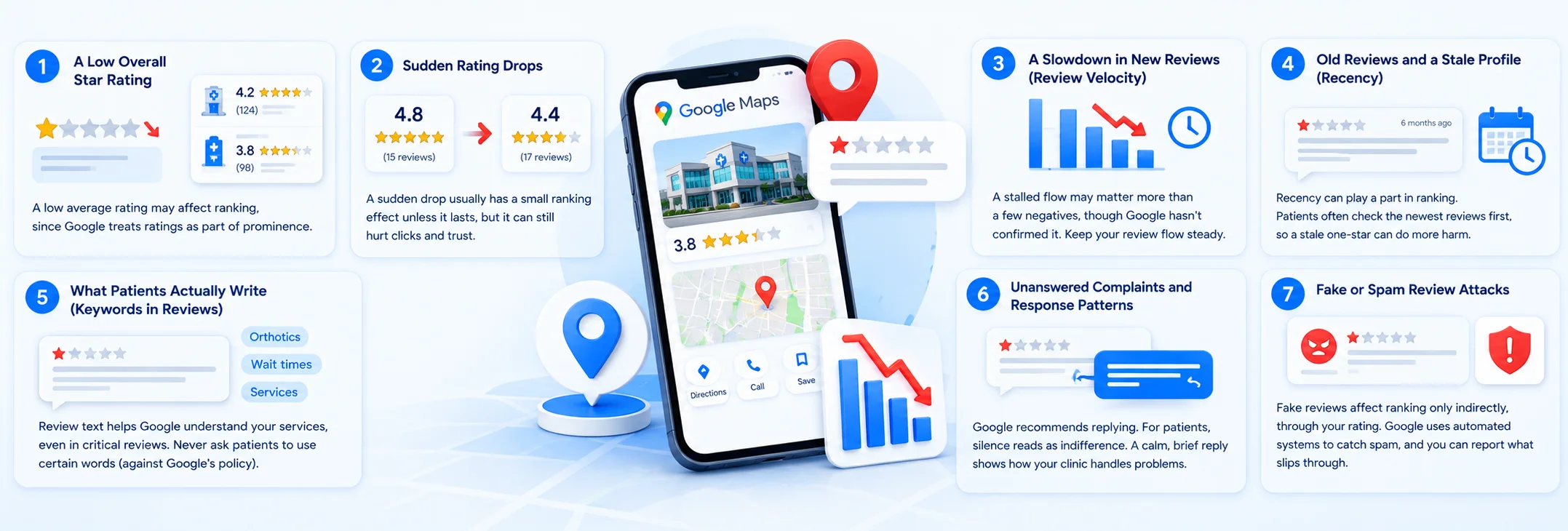
A low average rating may affect ranking, since Google treats ratings as part of prominence. It’s one signal among many, and Google hasn’t published any rating cut-off. The bigger hit is to trust, because your stars sit right beside your competitors’ in the map pack.
Sudden Rating Drops
A sudden drop usually has a small ranking effect unless it lasts, but profile size changes everything. A dental office in Calgary with 15 reviews at 4.8 stars falls to about 4.4 after two one-star reviews. With 300 reviews, the same two leave it at 4.8.
A Slowdown in New Reviews (Review Velocity)
Review velocity is how steadily new reviews arrive. Industry testing suggests a stalled flow may matter more than a few negatives, though Google hasn’t confirmed it. A sudden burst isn’t the fix, since Google’s systems can flag unusual patterns. A steady, routine ask is.
Old Reviews and a Stale Profile (Recency)
Industry observation suggests recency can play a part in ranking. The click effect is clearer. Many patients skim the newest reviews first, so a months-old one-star at the top of a quiet profile does far more damage than it should.
What Patients Actually Write (Keywords in Reviews)
Review text likely helps Google understand your services, even in critical reviews. A complaint about orthotics wait times still tells Google you offer orthotics. Google hasn’t said review keywords are weighted, though. And never ask patients to use certain words; Google’s policy doesn’t allow it.
Unanswered Complaints and Response Patterns
Google hasn’t confirmed review replies as a direct ranking factor, but it does recommend replying. For patients, silence reads as indifference. A calm, brief reply shows everyone reading how your clinic handles problems.
Fake or Spam Review Attacks
Fake reviews affect ranking only indirectly, through your rating. Google uses automated systems to catch spam, and you can report what slips through. Until removal, the damage is mostly to clicks. If someone demands payment to stop fake reviews, Google has a separate process for reporting extortion.
Here’s the quick version, signal by signal.
Ranking Drop or Click Drop? How to Tell the Difference
Check your data first. A ranking drop and a click drop feel the same at the front desk, but they need different fixes.
Signs Your Map Ranking Actually Changed
Your ranking has likely shifted if a local rank tracker or geogrid tool shows your position falling across your area, not just in one spot. Fewer searches finding your profile is another sign. If that’s the pattern, our guide on why a clinic stops showing in the Google Map Pack covers other causes to rule out first.
Signs Patients Are Seeing You but Not Choosing You
Your visibility holds steady, but calls, website clicks and direction requests in Google Business Profile Performance fall. Patients are finding you and picking someone else. That’s a click-through problem, so your rating and replies are the first place to look.
What to Do After Your Clinic Gets a Negative Review
Work through these four steps in order, and don’t rush the reply.
Step 1: Check the Review Against Google’s Policies
Start with Google’s prohibited and restricted content policy. Fake reviews, spam, conflicts of interest, off-topic rants, hate speech and posts that share personal information can be reported. A review that’s simply negative, or unfair in your view, usually doesn’t qualify.
Step 2: Respond Calmly and Briefly
Reply within a day or two, in three or four sentences. Thank the person, acknowledge the concern in general terms and move the conversation offline. This is the heart of online reputation management,the ongoing work of monitoring and responding to what people see about your clinic online.
What to Leave Out of Every Reply
- Anything that confirms or denies the person was a patient
- Treatments, conditions, appointment dates or billing details
- Arguments, sarcasm or blame
- Offers in exchange for changing or removing the review, which Google prohibits
Step 3: Report Fake or Policy-Violating Reviews
Report a review only if it breaks Google’s rules. Google says it doesn’t step into disagreements between a business and its reviewers.
How to Flag a Review in Google Business Profile
- Go to your Business Profile and select Read reviews.
- Next to the review, select Report.
- Choose the reason that fits best.
- Select Send report.
How to Track or Appeal a Report
Reports usually take several days. Check the status in Google’s Reviews Management Tool; if Google finds no violation, you can file a one-time appeal there. Google won’t remove a review just because it’s negative.
Step 4: Keep Earning Genuine Reviews the Right Way
The most reliable way to improve your online reputation is simple: ask every patient, the same way, every time. A Google review link or QR code at checkout works well. A steady review flow is also part of optimizing your Google Business Profile (formerly Google My Business).
- No review gating: Don’t screen patients first and send only happy ones to Google.
- No incentives: No discounts, draws or gifts in exchange for reviews.
- No staff or family reviews: Anyone with a conflict of interest shouldn’t post one.
Also Read: Local SEO Reviews Impact: What Medical Practices Must Know in 2026
A Canadian Privacy Note: What Your Clinic Must Never Say in a Review Reply
Never confirm or deny that a reviewer is or was a patient, even if they’ve said so publicly. In Canada, your reply itself can disclose personal health information.
That means no treatments, diagnoses, appointment dates, billing or anything from a patient’s file. Offer a phone number or email for your clinic manager or privacy officer instead.
The rules come from PIPEDA at the federal level, plus provincial health privacy laws such as Ontario’s PHIPA or Alberta’s Health Information Act, and the equivalent law in your province. Our guide to PHIPA marketing rules for Canadian clinics covers consent in more depth.
Provincial regulatory colleges also set advertising and conduct rules, and some limit patient testimonials. Don’t repost reviews as testimonials on your website without checking your college’s guidance.
Why Most Clinics Struggle to Fix This on Their Own
Most clinic owners know what they should do. The hard part is doing it every single week while the waiting room is full.
Review requests go out when the front desk remembers, so reviews arrive in bursts and then stop. Replies get written in a rush between patients, which is exactly when privacy mistakes happen. And nobody checks how the clinic ranks beyond the computer at reception.
Signs It’s Time to Get Help
- Your rating dipped and new-patient calls fell in the same month
- Your newest Google review is several months old
- Negative reviews sit unanswered because no one owns replies
- You’ve had a sudden wave of reviews from names you don’t recognize
- A competitor with a busier, newer profile now shows above you
- Your team isn’t sure what they’re allowed to say under Canadian privacy rules
If two or more of these sound familiar, your review profile may already be costing you patients, and it’s worth getting a second set of eyes on it.
How Rankingeek Helps Clinics Protect Their Rankings and Win Back Clicks
We work only with healthcare practices, so we build review and local SEO systems around how clinics actually run, including Canadian privacy rules. Here’s what that looks like.
- A map visibility audit: We check where you rank across your service area, not just from your front desk, and compare your review profile with the clinics above you.
- A compliant review request system: Every patient gets the same short request after their visit, by text or email, so reviews arrive steadily. No gating, no incentives.
- Instant alerts and privacy-safe replies: You hear about new reviews right away, with a suggested reply that keeps patient information out of public view.
- Fake review documentation and reporting: We help you gather evidence, report through Google’s channels and follow each case in the Reviews Management Tool.
- Google Business Profile optimization: Categories, services, photos and profile details that strengthen relevance, so reviews aren’t doing all the work.
We review progress with you on a monthly strategy call, so you always know what changed and why.
Want to see the kind of results we work toward? Our success stories show how we’ve grown patient calls and conversions for healthcare practices.
The Bottom Line
So, do negative Google reviews affect local SEO? Sometimes a little, but rarely as much as that Monday-morning panic suggests. The clinics that win protect prominence with a steady flow of genuine reviews, protect clicks with calm replies and protect patient privacy in every word. For small clinics, local search is often where new patients first meet you, and that’s exactly why local SEO matters.
What Your Free Audit Includes
- Where your clinic ranks across your service area, not just from reception
- How your rating, review count and recency compare with the top three clinics near you
- Whether any current reviews may qualify for reporting to Google
- Your Business Profile trends for calls, website clicks and direction requests
- A plain-language list of what to fix first
It’s free, and there’s no obligation to sign up for anything.
Frequently Asked Questions
Do negative Google reviews affect local SEO?
They can, but usually less than clinic owners fear. Google counts reviews and ratings as part of prominence, one of its three main local ranking factors. A few negatives rarely move your position on their own. The more common effect is fewer patients clicking, calling or booking after they see your rating.
How many bad reviews does it take to hurt my Google Maps ranking?
There’s no set number, and Google hasn’t published a rating threshold. The impact depends on your total review count, your competitors and how long the trend lasts. Two bad reviews shift a 15-review profile far more than a 300-review one. A steady flow of genuine reviews is your best buffer.
Can bad reviews hurt SEO for my clinic’s website too?
Not directly, based on what Google has said. Business Profile reviews mainly feed local map results, not your website’s organic rankings. The indirect risk is patient behaviour. A weak rating can mean fewer clicks through to your site and fewer bookings, even when your pages rank well.
Can I get a negative Google review removed?
Only if it breaks Google’s policies, for example if it’s fake, spam, off-topic, hateful or shares personal information. Report it in Google Business Profile and track it in the Reviews Management Tool. Google won’t remove a review because it’s negative or feels unfair, and nobody can guarantee removal.
Does replying to reviews improve my local ranking?
Google hasn’t confirmed replies as a direct ranking factor. It does recommend replying, and says helpful replies can make a business stand out. The clear benefit is trust, because future patients read how you respond. A calm, privacy-safe reply often does more for bookings than the original review costs you.
Can I tell a reviewer they were never our patient?
It’s best not to. Confirming or denying patient status can itself be a privacy disclosure under Canadian law. Reply neutrally instead, for example by inviting the person to contact your office directly. If the review looks fake, report it to Google rather than arguing about it in public.
Should I manage Google reviews myself or get help?
You can handle the basics yourself if someone on your team has time to ask every patient and reply within a day or two. Clinics usually bring in help when reviews stall, replies slip, a fake-review wave hits or they run several locations. What matters is a system that keeps working during your busiest weeks.