


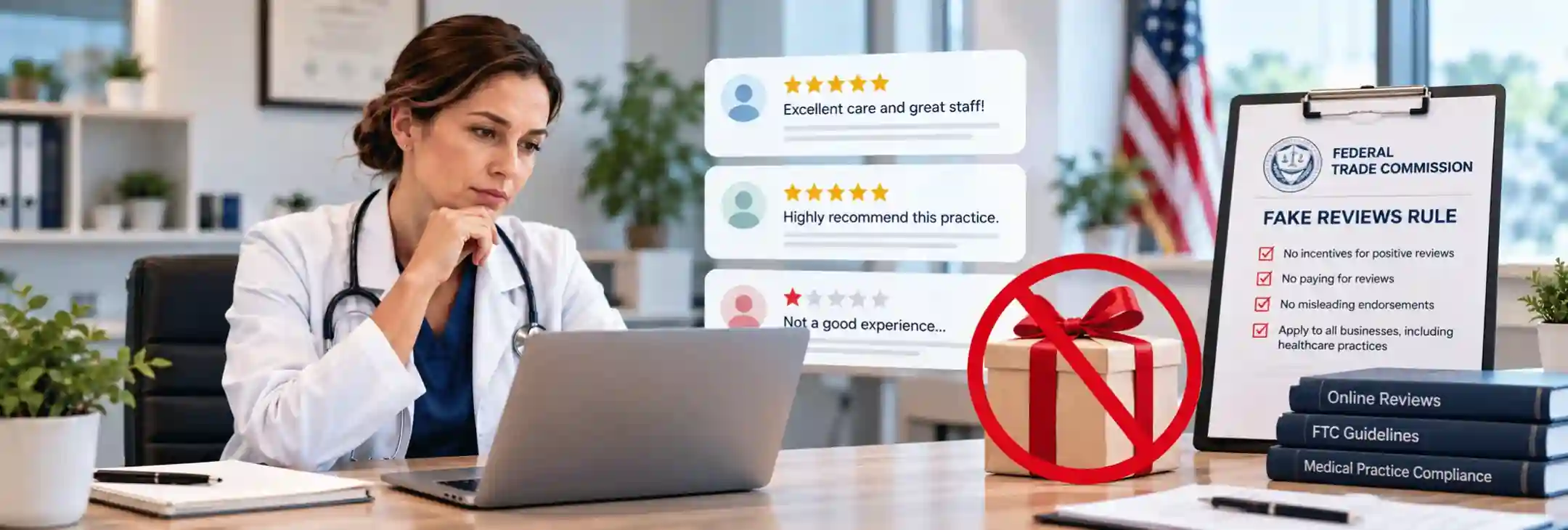

Most clinic owners know that patient reviews shape who books the next appointment. Fewer know where the legal line sits once a gift card or discount enters the picture. The FTC fake reviews rule took effect in October 2024 and gave regulators the power to fine businesses for deceptive review tactics. This guide breaks down review incentives for medical practices in plain and practical terms.
Quick Answer for Clinic Owners
The FTC rule bans fake reviews and any reward tied to a positive rating. Google goes further and removes all incentivized content. The safest approach to review incentives for medical practices is to skip them entirely. Every patient gets the same request, with no reward, no filtering, and no staff reviews.
What Does the FTC Fake Reviews Rule Cover?
The federal rule on consumer reviews and testimonials took effect on October 21, 2024. The rule lets the FTC seek civil penalties for knowing violations. That ceiling currently stands at $53,088 per violation, since the federal government cancelled the 2026 inflation adjustment. The rule bans six practices that matter to a clinic:
1. Fake reviews from people who never visited, never existed or never had the treatment they describe, including AI-generated reviews
2. Sentiment rewards, which means any perk that hinges on a positive or negative review
3. Undisclosed insider reviews from owners, managers, staff or their relatives without a clear disclosure
4. Company-controlled review sites that pose as independent rating platforms
5. Review suppression through groundless legal threats, intimidation or false accusations
6. Fake social proof, such as bought followers or views
Patients carry no liability under the rule. The clinic does, and so do the agencies or review software vendors behind its campaigns. That matters for review incentives for medical practices, since most clinics outsource the job.
The rule also gives clinics one useful protection. A clinic that sends the same request to all patients is not responsible when an employee who visited as a patient posts without a disclosure.
Also Read: Local SEO Reviews Impact and What Medical Practices Must Know in 2026
Are Discounts and Gift Cards Allowed as Review Incentives for Medical Practices?
The FTC rule does not ban every incentive. It bans rewards that depend, openly or by hint, on a positive or negative review. A $10 gift card for any honest review sits outside the rule itself. A coupon for patients who "share how much they loved their visit" falls inside it, because the wording implies a happy review.
That gap is narrower than it looks. The FTC treats incentivized reviews as testimonials, and a testimonial needs a clear disclosure of the reward. A patient who takes a gift card and stays silent about it leaves the clinic exposed under the broader FTC Act.
Rewards for edits carry risk too. The rule does not name payments for removing a negative review, but FTC staff warn that such deals can still break federal law. Google bans them outright.
The real test of review incentives for medical practices goes beyond federal law. A reward that passes FTC scrutiny can still erase a clinic's hard-earned ratings on Google. The table below shows where clinics stand on both rulebooks.
A short audit often uncovers risky settings nobody chose on purpose.
Is Review Gating Still Legal for Clinics?
Review gating uses a short survey to send happy patients to Google and unhappy ones to a private form. Many review software vendors sold this feature to clinics for years, and plenty of accounts still run it today.
The FTC rule does not name the practice outright. FTC staff still say that requests that go only to satisfied customers can violate the FTC Act. An online fashion retailer paid $4.2 million in 2022 after it blocked negative reviews from its own website.
A clinic website that hides critical reviews while claiming to show them all falls under the suppression ban. That shortcut can damage a clinic's online reputation faster than a few bad reviews ever could.
Google leaves no doubt. Its policy forbids attempts to discourage negative reviews or selectively request positive ones. The short answer is a firm no on Google and a high-risk choice under federal law. Most compliance problems with review incentives for medical practices actually start with software defaults that nobody checked.
How Is the Google Review Policy Stricter Than the FTC Rule?
Google treats any review that a business pays for, in cash or in kind, as fake engagement. The platform removes those reviews from Maps even when the reward had nothing to do with the rating. Its systems also hunt for fake reviews from bots and review farms. The Google review policy also covers habits that many front desks see as harmless.
1. A discount for a new review or for a change to a negative one
2. Pressure to post a review while the patient is still in the office
3. Requests for specific content, such as the name of a doctor or hygienist
4. Staff targets for a set number of reviews
5. Reviews from owners or employees, which Google flags as a conflict of interest
Some Google Maps users now see a prompt that asks whether a business offered rewards for reviews. A yes can lead to deleted reviews, and repeated abuse can limit the profile itself. This gap explains why review incentives for medical practices rarely make sense, even when they pass the FTC test. Google still welcomes honest requests, and every Google Business Profile comes with a short review link and QR code.
Also Read: Google Business Profile for Doctors Complete Optimization Guide 2026
What Does a Compliant Review Request Process Look Like?
A compliant process replaces review incentives for medical practices with a system that patients trust. Each part below keeps patient reviews flowing without crossing a legal or platform line.
Timing of the Request
The best window sits within 24 hours of the visit, while the details are still fresh. Many clinics send review requests by text, since patients often read texts within minutes. Google frowns on in-office pressure, so a printed card beats a tablet at the checkout desk. The same short link works well in both formats.
Example Text Message After a Visit
"Hi Sarah, this is Maple Family Clinic. We hope your visit today went well. Your honest feedback helps other families choose the right care. You can share it here whenever you have a minute. [review link]”
Wording That Stays Neutral
Words like "honest" and "your experience" set a neutral tone. Phrases such as "five stars" or "tell us what you loved" hint at the answer the clinic wants. The message asks for patient feedback, not praise.
Health privacy rules matter here too. Good review requests never mention a diagnosis, a procedure or a test result. Public replies follow the same rule and never confirm that the reviewer is a patient.
Example Email Request
Subject line: "How was your visit with us?"
"Dear James, we appreciate your visit to Northside Physical Therapy this week. We send this note to every patient, and all feedback matters to us. A short review helps us improve and helps others in our community find care. The link below takes about two minutes. [review link]"
Example Front Desk Script
"We ask every patient for feedback after their visit. You will get a short text with a link later today. Any honest review, good or bad, helps us a lot."
Software Settings to Check
Review software often ships with features that create quiet risk. These settings deserve a look before the next round of review requests goes out.
1. Sentiment screens that route unhappy patients away from public sites
2. Automatic sends that skip patients with low satisfaction scores
3. Templates that mention five stars or any kind of reward
4. Website widgets that show only top ratings while they claim to show every review
A private feedback form can stay, as long as every patient also gets the public link from the clinic's Google Business Profile. Most platforms let an admin switch off sentiment routing in a few clicks.
Final Thoughts on Google Review Incentives for Medical Practices
Review incentives for medical practices can create legal and reputational risks. The FTC prohibits rewards tied to positive or negative reviews. Google also bans incentivized reviews, even when patients can share honest feedback.
Clinics should request reviews from every patient without offering rewards. Keep requests neutral, protect patient privacy, and avoid review gating. Regular audits of review software can help identify risky settings.
At Rankingeek, we help medical practices build compliant review strategies that support patient trust and local SEO growth. Our online reputation management team builds review workflows for US clinics that grow ratings steadily and safely.
FAQs on Review Incentives for Medical Practices
Can I offer a discount for leaving a Google review?
Google does not allow it. The Google review policy removes any review that comes with a discount, free service or other reward, even an honest one.
Is review gating illegal under the FTC rule?
The FTC rule does not ban gating by name. FTC staff say the practice can still violate the FTC Act, and Google bans it outright. Most clinics treat it as off limits.
Can staff or family leave reviews for our clinic?
Relatives may post on some sites when they clearly disclose the connection in the review. Google treats reviews from owners and employees as a conflict of interest and removes them. The safest choice is no reviews from anyone close to the practice.
Can we offer a raffle entry to every patient who leaves a review?
The FTC rule itself does not ban a raffle open to every reviewer, as long as entry does not depend on the rating. Google still treats raffle entries as incentivized reviews and removes them. Most clinics find the raffle not worth the risk.
Can we ask an unhappy patient to update a negative review?
A clinic can reach out, fix the problem and let the patient decide. Any reward for a changed or deleted review crosses the line on Google. Honest patient feedback, even when it stings, still helps the next patient choose.