
.png)



Almost every clinic owner we speak with has some version of the same story. A few years ago, someone sold them an SEO package. Reports arrived every month, full of green arrows and keyword positions. The phones sounded exactly the same.
So when SEO comes up again, the skepticism is earned. Is clinic SEO a waste of money, or did they simply buy the wrong thing? Below is an honest answer for Canadian dental, medical, physiotherapy, chiropractic, mental health, and aesthetic clinics, including the situations where we'd tell you to hold off.
Short Answer: Is Clinic SEO a Waste of Money?
No. For most Canadian clinics, SEO is not a waste of money, but it becomes one under the wrong conditions. Clinic SEO tends to pay for itself when local patients actively search for your services, you have room to take new patients, and you can commit to six to twelve months of consistent work. It turns into wasted spend when search demand is low, your schedule is already full, results are expected within 30 days, or success is measured in rankings instead of booked appointments.
Why Clinic SEO Gets a "Waste of Money" Reputation
The channel usually isn't the problem. The purchase is.
Most disappointing programs we review share a pattern: the clinic paid for activity (blog posts, backlinks, a monthly PDF) instead of outcomes tied to patients. Nobody checked whether people nearby were even searching for the clinic's most profitable services. Nobody connected phone calls and online bookings back to organic search.
Six months later, the owner couldn't tell whether SEO had worked, so it looked like it hadn't. That distinction matters. "SEO didn't work for us" and "we never measured what SEO did" lead to very different decisions.
Not sure whether your last SEO investment actually failed, or was just never measured properly?
When Clinic SEO Is Worth the Investment
So, is SEO worth it for clinics? It is when a few conditions line up. You don't need every one, but the more that apply, the stronger the case.
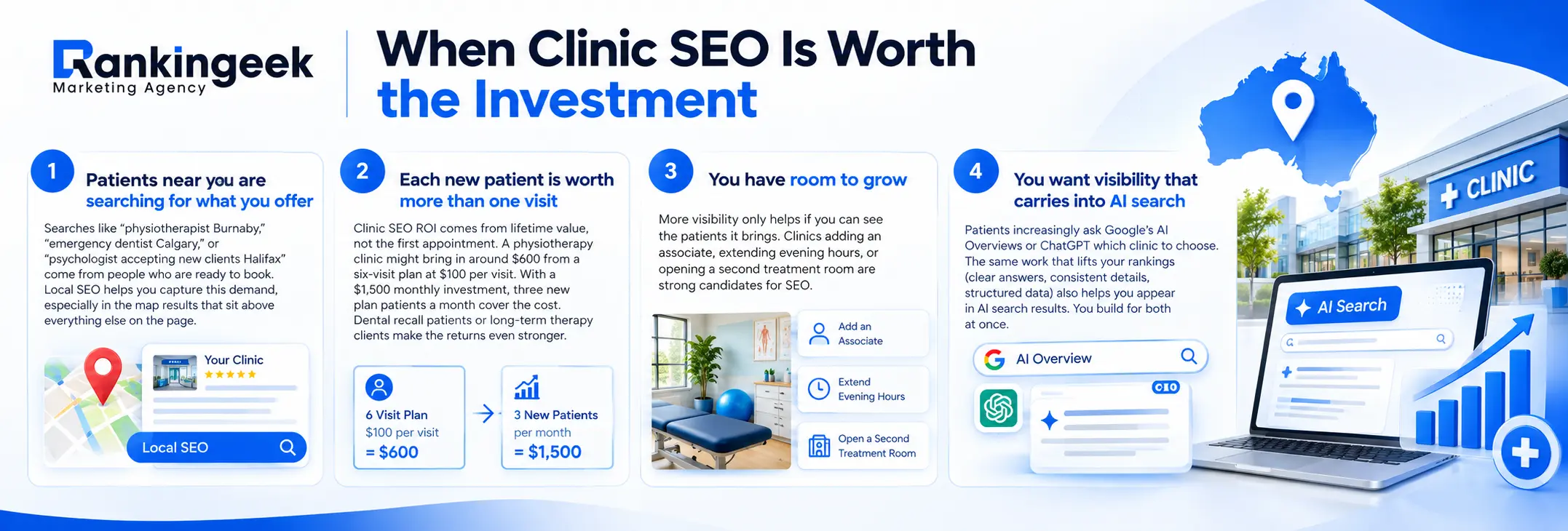
Patients near you are searching for what you offer
Searches like "physiotherapist Burnaby," "emergency dentist Calgary," or "psychologist accepting new clients Halifax" come from people who are ready to book. If that demand exists inside your catchment area, local SEO for clinics is how you capture it, especially the map results that sit above everything else on the page.
Each new patient is worth more than one visit
Clinic SEO ROI comes from lifetime value, not the first appointment. Take an illustrative physiotherapy clinic: a new patient on a six-visit plan at $100 per visit brings in about $600. At a $1,500 monthly investment, three new plan patients a month cover the cost. Dental recall patients or long-term therapy clients tilt that math even further.
You have room to grow
More visibility only helps if you can see the patients it brings. Clinics adding an associate, extending evening hours, or opening a second treatment room are strong candidates.
You want visibility that carries into AI search
Patients increasingly ask Google's AI Overviews or ChatGPT which clinic to choose. The work that lifts your rankings (clear answers to patient questions, consistent clinic details, structured data) is largely the same work that decides how to appear in AI search results. You build for both at once.
If these conditions sound like your clinic, the next question is what a realistic program would cost in your market.
When SEO May Not Deliver Enough Value
Here's the part most agencies skip. There are real situations where we'd advise a clinic to wait:
- Your schedule is already full: Plenty of Canadian family practices carry long waitlists and aren't accepting new patients. More visibility adds little until capacity changes.
- Search demand is genuinely tiny: If you're the only provider of your kind in a town of 4,000, you may already receive nearly every relevant local search.
- You need patients next month: SEO compounds; it doesn't switch on. A clinic opening in six weeks shouldn't count on organic search to fill its first quarter.
- You can only commit for three months: Stopping just before results compound means paying for the foundation without collecting the return.
- Inquiries go unanswered: If calls roll to voicemail, stronger rankings simply send more patients to a dead end.
None of this means SEO is a bad channel. It means the timing or conditions are wrong, and that's far cheaper to learn before you sign than after.
What Drives Clinic SEO Cost and ROI in Canada
There's no single price for clinic SEO in Canada. Most single-location clinics invest somewhere between roughly $800 and $3,500 a month, while multi-location groups in competitive metros often spend more. Where you land, and how fast the investment pays back, depends on these factors:
Location deserves a closer look. Google says its local results are based mainly on relevance, distance, and prominence. You can't change distance, which is why two identical clinics in different neighborhoods can face very different costs to rank.
Content standards matter for a similar reason. Google's own guidance notes that its systems give extra weight to trustworthiness on topics that affect people's health. For a fuller picture of how programs are scoped, see our guide to healthcare SEO in Canada.
Realistic SEO Timelines for Canadian Clinics
Many clinic owners who call SEO a waste of money stopped somewhere around month four, just before the curve bends. Here's a realistic timeline for a single-location clinic in a moderately competitive Canadian market:
Clinics in downtown Toronto, Vancouver, or Montreal usually sit at the longer end of this range. A physiotherapy clinic in Saskatoon with an established website may move noticeably faster.
Common Reasons Clinic SEO Investments Fail
When we look at programs that didn't pay off, the cause is rarely "SEO doesn't work for healthcare." It's usually one of these:
- The wrong finish line: Reports celebrate rankings for terms nobody books from, while calls and booking requests go untracked.
- Clinical language instead of patient language: Patients search "physio for sciatica," not "lumbar radiculopathy management."
- Your best services never get a page: A multidisciplinary clinic's highest-value offering, such as pelvic health physiotherapy or sedation dentistry, sits buried in a generic services list.
- Generic, unreviewed content: Mass-produced health articles rarely rank because they show no real clinical expertise.
- Quitting too early: Cancelling at month four locks in the cost and forfeits the compounding.
We've unpacked several of the technical culprits in our breakdown of common Canadian clinic SEO problems.
What to Check Before You Start an SEO Program
Whether you're comparing providers of SEO services in Canada or planning to handle some of the work in-house, get clear answers to these questions first:
- Is there enough demand? Ask for search volume on your top five services within your real catchment area, not the whole province.
- What is a new patient worth to you? Work out how many new patients a month you'd need to break even before signing anything.
- How will success be measured? Booked appointments, calls, and form submissions from organic search, not rankings on their own.
- Does the provider understand Canadian healthcare rules? Provincial college advertising standards and privacy obligations should come up without you prompting them.
- What's the plan for AI search? Ask which AEO GEO best practices they follow (structured answers, FAQ schema, consistent clinic details) and how to optimize for AI search without neglecting traditional rankings.
- Who owns the assets? Your Google Business Profile, analytics accounts, and content should stay in your clinic's name.
- Are there guarantees? A promise of #1 rankings in 30 days is a red flag, not a selling point.
So, Is Clinic SEO a Waste of Money?
It can be. It doesn't have to be.
Clinic SEO is a poor investment when there's no demand to capture, no capacity to serve it, or no patience to let it compound. When those conditions are in place and the work is measured against booked appointments, it becomes one of the most dependable long-term sources of new patients a Canadian clinic can build.
The smart first step isn't signing a contract. It's finding out which of those two situations your clinic is actually in.
Find out whether SEO makes financial sense for your clinic, based on your market, your services, and your capacity.
Frequently Asked Questions
How much does clinic SEO cost in Canada?
Most single-location Canadian clinics invest roughly $800 to $3,500 per month in SEO, while multi-location groups in competitive cities like Toronto or Vancouver often spend more. Medical SEO cost in Canada depends mainly on local competition, number of locations, your website's starting point, and how much clinician-reviewed content is needed.
How long does it take to see ROI from medical SEO?
Most clinics see early movement within three to four months and steadier patient inquiries by around month six. Positive ROI typically arrives between six and twelve months. New websites and clinics in highly competitive metros can take twelve to eighteen months to reach full results.
Is SEO worth it for a small or single-location clinic?
Often, yes. A single-location clinic competes in a smaller geographic area, so local SEO can deliver results on a modest budget. It's worth it when local patients search for your services, you have room for new patients, and each patient's lifetime value comfortably exceeds what it costs to attract them.
What makes clinic SEO fail?
Clinic SEO usually fails because of strategy and measurement, not the channel itself. Common causes include tracking rankings instead of booked appointments, targeting clinical terms patients don't use, publishing generic unreviewed health content, ignoring high-value services, and cancelling before results compound around months four to six.
Does SEO help my clinic show up in AI search results?
Yes. Google AI Overviews and tools like ChatGPT tend to draw on sources with clear answers, consistent clinic information, and structured data such as FAQ schema. Strong SEO foundations are the starting point for appearing in AI search results, so the same investment supports both traditional rankings and AI-driven discovery.