
.png)


Quick Answer
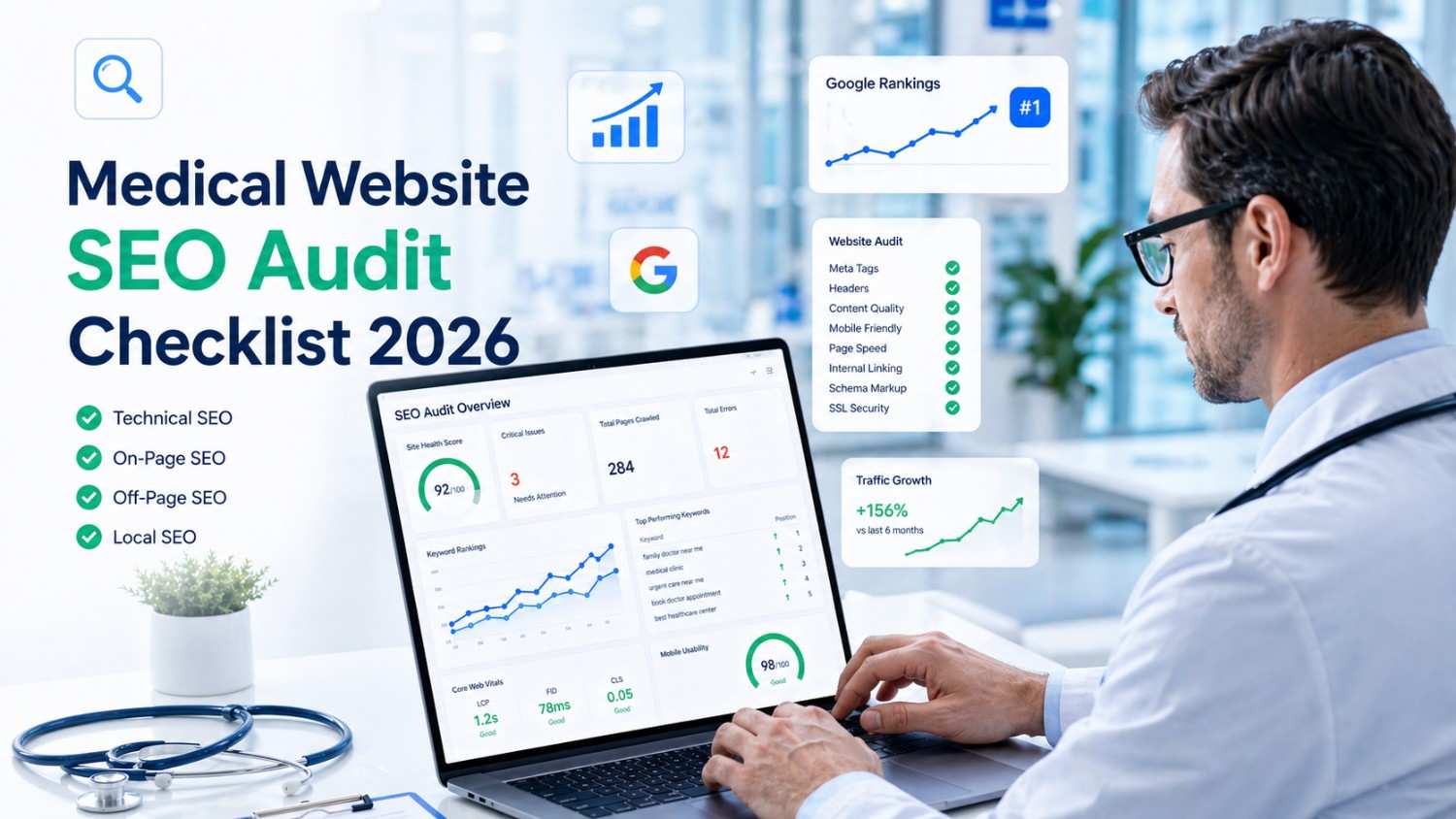
A medical website SEO audit checks four areas: technical health (indexing, speed, mobile, HTTPS), content authority (E-E-A-T, clinician-reviewed pages, author bios), local visibility (Google Business Profile, NAP, reviews, location pages) and compliance (HIPAA-safe forms and tracking). Run it every six months and fix technical errors first.
Is your medical practice invisible on Google despite having a professional-looking website? In 2026, a "pretty" site isn't enough to capture patient attention. To dominate search results, you need a site that satisfies Google’s complex algorithms for health-related content. A Local SEO Medical Website Audit Checklist 2026 is your roadmap to identifying and fixing the invisible technical and content-based errors that keep your practice from reaching the first page. By auditing your site for E-E-A-T, mobile speed, and keyword relevance, you can turn a stagnant website into a 24/7 patient acquisition machine.
If you are wondering how to do an SEO audit for a medical website in 2026, the process involves four critical pillars: technical health, content authority, user experience, and local visibility. This guide provides a step-by-step breakdown of every issue you need to fix to improve your rankings and grow your clinic.
A medical website seo audit checklist 2026 is your roadmap to identifying and fixing technical and content-based errors that stop your practice from ranking. By auditing for E-E-A-T for medical websites, mobile speed, and keyword relevance, you can turn your website into a patient acquisition machine.
If you are wondering How to do an seo audit for a medical website in 2026, the process involves four pillars: Technical Seo, Content Authority, User Experience, and Local Seo.
1. Technical SEO Checklist for Hospital Websites
Technical SEO is the foundation. If Google’s "crawlers" cannot read your site or if it takes too long to load, you will never rank-no matter how good your medical advice is.
Core Web Vitals and Page Speed
In 2026, Google uses "Core Web Vitals" as a primary ranking signal. Patients are often stressed; they won't wait for a slow page to load.
- LCP (Largest Contentful Paint): Ensure your main content loads in under 2.5 seconds.
- CLS (Cumulative Layout Shift): Elements shouldn't "jump" around as the page loads.
- Mobile-First Indexing: Your site must perform better on a phone than on a desktop.
Site Architecture and Secure HTTPS
Healthcare sites handle sensitive data. Having a secure site (HTTPS) is not just a HIPAA-compliant SEO practice; it’s a mandatory trust signal for Google. Ensure your site has a logical "hierarchy"-for example: Clinic.com > Services > Cardiology > Heart-Valve-Repair.
2. On-Page SEO for Medical Websites: Content that Heals
Content on medical sites is classified as YMYL (Your Money or Your Life). Google applies the world's highest standards to this information.
Mastering E-E-A-T (Experience, Expertise, Authoritativeness, Trustworthiness)
To rank in 2026, every page must prove it was written or reviewed by an expert.
- Author Bios: Every medical article must have a bio for the doctor, including their credentials (MD, DO, PhD) and links to their board certifications.
- Medical Review Dates: Show patients (and Google) that your content is current. An article on "Latest Cancer Treatments" from 2021 is now obsolete.
Medical Content Optimization
Stop writing for other doctors; start writing for patients. Use Local SEO for medical professionals medical best practices by targeting "natural language" questions. Instead of just targeting "Myocardial Infarction," target "What are the early warning signs of a heart attack?"
3. The Local SEO Advantage for Clinics
For most medical practices, the "Local 3-Pack" is the most valuable real estate on the internet. This is where healthcare website optimization meets local search.
- Google Business Profile (GBP): Ensure your clinic’s name, address, and phone number (NAP) are identical across the web.
- Localized Service Pages: If you have clinics in three different cities, create a unique page for each location rather than one generic contact page.
- Patient Reviews: High-quality, frequent reviews are a major ranking factor.
4. Complete Healthcare SEO Audit Checklist: Step-by-Step
Follow this Complete Healthcare SEO audit checklist step by step to perform your own site checkup.
Step 1: Technical Crawl
Use a tool like Screaming Frog or Ahrefs to identify 404 errors (broken links), duplicate metadata, and missing "Alt Text" on images.
Step 2: Content Accuracy Audit
Review your top 20 pages. Do they cite reputable sources like the CDC, Mayo Clinic, or peer-reviewed journals? Google rewards sites that "back up" their claims.
Step 3: Check for HIPAA Compliance
Ensure your contact forms and appointment booking tools are encrypted. While SEO doesn't directly measure HIPAA, it does measure "Trustworthiness," and a data leak will destroy your rankings.
Step 4: Mobile Usability Test
Open your site on three different smartphones. Can you click the "Call Now" button easily? Is the text large enough to read without zooming?
Step 5: Indexing and On-Page Check
In Google Search Console, open the Pages report to see which pages are not indexed and why (noindex tags, redirects, duplicates). Then confirm every service page has a unique title tag under 60 characters, a meta description, one H1, and the service plus location in the title.
Step 6: Schema and AI Search Check
Test key pages in Google's Rich Results Test. Service and location pages should carry MedicalClinic or Physician markup, and each FAQ should answer one patient question in plain language in its first sentence, so AI Overviews can quote it.
Step 7: Local and Tracking Check
Compare your Google Business Profile categories, hours and services with your website, and check that your NAP matches on the main directories. Finally, confirm no tracking pixels fire on patient portals or appointment forms, in line with the HHS guidance on online tracking technologies.
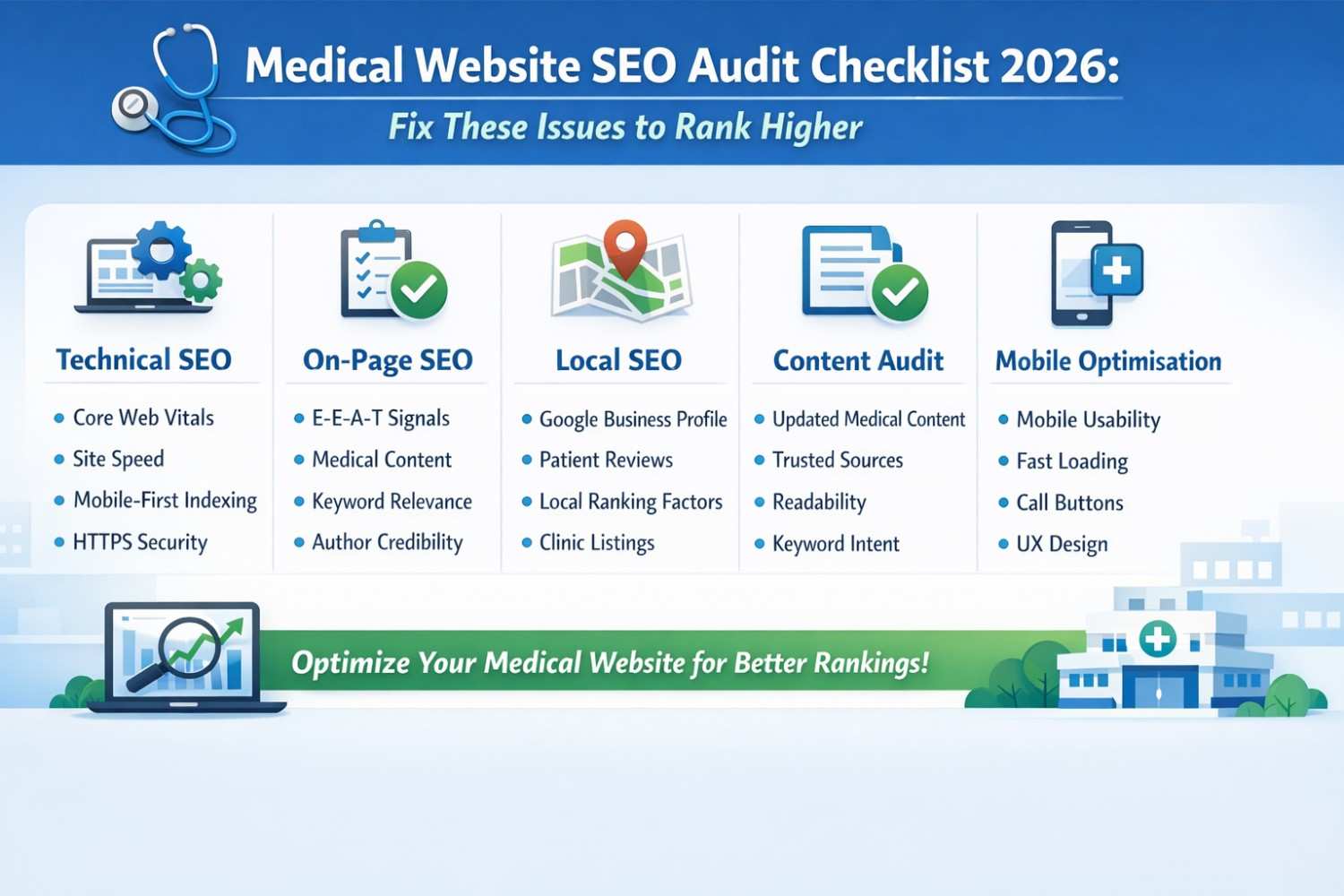
Medical Website SEO Audit Checklist at a Glance
5. Comparison: SEO 2021 vs. SEO 2026 for Healthcare
- Use Video Content: A 60-second video of a doctor explaining a procedure can increase "dwell time" (how long someone stays on your site), which is a positive ranking signal.
- Avoid AI-Only Content: While AI can help draft, Google’s 2026 algorithm can detect unedited AI medical advice. Always have a human medical professional review and "sign off" on AI content.
- Internal Linking: Link your blog posts to your service pages. If you write about "Knee Pain," link it directly to your "Orthopedic Surgery" service page.
7. Conversion-Focused: Your Next Steps
An audit is useless without action. If you find common medical website SEO issues, prioritize them in this order:
- Fix Technical Errors: Repair broken links and speed up the site.
- Update Your Author Bios: Ensure every clinician has a verified profile.
- Local Sync: Update your Google Business Profile with new photos and hours.
If this feels overwhelming, partnering with a healthcare digital marketing SEO expert can help you execute the audit while you focus on patient care.
Conclusion: Claim Your First-Page Ranking
A Medical Website SEO Audit Checklist 2026 is the only way to ensure your digital presence is as healthy as your patients. By fixing technical glitches, proving your expertise through E-E-A-T, and optimizing for local intent, you aren't just "doing SEO"-you are building a bridge to the people who need your care.
Don't wait for your rankings to drop further. Start by auditing your mobile speed today, and work through the checklist to secure your practice’s future at the top of the search results. If you need help, reach out to a specialized healthcare digital marketing SEO agency to turn these insights into reality.
Frequently Asked Questions
How often should I perform an SEO audit?
For a growing practice, a deep-dive Healthcare SEO Audit Checklist should be completed every 6 months. Search algorithms change frequently, and "content decay" happens quickly in the medical field.
Does social media help my medical SEO?
Indirectly, yes. Social signals (shares and engagement) can lead to more brand searches and natural backlinks, which tell Google your practice is an authority.
What is the most common SEO mistake doctors make?
Using too much medical jargon. Patients search for "sore throat," not "acute pharyngitis." If your site doesn't use patient-friendly language, you won't appear in their search results.
How long does it take to see results after fixing issues?
Once you fix technical issues and update content, it typically takes 4 to 12 weeks for Google to "re-index" your site and for you to see a jump in rankings.
Are backlinks still important for doctors in 2026?
Yes. A backlink from a university (.edu) or a government health site (.gov) is a massive "vote of confidence" that can skyrocket your authority.
Is a blog necessary for a hospital website?
Absolutely. A blog allows you to target "Long Tail Keywords" and answer patient questions that your service pages might miss. It is the best way to demonstrate E-E-A-T for medical websites.
How long does a medical website SEO audit take?
A small practice site can be audited in a day or two with free tools. A hospital or multi-location site with hundreds of pages takes longer, mostly in the content and local review. Fixing what the audit finds usually takes weeks, not days.
Can I do a medical SEO audit myself?
Yes. Google Search Console, PageSpeed Insights and the free version of Screaming Frog cover most technical checks. Content accuracy, schema and compliance are where practices usually want specialist help; our free audit covers all of them.
What should a healthcare SEO audit report include?
A prioritized list of issues, each with the page affected, why it matters and the fix, plus a short summary of indexing, speed, content, local and compliance health. A report that only lists rankings or a single score is not enough to act on.