
.png)



Quick Answer
The medspa website development mistakes that cost the most patients are usually invisible to owners: pages Google can't crawl or index, one catch-all services page instead of dedicated treatment pages, weak location signals, slow mobile pages and a booking path that takes too many taps. Fix crawling and page structure first, then speed, then the route from the treatment page to the booked consultation.
Why Good-Looking Medspa Sites Still Lose Patients
A medspa can have gorgeous photography, a strong treatment menu and loyal regulars, and still watch new-patient inquiries stall. When we audit these sites, the medical spa website design is rarely the real problem. The damage usually comes from medspa website development mistakes made during the build: choices about code, page structure, content and forms that limit how often you appear in search and how easily someone can book. Most can be fixed without starting over.
Common Medspa Website Mistakes at a Glance
Technical SEO Mistakes That Keep Your Site Out of Search
Technical problems do the most damage because Google can't rank what it can't see.
Crawlability and Indexing Gaps
Most creep in at launch.
Leftover noindex tags
Developers often hide a staging site from search. If that setting survives launch, your new pages stay invisible. Check Google Search Console's page indexing report within a week of going live.
Redirect gaps after a redesign
Changing URLs without clean 301 redirects throws away the authority your old pages earned. Map every old URL to its closest new page, in one hop, before launch.
Treatment menus built only in JavaScript
Tabbed menus and sliders can hide text and links from crawlers when content loads only after a script runs. Keep treatment names and links in the page's HTML.
Slow Mobile Pages and Poor Core Web Vitals
Many patients research treatments on their phones. Autoplay videos, heavy before-and-after galleries and stacked tracking scripts slow everything down. Google's Core Web Vitals guidance asks for the main content to load within 2.5 seconds and for taps to get a response in under 200 milliseconds. Compress media, lazy-load galleries and test on a real mid-range phone.
Local SEO and Location Page Mistakes
A medspa lives or dies on local search. Google's Business Profile guidance says local results depend mainly on relevance, distance and how well-known a business is, and your website shapes relevance. For the bigger picture, see our guide to SEO for healthcare clinics in the USA.
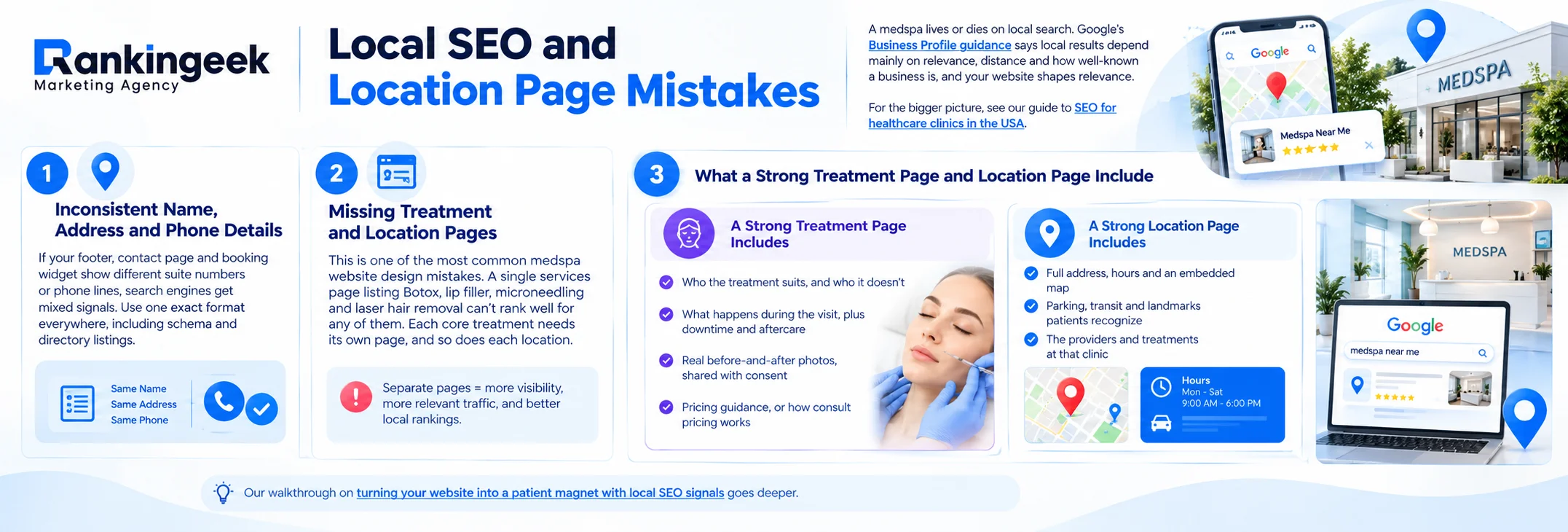
Inconsistent Name, Address and Phone Details
If your footer, contact page and booking widget show different suite numbers or phone lines, search engines get mixed signals. Use one exact format everywhere, including schema and directory listings.
Missing Treatment and Location Pages
This is one of the most common medspa website design mistakes. A single services page listing Botox, lip filler, microneedling and laser hair removal can't rank well for any of them. Each core treatment needs its own page, and so does each location.
What a strong treatment page includes
- Who the treatment suits, and who it doesn't
- What happens during the visit, plus downtime and aftercare
- Real before-and-after photos, shared with consent
- Pricing guidance, or how consult pricing works
What a strong location page includes
- Full address, hours and an embedded map
- Parking, transit and landmarks patients recognize
- The providers and treatments at that clinic
Our walkthrough on turning your website into a patient magnet with local SEO signals goes deeper.
On-Page SEO Mistakes and Content That Misses Search Intent
Someone searching "lip filler cost in Dallas" wants a price range and what affects it. Someone searching "does microneedling hurt" wants an honest answer. A page that only says "We offer premium aesthetic care" answers neither.
Build each page around what patients actually ask: cost, comfort, downtime, results and who's a good candidate. Also give every page its own title tag naming the treatment and city, and one clear H1.
Also Read: The 7 SEO Mistakes Medical Spas Make and How to Fix Them
Schema Markup Mistakes Most Medspa Sites Make
Schema is code that labels your content so search engines and AI tools understand it. The usual medspa website SEO mistakes here are skipping it, using a generic type for a clinic, or marking up details that aren't on the page. A sensible starting point:
- MedicalBusiness or MedicalClinic markup on the homepage and location pages
- Service markup on each treatment page
- FAQPage markup where the page shows real questions and answers
Match every detail to your page and Business Profile, and test with Google's Rich Results Test after template changes.
Medspa Website Conversion Mistakes That Lose Ready-to-Book Visitors
Rankings bring people in. Your conversion path decides whether they book.
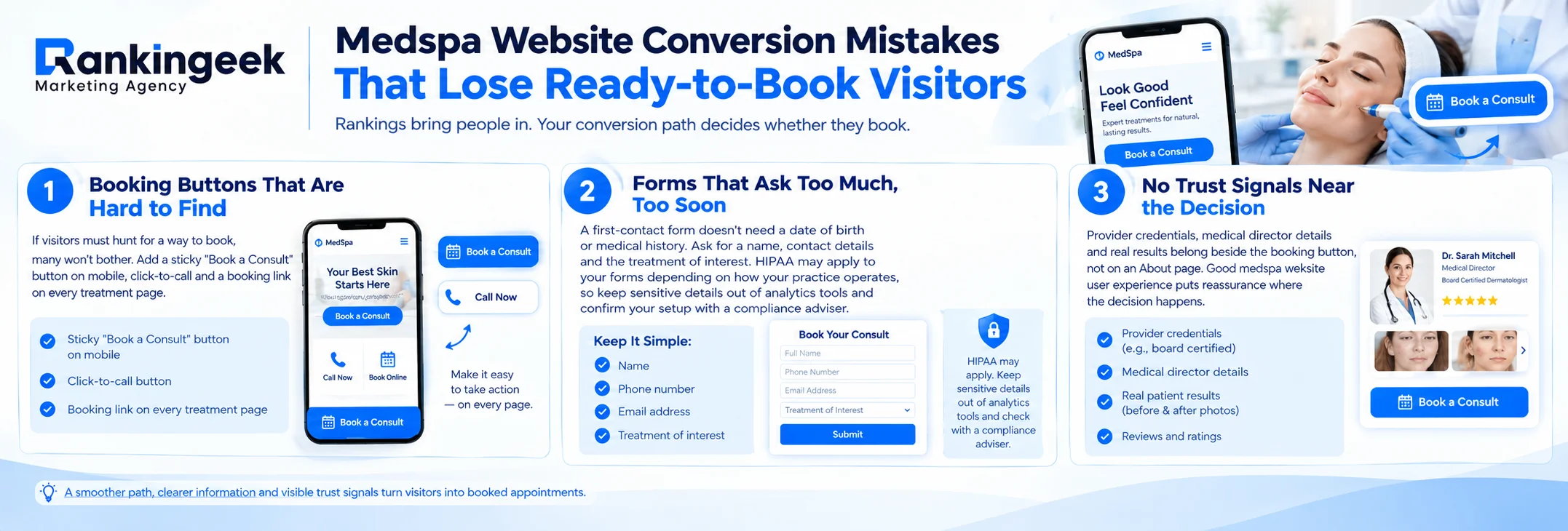
Booking Buttons That Are Hard to Find
If visitors must hunt for a way to book, many won't bother. Add a sticky "Book a Consult" button on mobile, click-to-call and a booking link on every treatment page.
Forms That Ask Too Much, Too Soon
A first-contact form doesn't need a date of birth or medical history. Ask for a name, contact details and the treatment of interest. HIPAA may apply to your forms depending on how your practice operates, so keep sensitive details out of analytics tools and confirm your setup with a compliance adviser.
No Trust Signals Near the Decision
Provider credentials, medical director details and real results belong beside the booking button, not on an About page. Good medspa website user experience puts reassurance where the decision happens.
Also Read: From Clicks to Bookings: How to Build a Patient Funnel That Converts
What to Check Before Your Next Build or Redesign
These mistakes are cheaper to prevent than to fix. Whether you hire medspa website development services or redesign in-house, get clear answers first.
How to Choose a Website Development Agency for Your Medspa
- Will every core treatment and location get its own page?
- Who owns the 301 redirect map, and will you see it before launch?
- Is schema built into the page templates?
- How will forms and tracking work without exposing patient data?
- What mobile speed targets will the build be tested against?
The best website development company for medspas answers these plainly. When comparing medspa website development cost quotes, weigh these answers, not just mock-ups. A cheaper custom medspa website design that skips redirects often costs more in lost patients. The same checks apply to any clinic web development project, including broader healthcare website design services.
Frequently Asked Questions
What are the most common medspa website development mistakes?
Pages blocked from indexing, one page for every treatment, inconsistent location details, slow mobile pages and hidden booking buttons. Each one cuts visibility or bookings.
How do I know if Google can see my medspa's pages?
Check the page indexing report in Google Search Console. It shows which pages are indexed and why others aren't.
Does every treatment need its own page?
Yes, for every treatment you want to rank for. A dedicated page can answer questions about cost, downtime and results that a combined services page can't.
How fast should a medspa website load on mobile?
Google recommends the main content load within 2.5 seconds. Compress images and video, limit scripts and test on real phones.
Can I fix these mistakes without rebuilding my website?
Usually, yes. Indexing, missing pages, schema, speed and booking paths can often be fixed on your current platform. Rebuild only when the platform limits speed or structure.