
.png)



Your clinic's Facebook campaigns looked healthy last quarter, and now the booking data has gone quiet. Lead quality dropped, costs crept up, and your dashboard no longer offers the conversion goal you relied on. Meta's Health and Wellness ad restrictions limit the data clinics can send to Meta. This guide explains the rules and the campaign setups that still bring patients.
Quick Answer on Why Meta Stopped Optimizing for Bookings
Meta now limits which conversion events health and wellness advertisers can share and optimize for. As a result, your booking campaigns often lose their main signal. Clinics still have 4 workable ways to adapt:
- Instant forms keep lead capture inside Facebook and Instagram, where the limits bite less.
- Upper-funnel signals, such as video views, give the algorithm something safe to learn from.
- A clean CRM process shows which leads actually book a visit.
- A search-led channel mix reaches patients who already want care.
What Changed in Meta's Health Ad Rules for US Clinics
Meta began sorting advertiser websites and apps into data source categories in early 2025. Health and wellness became one of the restricted groups, and most US accounts felt the change between January and February that year. This shift reshaped healthcare Facebook advertising almost overnight.
Meta describes the category as businesses tied to medical conditions, specific health statuses or provider and patient relationships. That definition covers dental offices, physical therapy practices, mental health providers and most specialty clinics.
The reason is legal risk. A pixel that ties a real person to a clinic appointment can create protected health information or PHI, and Meta no longer wants that data on its servers. Meta applies the rules at three levels:
- Core Setup strips custom parameters and everything in the URL after the domain name. Audiences that depend on specific page paths shrink or stop filling.
- Standard event restrictions block optimization toward mid- and lower funnel actions, including purchases and appointment-style events.
- Full Meta's Health and Wellness ad restrictions block every event from that data source.
Meta calls these health and wellness data restrictions, and they apply to browser and server events alike. The Conversions API does not get around them. Meta's policy on prohibited information also places the final responsibility on the advertiser. Your clinic owns the job of keeping health details out of every event it sends.
Signs Meta Has Restricted Your Clinic's Ad Account
Many practice managers spot the problem in their reports before any notice from Meta. These conversion event restrictions rarely arrive with a clear warning.
- The Schedule or Purchase goal no longer appears when you build a new campaign.
- Events Manager shows a banner about restricted data on your pixel.
- Custom audiences that rely on website visitors shrink week after week.
- The conversions Meta reports fall sharply while the front desk still takes a similar number of calls.
- Lead quality slips because Meta now chases cheaper actions instead of real bookings.
The surest check sits in the Settings tab of your data source. Meta lists the assigned category there, and clinics can request a review if the label looks wrong.
Also Read: Why 80% of Clinic Ads Fail and How Smart Targeting Fixes It
Meta Campaign Setups That Still Work for Clinics
Meta still works for patient acquisition when the structure fits the new rules. Three setups bring in most of the leads for the clinics we manage.
Instant Form Lead Campaigns
Instant Forms keep the whole conversion inside Facebook and Instagram. Industry analysis of the rollout found that in-app lead generation sits mostly outside the event limits, apart from Core Setup. That makes this format the most dependable source of appointment requests for clinics right now.
Objective and Form Type
The campaign uses the Leads objective with Instant Form as the conversion location. The Higher Intent form type adds a review screen, which filters out accidental taps.
Questions That Filter Weak Leads
Two or three short questions work best, such as preferred location, insurance type and best time to call. These questions stay general and never ask about a diagnosis or symptom.
Audience and Location Settings
Broad targeting across the ZIP codes around each location usually beats narrow interest stacks. Meta removed most health-related detailed targeting options years ago, so broad audiences now carry most of the delivery. One campaign with one or two ad sets is enough for most single location practices.
Awareness and Video Campaigns
Video gives Meta a safe signal when booking data disappears. ThruPlay and engagement goals sit outside the restricted events, so delivery stays stable. These upper funnel campaigns also build a warm pool of viewers, which lowers the cost of every lead form that follows.
Content That Builds Patient Trust
Short clips of a provider explaining a treatment or a first visit tend to perform well. Meta's health and wellness ad standards reject ads that promote a negative self-image, so the tone needs to stay positive. Copy that names a condition the viewer might have often triggers a rejection.
The Real Limits of Retargeting
Website retargeting took the biggest hit. Core Setup strips page paths, so an audience of people who visited your implant page no longer fills reliably.
Audiences Meta Still Allows
Video viewers, page engagers and Instagram engagers all remain usable. People who open an Instant Form also make a solid warm pool.
Audiences Clinics Avoid Now
Lookalike audiences that start from booked patients carry the most risk. A patient list from a HIPAA-covered clinic usually counts as protected data in its own right. The table below shows where each setup stands today.
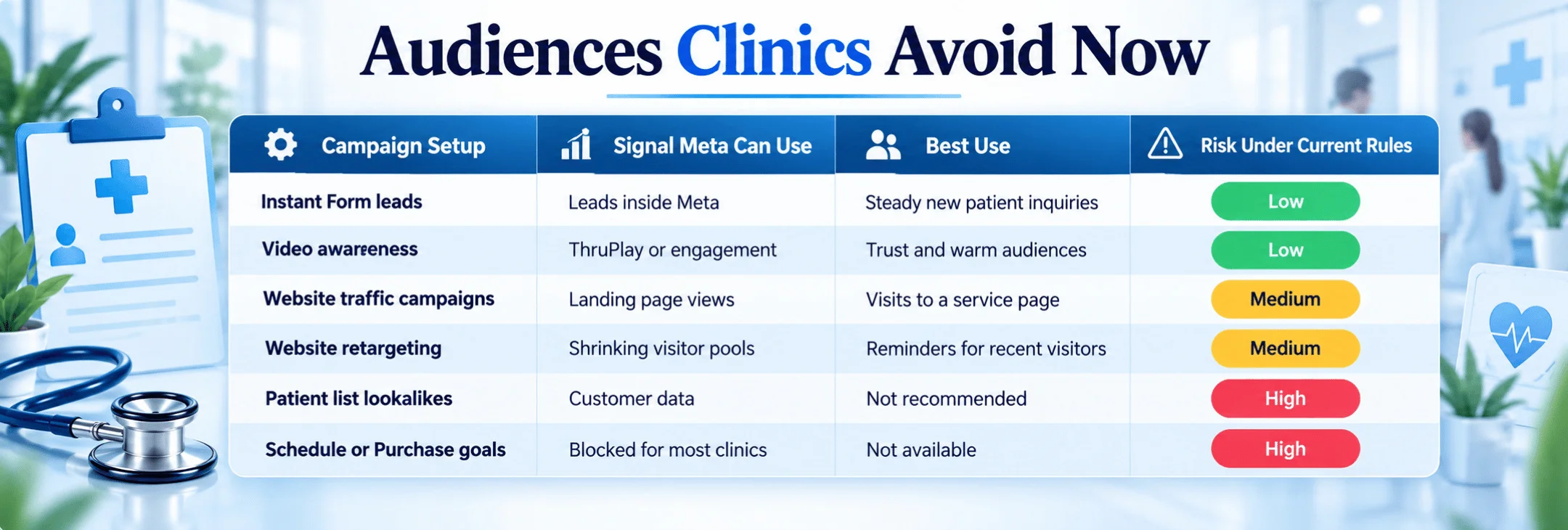
Most clinics we audit still run one or two campaign types that Meta quietly throttles. A short review spots them on the first call.
How Clinics Can Measure Patient Bookings Without Breaking Privacy Rules
Meta will undercount bookings from now on, so the real scoreboard has to live in your own systems. The HHS Office for Civil Rights bulletin on online tracking technologies says that trackers on patient portals and other login pages generally have access to PHI. A federal court in Texas vacated one part of that guidance in June 2024, which covered IP addresses on public pages. The rest of the bulletin still stands.
Most careful clinics keep the Meta Pixel off portals, intake forms and booking confirmation pages. Any vendor that handles patient data also needs a signed business associate agreement.
A practical measurement setup looks like this:
- Each Meta lead flows straight into the clinic CRM through a native integration.
- The front desk marks every lead as contacted, booked or no-show within one business day.
- Offline conversions go back to Meta only after a privacy review, and only as neutral events with no treatment names.
This process reveals your true cost per booked patient. That figure matters far more than the cost per lead Meta reports.
When Clinics Should Shift Budget to Google Ads
Meta builds demand, and Google captures it. A patient who searches for a dentist open on Saturday already wants an appointment. Search campaigns work from that keyword, so they rely far less on audience data than Meta does. Google applies its own health rules to remarketing, but search intent stays fully usable. A shift makes sense when these patterns show up.
- Meta leads costs more than twice your Google cost per booked patient for two straight months.
- Most of your services have clear local search demand, such as dental implants or physical therapy.
- Your account sits under standard events or full restrictions with no realistic path to appeal.
A 60 to 40 split in favor of search makes a sensible starting point for most clinics. Meta then handles awareness and Instant Form leads, while Google catches patients who are ready to book. Strong Google Ads for clinics also send each service to its own page rather than the homepage.
Also Read: The Anatomy of a High Conversion Landing Page
The What Still Works Checklist for Clinic Ads
A clinic account that runs well under the current rules usually ticks every box below.
- The account runs Instant Form lead campaigns with two or three general questions.
- One video campaign builds a warm audience every month.
- The Meta Pixel stays off patient portals, intake forms and confirmation pages.
- Every lead lands in the CRM and gets a call within one business hour.
- The team judges results by cost per booked patient, not by Meta's reported conversions.
- Each vendor that touches patient data has a signed business associate agreement.
- Someone on the team checks the Events Manager once a month for new notices.
A checklist with more gaps than ticks usually means the account needs a rebuild rather than small tweaks.
Final Thoughts on Meta's Health and Wellness Ad Restrictions in the US
Meta’s health and wellness ad restrictions changed the rules, but they did not take Meta off the table for clinics. The practices that keep growing pair Instant Forms with steady video, clean tracking in their own systems and a strong search presence.
Rankingeek works as a social media advertising agency focused on healthcare. Our team builds these setups for US clinics every month. The first step is a short call to see where your bookings leak today.
FAQs About Meta Health Ad Restrictions
Why did my Meta ads stop tracking appointment bookings?
Meta now places most clinics in its health and wellness category and blocks lower funnel events such as Schedule and Purchase. Your pixel may still fire, but Meta no longer uses those events for optimization or full reporting.
Can I appeal Meta's health and wellness classification?
Clinics can request a category review from the settings page of their data source. Reviews rarely succeed for genuine medical providers, so a setup that works within Meta’s Health and Wellness ad restrictions matters more than the appeal.
Are Meta lead forms better for clinics now?
Under Meta’s Health and Wellness ad restrictions, lead forms usually outperform website conversion campaigns for clinics. The lead stays inside Meta, so the algorithm still gets a usable signal. A call within the hour keeps lead quality high.
Does the Conversions API fix Meta's health restrictions?
The Conversions API does not bypass these limits. Meta runs the same category checks on server events as it does on browser events.
Should clinics stop advertising on Facebook altogether?
Facebook ads for clinics still work well for awareness and lead generation, even with Meta’s Health and Wellness ad restrictions in place. The difference is that bookings now need tracking in your own systems. Search campaigns then reach the patients who already know what they want.