
.png)

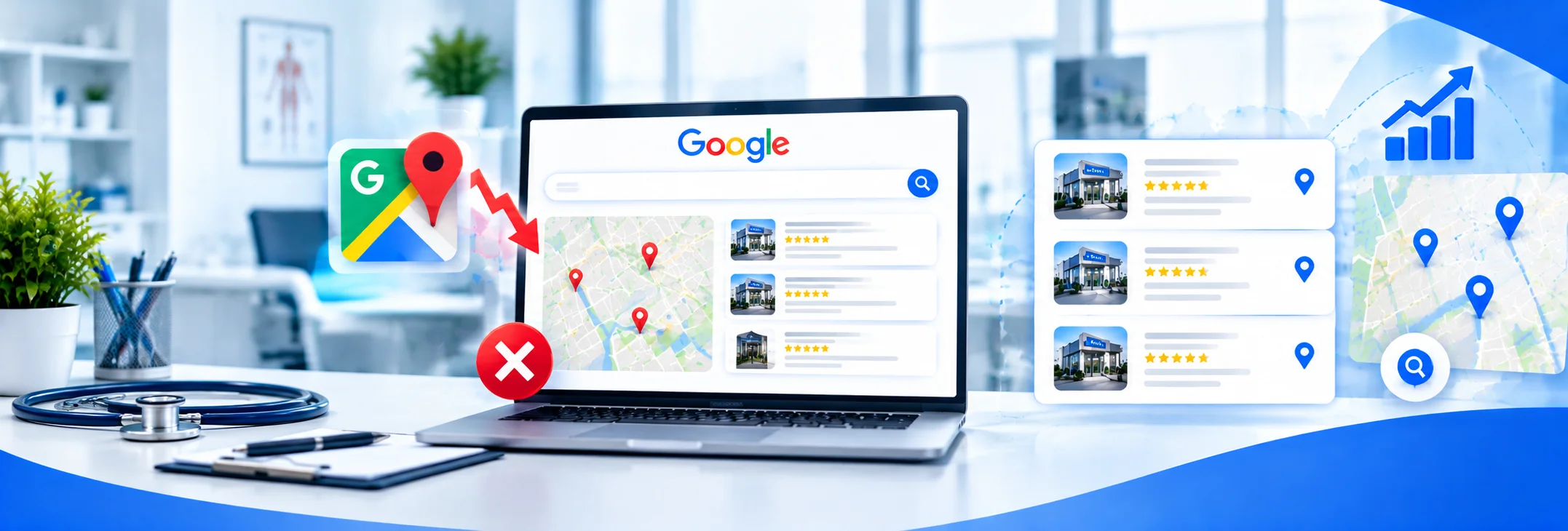

Quick Answer
Poor SEO hurts a medical practice by keeping it out of the Google results and Google Maps listings patients check first, so calls and appointment requests go to competitors. The fix combines an accurate Google Business Profile, clear location and service pages, consistent contact details, steady reviews, and regular ranking checks.
The Patient Search Starts Online
Most patients start with a search, not a phone call. If your medical practice SEO is weak, the clinic down the road collects the appointments you never saw. The patient didn't reject you. They simply never found you.
That's the real answer behind "why is my medical practice not showing on Google." It's usually a neglected Google Business Profile and thin website pages, quietly adding up.
Knowing how patients find doctors online helps you spot the fixes. They search, compare a few listings, and call the clearest one.
How Poor SEO Can Cost a Medical Practice Patients
Poor SEO costs a practice patients at every step between a search and a booked visit. Each gap looks small, but together they send appointments elsewhere.
Low visibility in search results
If Google can't tell what you treat or where you practice, it shows someone else. Most people don't scroll far.
Fewer website visits
Fewer impressions mean fewer clicks. A well-built site stays quiet when search engines rarely send anyone to it.
Fewer calls and appointment requests
Every missed click is a call your front desk never answers. Someone with a toothache wants help quickly, and books with whoever appears first and looks easy to reach.
Competitors showing up first
A clinic in the Google Maps local pack also looks more established. Patients read position as trust, so a newer practice with a tidy profile can look safer than an older one with stale details.
Why Local SEO Matters for US Medical Clinics
Local SEO matters because patients want care close to home, and Google answers with a map. Local SEO for healthcare means showing up on that map and in searches that name a place. The local pack is the three-business list Google shows above regular results.
Google Business Profile and Google Maps
Your Google Business Profile (GBP) is the free listing that feeds Google Maps. Google says local results rest mainly on relevance, distance, and prominence. A Chicago clinic with the right categories, accurate hours, and recent reviews gives Google far more to work with than a bare listing.
A planned approach to optimizing your Google Business Profile for local visibility covers categories, services, photos, and patient questions.
Location-based searches patients actually type
Patients add a place, or "near me," to most health searches. Here's how the intent differs.
"dentist near me"
A patient in Phoenix with a cracked tooth types this on a phone. Google leans on where that phone is, so your listing needs a clear dental category and a trusted address.
"primary care doctor in Dallas"
This patient has time to compare. They'll read reviews, check your services, and look for insurance details.
"urgent care near me"
In Houston, a parent with a feverish child wants hours and directions right now. A wrong closing time on your profile sends them to the next clinic on the list.
"dermatologist in Miami"
Specialty searches often name a condition or treatment. A dedicated page for each service gives Google and the patient something precise to match.
Why Your Competitors May Be Ranking Above You
Competitors usually outrank a clinic because they send Google clearer signals, not because they spend more. The table below shows where practices most often fall short.
Picture a multi-location group in New York and another in Los Angeles. Medical practice SEO at that scale means each office needs its own page and profile. One weak row can hand a patient to the clinic next door.
SEO Mistakes That Make a Clinic Harder to Find
Clinic SEO problems usually come from a short list of fixable mistakes. These six show up most often.
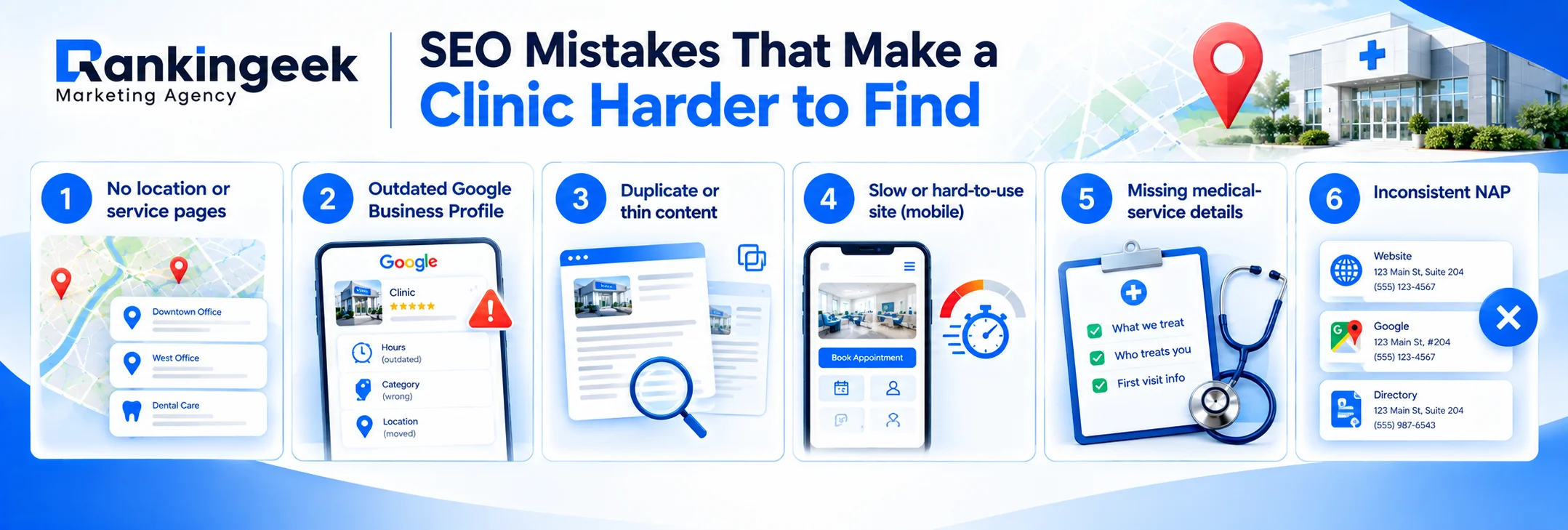
No location or service pages
An Atlanta practice with two offices and one contact page gives Google little to match against a local search. Give each office and each major service its own page.
Outdated Google Business Profile
Old hours, a wrong category, or a moved office confuse patients and Google alike. Don't add keywords to your business name either. Google's guidelines for representing your business say the name should match your real-world signage.
Also Read: Why Is My Clinic Not Showing in the Google Map Pack Anymore?
Duplicate or thin content
Near-identical pages force Google to pick one, and it may not pick yours. Pages with a few vague sentences say almost nothing.
Slow or hard-to-use site (mobile)
Many patients look up a clinic on a phone. If buttons are tiny or the page drags, they leave. Try booking on your own phone tomorrow.
Missing medical-service details
Patients want to know what you treat, who treats them, and what a first visit looks like. Pages that skip those details lose to pages that cover them.
Inconsistent name, address, and phone (NAP)
NAP is your name, address, and phone number. If one directory says "Suite 204," your website says "#204," and another lists an old phone line, Google trusts your listing less. Fix the directories patients see most first.
How to Improve Your Clinic's Google Visibility
If you're asking how to improve medical practice Google rankings, start with the basics: an accurate profile, clear location pages, and steady proof that patients trust you. Good SEO for medical practices is ordinary work done consistently.
Build service and location pages
Create one page per location and one per major service, each with the address, real details about the care, and an easy way to book. This is the heart of a local SEO plan built around each clinic location.
Keep your Google Business Profile accurate
Treat your profile like your front door. Patients judge it before they judge you. Update it whenever something changes, and add real photos.
Details to check monthly
- Regular and holiday hours
- Primary and secondary categories
- Services list and appointment link
- Phone number, address, and website link
- New reviews waiting for a reply (never confirm that someone is a patient, since that can break HIPAA privacy rules)
Create patient-focused content
Write answers to questions your front desk hears every week: what happens at a first visit, how to prepare, which insurance you accept. Have a clinician review any medical claim before it goes live.
Earn legitimate local citations and links
A citation is a mention of your clinic's name, address, and phone on another site. Choose trusted, relevant sources and keep details identical. Skip link packages that promise fast jumps.
Track rankings and organic traffic
Check Google Search Console and your profile insights each month for the searches that bring visits, calls, and direction requests. Doctor Google rankings shift by location, so test from a few neighborhoods. Results vary, and SEO rewards steady work.
Search alone can't fix everything. Medical practice SEO brings people to you, but medical practice marketing decides what happens next, so it helps to build a healthcare marketing strategy that ties search, your website, and follow-up together, backed by a patient acquisition plan that turns searches into booked visits.
Frequently Asked Questions
Why is my medical practice not showing on Google?
Your practice may not show on Google because Google can't confirm what you treat, where you are, or whether patients trust you. Common causes include an unverified or outdated Google Business Profile, thin service pages, and mismatched contact details. Checking those areas first usually points to the cause.
How do patients find doctors online?
Many patients find doctors by searching Google with phrases like "dentist near me" or "dermatologist in Miami." They compare Google Maps listings, reviews, and websites before they call. Some also ask AI tools for suggestions, so clear and consistent online information helps there too.
How can I improve my doctor Google rankings?
Start by keeping your Google Business Profile accurate and building a page for each location and service. Then add patient-focused content, collect genuine reviews, and keep your name, address, and phone details the same everywhere. Track results monthly and adjust.
What do medical practice SEO services include?
Medical practice SEO services typically include a Google Business Profile review, technical website fixes, location and service pages, content, citations, and ranking reports. The exact scope varies by provider and by your goals. Ask any provider how they handle healthcare compliance and reporting.
How long does SEO take for a medical practice?
How long SEO takes varies with your market, your starting point, and your competition. Some fixes, like correcting a Google Business Profile, may show effects sooner, while content and authority take longer. No reputable provider can guarantee a specific ranking or timeline.
Why does Google Business Profile matter for doctors?
Your Google Business Profile controls how your clinic appears in Google Maps and the local pack. It puts your hours, phone number, reviews, and directions in one place. A complete, accurate profile makes it easier for patients to choose and contact you.
Final Thoughts
Patients choose from what they can see. When competitors show up first with clear pages and accurate listings, they get the calls. Most causes are fixable.
Start with your Google Business Profile this week. Then build your location and service pages, and keep your details consistent everywhere. Healthcare SEO rewards patience and accuracy, and better medical practice online visibility means more patients reach you first.