



More Americans now ask ChatGPT where to find a dentist, an urgent care center or a clinic open on Saturday. Paid ads inside those answers became possible in 2026, and many practice owners want to know if it fits their plans. This guide explains ChatGPT ads for healthcare in plain terms, including who qualifies, where health ads never appear and how to test them safely.
Can US Healthcare Practices Advertise on ChatGPT?
OpenAI began showing ads in ChatGPT in the US in 2026. It now reviews some health advertisers, such as dental and urgent care, on a case-by-case basis.
Ads stay out of sensitive personal health conversations. That makes them a fit for service-level searches, like finding a dentist nearby, rather than symptom questions.
Key Takeaways
- Only certain health categories qualify, and each advertiser goes through manual review.
- Ads never appear in mental health or personal health conversations.
- The opportunity sits in practical service searches, not medical questions.
- A small, tightly tracked test reveals more than a large launch.
- Paid placements work best alongside strong organic visibility in AI answers.
How ChatGPT Ads Work
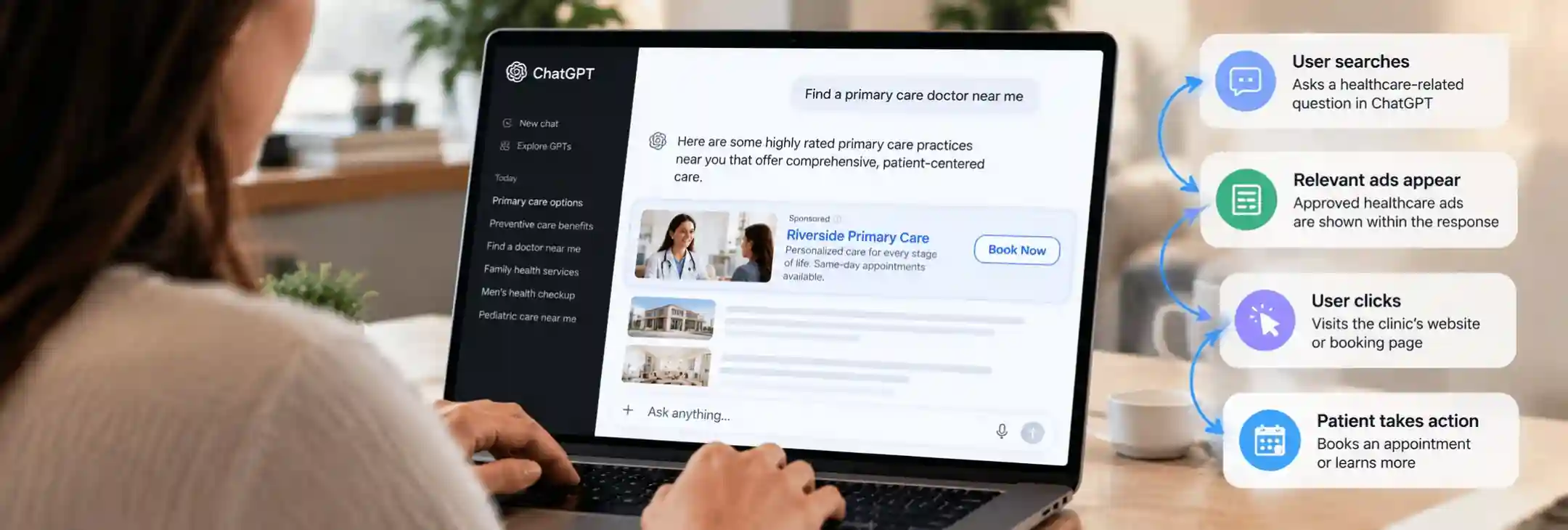
ChatGPT ads appear below an answer, clearly separated and labelled as sponsored. OpenAI states that ads do not influence what ChatGPT recommends in the answer itself.
- Adult users on the Free and Go plans see ads, while paid plans such as Plus and Pro are ad-free.
- Accounts identified as belonging to users under 18 do not see ads.
- Advertisers receive aggregate results such as views and clicks, never private conversations.
- Users can dismiss ads, see why an ad appeared and turn off personalization.
Ads match the topic of the conversation and, where users allow it, their past chats and ad interactions. Practices cannot target people by health condition.
A self-serve Ads Manager opened to US advertisers in beta during 2026. It uses cost-per-click bidding and supports conversion measurement through a pixel and a conversions API.
Each sponsored placement links to the advertiser's own website. OpenAI reviews the advertiser, the creative and that destination before an ad can run.
Also Read: Why Patients Are Asking ChatGPT for Doctor Recommendations Instead of Scrolling Google
Which Healthcare Practices Are Eligible
OpenAI's ad policies list a small set of health categories that may qualify in the US. Approval happens advertiser by advertiser, and some practices must provide proof of licensure.
The policy also bans unsupported treatment claims, experimental therapies and products that exploit body image concerns. Diet pills, detox programs and wellness claims without evidence fall outside the rules.
Health services ads outside the US are generally not allowed. OpenAI has updated these rules several times since launch, so ad eligibility needs checking again on the day a campaign starts. Dental practices and urgent care centers are the most natural fits for most readers of this guide. Both answer practical questions about location, hours and availability.
Where Health Ads Will Not Appear
OpenAI keeps ads away from sensitive conversations. That rule shapes where a practice can realistically show up.
- Conversations about mental health or a person's own health concerns
- Emotionally reliant or vulnerable exchanges between a user and ChatGPT
- Accounts that belong to users under 18
- Paid plans that remain free of ads
A question about tooth pain after a filling is a personal health conversation, so ads stay away. A search for a dentist open on Saturday in a named city is a service question, which is where an approved dental ad may appear.
Details like opening hours, insurance accepted, languages spoken, and parking all make strong content for these service searches.
Is Your Practice Ready? A Quick Decision Checklist
A short checklist shows whether a test makes sense right now. Most practices should be able to answer yes to each point first.
- The practice falls into an eligible category, such as dental services or urgent care
- The team can provide licensure details if OpenAI asks for them
- A dedicated landing page explains the service, location and booking steps
- Conversion tracking already works on Google Ads or the website
- The practice can set aside a modest test budget without hurting proven channels
- Someone on the team can review results weekly
A practice that answers no to several points usually gains more from fixing its website, tracking and AI visibility first. Practices in a prohibited category can still build visibility in AI answers organically.
How to Run a Low-Risk Test Campaign
A small, measurable test campaign answers the real question, which is whether ChatGPT ads bring patients at a sensible cost.
Budget and Goals
Steps to Set Up the Test
- A fixed test budget sits apart from Google Ads, so proven campaigns keep running.
- One clear goal, such as booked appointments, defines success.
- One service and one location keep the results easy to read.
- A set time frame of several weeks gives the test enough data before any decision.
Landing Pages
Steps for a Compliant Page
- The page matches the ad, with the same service, location and offer.
- Factual claims describe the service without promising results.
- Clear booking details sit near the top, with online scheduling and a phone number.
- Licensure and practice details appear clearly, since OpenAI reviews the destination too.
Tracking Without PHI
Steps for Privacy-Safe Measurement
- Conversion events use neutral names such as booking request submitted.
- The ad platform receives no health details, such as conditions or treatment types.
- Pixels stay off patient portals and pages that reveal a person's health information.
- Offline matching compares booked appointments in the practice software with ad clicks.
Federal health privacy rules limit how practices share protected health information with tracking tools. The practice's privacy officer or counsel should review any pixel setup before launch.
The most useful measures are cost per booked appointment, the share of clicks that book and the quality of those patients compared with Google Ads.
ChatGPT Ads vs Google Ads vs Earning Organic AI Mentions
Each channel plays a different role, and most practices need more than one.
- Google Ads still captures the largest share of high-intent local searches today.
- ChatGPT advertising offers an early, less crowded placement for eligible categories.
- Organic AI mentions come from a strong website, reviews and consistent listings, and they cost nothing per click.
Paid placements stop when the budget stops. Strong AI search visibility keeps working, because ChatGPT draws on the same signals that help a practice rank in local search.
A practice that already ranks well locally usually finds ChatGPT ads easier to justify, since its pages and reviews already support the click.
Rankingeek's online advertising services help practices test new channels like ChatGPT while protecting the Google Ads campaigns that already bring in patients.
Also Read: AEO and Paid Ads as the One Two Punch for Immediate Needs and Long Term Search Trends
Final Thoughts on ChatGPT Advertising for Medical Practices
ChatGPT ads open a new door for a small group of healthcare advertisers, mainly dental, urgent care and similar service categories. The opportunity is real, but the rules change often, so a careful, measured test makes far more sense than a big budget shift.
At Rankingeek, our Paid Patient Acquisition service helps US practices test ChatGPT ads for healthcare alongside Google Ads. We check eligibility, build compliant landing pages and set up privacy-safe tracking so each test shows real booked appointments.
Frequently Asked Questions
Can Medical Practices Advertise on ChatGPT?
Some can, depending on the category. Dental services, urgent care, hospitals, vision and certain other categories may qualify in the US after manual review.
How Much Do ChatGPT Ads Cost?
The self-serve beta uses cost-per-click bidding with no stated minimum spend. Actual costs vary by market and competition, so a small test gives the clearest answer.
Do ChatGPT Ads Replace AEO and GEO?
Ads do not replace answer engine optimization or generative engine optimization. Organic visibility shapes what ChatGPT recommends, while ads only appear in a separate sponsored slot.
Will ChatGPT Ads Show Next to Health Questions?
Ads stay out of mental health and personal health conversations. They suit practical service searches, such as finding a nearby clinic or opening hours.
Do Multi-Location Practices Benefit More From ChatGPT Ads?
Multi-location practices often gain more, since they cover more service searches across several areas. Each location still needs its own landing page and tracking.