



A mom in suburban Dallas searches for braces for her 12-year-old, and the top results show a general dentist, a national aligner brand, and a directory. The specialist across town never appears. Smart orthodontic SEO changes that picture, so families and adults find the practice with the training to treat them, right when they compare options online.
What Makes Orthodontic SEO Work for US Practices?
Search visibility grows when each treatment has its own page, including Invisalign treatment, braces, early treatment, and adult orthodontics. Google then has a clear match for every type of search.
The Google Business Profile should reflect orthodontic categories and services, not general dentistry. Steady reviews from parents and adult patients then build the local trust that turns a search into a consultation.
Key Takeaways
- Separate pages for each treatment outrank one general services page in almost every market.
- The primary profile category should read Orthodontist, with services that mirror the website.
- Parents and adults search in different ways, so each group needs its own page and review flow.
- Trademark rules shape how a practice can use the Invisalign name in domains, ads, and page copy.
- Consultations and treatment starts by source prove what SEO actually brings in.
Why Orthodontists Lose Invisalign and Braces Searches to General Dentists and Aligner Brands
Orthodontists complete two to three years of specialty residency after dental school. Search engines cannot see that training unless the website and profile spell it out.
- General dentists who offer aligners: Many family dental offices list clear aligners and braces on their sites. A dental practice with a strong profile and hundreds of reviews often outranks a specialist with a thin site.
- National aligner brands and directories: Large brands and listing sites publish deep content on cost, timelines, and comparisons. Local practices win back those searches only with pages that answer the same questions with local detail.
- One page for every treatment: A single services page that mentions braces, Invisalign treatment, and retainers in one paragraph gives Google nothing specific to rank.
- A profile that looks like a dental office: A practice listed as Dentist or Cosmetic Dentist competes in the wrong set of local search results.
Each of these gaps has a fix. The sections below cover them in the order that usually brings results fastest.
Orthodontic Treatment Pages That Rank and Convert Patients
Orthodontic treatment pages do two jobs at once. They give Google a clear topic to rank, and they answer the questions a patient asks before booking a consultation.
Invisalign Treatment Page for Teens and Adults
Provider Status and Trademark-Safe Wording
Align Technology asks providers to use Invisalign as an adjective, as in Invisalign treatment or Invisalign aligners, and never as a generic word for every aligner. Its provider guidelines also keep the name out of domain names, practice names, and social handles.
A strong page names the orthodontist as an Invisalign provider and explains the training behind that status. Superiority words such as best or only next to the brand name break the same guidelines.
Treatment Timeline, Wear Time and Cost Range
Patients want to know how long treatment lasts, how many hours a day the aligners stay in, and what the practice charges. A clear range, along with monthly payment options, keeps price shoppers on the page instead of sending them back to Google.
Braces Treatment Page for Metal and Ceramic Options
Braces Types Compared for Kids, Teens and Adults
Families compare metal and ceramic braces before they compare practices. A short comparison of look, comfort, cost, and visit frequency answers those questions on one page.
Insurance, Financing and HSA Details for Braces
Many US dental plans include an orthodontic benefit with a lifetime maximum. The IRS also lists braces as an eligible medical expense, so HSA and FSA funds often apply, and a page that says so removes a real barrier.
Early Orthodontic Treatment Page for Parents
The Age 7 Orthodontic Check-Up in Plain Language
The American Association of Orthodontists recommends that every child see an orthodontist by age 7. A page built around that advice matches what parents search after a pediatric dental visit.
Phase One Treatment Explained for Worried Parents
Pages on early orthodontic treatment work best when they explain what the first visit checks and why many children simply return for monitoring. Honest wording builds the trust that leads a parent to book.
Adult Orthodontics Page for Working Professionals
Discreet Treatment Options and Flexible Appointment Times
The AAO notes that about one in three orthodontic patients today is an adult. Adults search for discreet options, evening or early appointments, and fewer office visits, so the page should lead with those details.
Answers on Gum Health, Crowns and Past Treatment
Many adults had braces as teenagers and now see their teeth shift. Clear answers on relapse, crowns, implants, and gum health speak to concerns that a general dental page rarely covers.
The table below sums up what each page needs.
Also Read: On-Page SEO for Your Dental Clinic and a Practical Guide to Ranking Higher
Google Business Profile Optimization for Orthodontic Practices
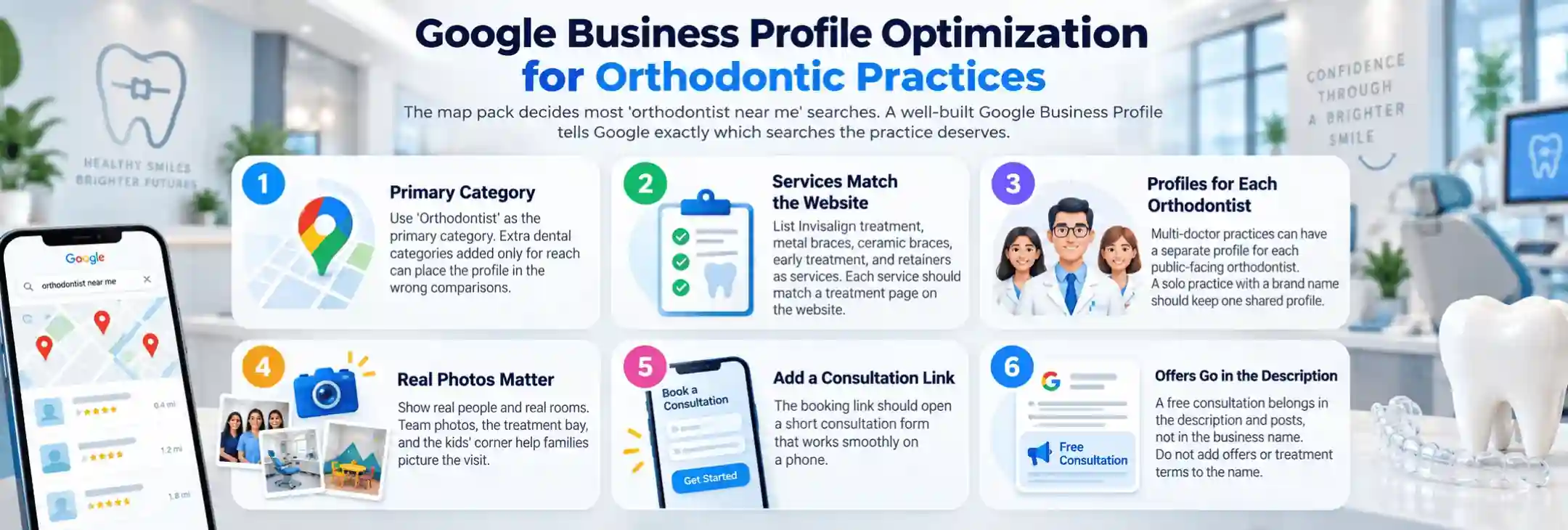
The map pack decides most orthodontist near me searches. A well-built Google Business Profile for orthodontists tells Google exactly which searches the practice deserves.
- Orthodontist as the primary category: Google asks for the fewest categories that describe the core business. A dental category added just for reach can pull the profile into the wrong comparisons.
- Services that match the website: Invisalign treatment, metal braces, ceramic braces, early treatment, and retainers should each appear as a service. Each entry then matches a treatment page on the site.
- Profiles for each orthodontist: Google allows a separate profile for each public-facing practitioner at a multi-doctor practice. A solo practice with a brand name keeps one shared profile instead.
- Photos of real people and real rooms: Team photos, the treatment bay, and the kids' corner show families what a visit feels like.
- A consultation link: The booking link should open a short consultation form that works well on a phone.
- Offers in the description, not the name: A free consultation belongs in the business description and posts. Google does not allow extra words such as offers or treatments in the business name.
Patient Reviews From Parents and Adult Patients That Build Trust
Patient reviews carry extra weight in orthodontics, because families commit to a practice for a year or more. Treatment runs for many months, so review timing matters. The best moments to ask arrive at clear milestones, such as the day braces come off or the final aligner tray.
- Parents speak for their children: Parent reviews mention comfort, scheduling and how staff treat a nervous child. Those details persuade other parents more than any marketing line.
- Adults talk about confidence and convenience: Adult reviews often praise discreet treatment and flexible hours, which helps the adult orthodontics page convert.
- Fair requests to every patient: Google bans incentives and requests aimed only at happy patients. A federal rule also bans fake reviews and staff reviews without disclosure.
- Careful replies: A reply should thank the reviewer without naming the child or confirming treatment details. Federal regulators have fined providers whose review replies exposed patient information.
Measuring New Patient Starts From Orthodontic Search Traffic
Rankings alone do not pay the lease. The numbers that matter are consultations booked and new patient starts from organic search and the map pack.
- Calls, direction requests, and website clicks from the Google profile
- Consultation form submissions tracked as key events in analytics
- Consult to start rate by source, which shows real case acceptance
Rankingeek saw this kind of tracking pay off for 32 Strong Dental, a dental and oral surgery practice. Its patient leads grew from 15 to 307 in about a year, an increase of roughly 1,900 percent. Proper call tracking and local search work made that growth visible and measurable.
Our Local Search Domination program applies the same approach to orthodontic practices. The local SEO services for small businesses cover profiles, treatment pages, reviews, and monthly reports on consultations. Practices that need more can add our wider SEO services in the USA.
Also Read: Why Dentists Need SEO for Their Website in 2026

Orthodontic SEO Checklist for US Practices
- Orthodontist set as the primary category on every profile
- One page each for Invisalign treatment, braces, early treatment, and adult orthodontics
- Trademark-safe wording on every page that mentions the Invisalign brand
- Cost ranges, insurance details, and HSA or FSA notes on treatment pages
- Profile services that match the treatment pages
- A milestone review request for every patient
- Call and consultation form tracking, with starts reported by source
Final Thoughts on Ranking an Orthodontic Practice for Invisalign and Braces
Orthodontists hold a real advantage in training and focus, but search engines only reward what the website shows. Treatment pages, a specialist profile, and steady reviews turn that expertise into visibility for Invisalign and braces searches. Practices that track consultations and starts by source also know exactly what their orthodontic marketing returns.
At Rankingeek, we provide orthodontic SEO for US practices that want booked consultations from search, not just more traffic. Our team builds treatment pages for Invisalign aligners, braces, early treatment, and adult orthodontics. We also set up the Google profile under the right categories and run a fair review flow for parents and adults. Each month, the practice sees consultations and starts reported by source.
Frequently Asked Questions About Orthodontic SEO
How Long Does SEO Take for an Orthodontic Practice?
Many practices see profile and map pack gains within three to four months. Treatment pages often need six months or more to reach steady first-page rankings, depending on local competition.
Should Orthodontists Target 'Invisalign Near Me' Searches?
Invisalign providers should target these searches with a dedicated treatment page and a matching profile service. The page must follow Align Technology's trademark guidelines, which keep the brand name out of domains and practice names.
Do Free Consultation Offers Help Orthodontic Conversions?
A free consultation lowers the barrier for parents and adults who are still comparing options. The offer works best when the page explains what the visit includes, such as photos, X-rays, and a treatment plan.
Should an Orthodontist Create a Page for Every Nearby City?
A separate page makes sense only for a real office location or a town that sends many patients. Thin city pages with swapped names rarely rank and can weaken the whole site.
Can a General Dentist Outrank an Orthodontist for Braces Searches?
A general dentist can outrank a specialist when its site and profile are stronger. Clear treatment pages, the Orthodontist category, and recent reviews usually tip those results back toward the specialist.